Summary

  1. BNP's Tarique Rahman says he 'waited more than a decade' for this daypublished at 06:32 GMT 12 February

    Azadeh Moshiri
    Reporting from Dhaka

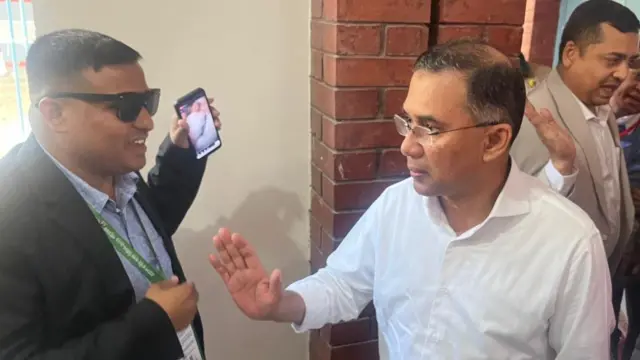
    Tarique RahmanImage source, Aamir Peerzada/BBC

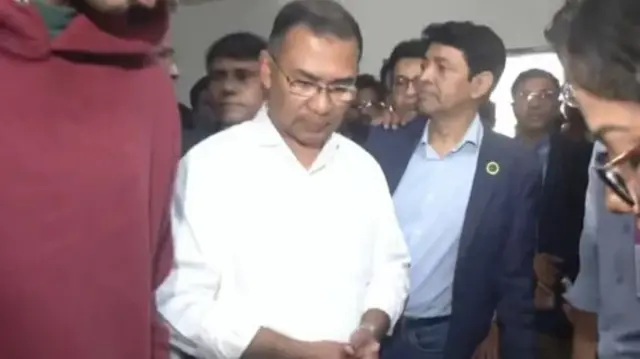
    Crowds of supporters and journalists swarmed around the leader of the Bangladesh Nationalist Party, Tarique Rahman this morning as he arrived to cast his vote.

    He tells me he's been waiting “more than a decade” for this day. The country had been waiting a long time too, he said.

    Before walking into the polling booth, Rahman said he was feeling “confident” about how the election would play out.

    What a contrast to how he spent election day in 2024 – in self-imposed exile in London during the rule of Sheikh Hasina. Thousands of his party's members and supporters were in jail then. His party had also boycotted the election.
  2. How AI-generated videos flooded Bangladesh ahead of this votepublished at 06:23 GMT 12 February

    Shruti Menon
    BBC Verify

    What’s interesting about this election is the amount of AI-generated political content that has flooded social media.

    I’ve been monitoring dozens of Facebook pages since January and have come across hundreds of AI-generated political videos, many of which are not labelled as synthetic content.

    The clips feature hyper-realistic but fabricated news presenters, computer-generated “ordinary citizens” and individuals dressed in police-style uniforms. The production quality is often polished, making the videos appear real at first glance.

    One video I’ve verified as AI-generated using SynthID, Google’s own AI detector tool, has been viewed nearly eight million times. It shows a man in a blue uniform resembling an official figure delivering a partisan political message.

    Another widely shared clip, viewed nearly 200,000 times, features a synthetic shopkeeper explaining why he would not vote for a particular candidate.

    Under Bangladesh’s electoral code of conduct, creating or sharing misleading AI-generated content is prohibited. However, there is limited clarity on how such content is being monitored or enforced online.

  3. Why this could be Bangladesh's 'most historic' electionpublished at 06:15 GMT 12 February

    Soutik Biswas
    India Correspondent

    Is this the most historic election in Bangladesh’s history - or simply another turn in a turbulent political journey?

    It may well be the former.

    Shafqat Munir of Bangladesh Institute of Peace and Security Studies (BIPSS), a think tank, offers a stark view: for 17 years, Bangladeshis have not had a genuine chance to vote.

    “The last proper election was in December 2008; everything since has been a fixed match,” he says.

    Nearly 60 million young voters have never "experienced a real contest" - to them, elections evoke "ballot stuffing and irregularities".

    There is excitement about reclaiming the ballot - but also caution.

    “Apprehension remains high, fuelled by disinformation,” Munir says.

    Yet he sees promise. This campaign has been far less violent than previous polls and marked by unexpected civility.

    “This is not just about casting ballots,” he says. “It is about a suppressed nation reclaiming its voice - perhaps the beginning of a golden hour.”

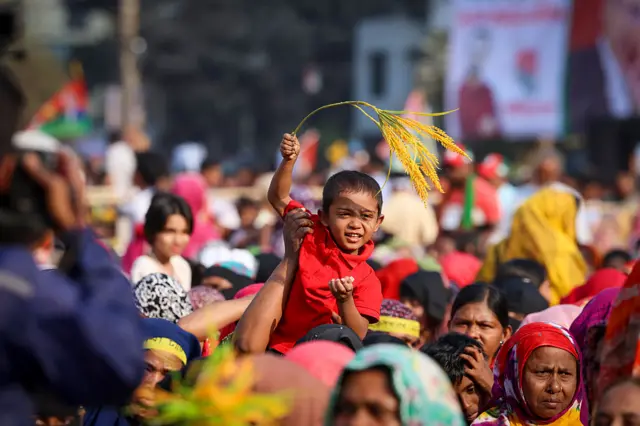
    BNP supporters at an election meeting in BangladeshImage source, NurPhoto via Getty Images)
    Image caption,

    BNP supporters at an election meeting in Bangladesh

  4. This 100-year-old has voted in all Bangladesh's electionspublished at 06:09 GMT 12 February

    BBC News Bangla

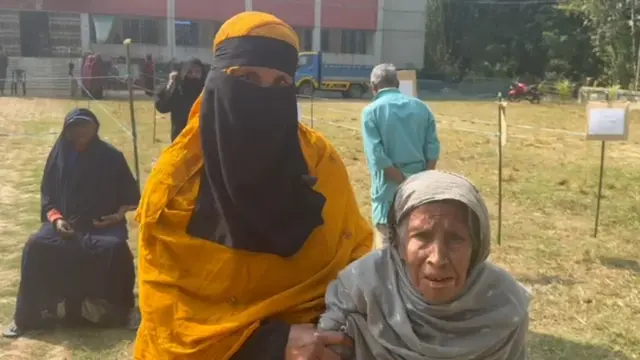
    Belajan Bibi (right) was accompanied by her daughter-in lawImage source, Hussain Ahmed Sujat/BBC
    Image caption,

    Belajan Bibi (right) was accompanied by her daughter-in law

    Belajan Bibi, 100, walked for 7km (4.3 miles) from the remote Koskonpur village in the eastern district of Sylhet, to cast her vote.

    She was accompanied by her daughter-in law.

    The centenarian, who has voted in all the previous elections, said she is happy to cast her vote today.

  5. More on Muhammad Yunus: Leader of Bangladesh's interim governmentpublished at 05:56 GMT 12 February

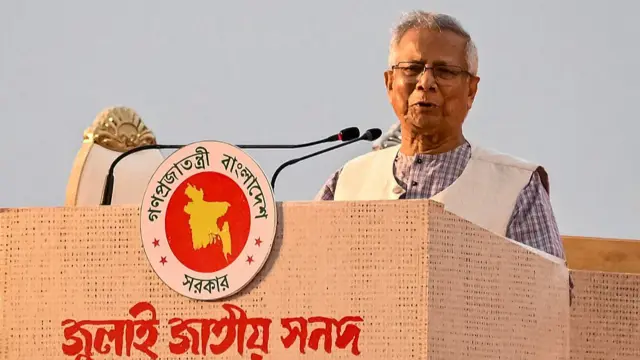
    Muhammad Yunus speaking at a podiumImage source, AFP via Getty Images

    In the days after Prime Minister Sheikh Hasina was ousted by anti-government protesters, Nobel laureate Muhammad Yunus was brought in to lead an interim government.

    Yunus received the Nobel Peace Prize in 2006 for establishing a pioneering system of micro-finance loans to help lift millions out of poverty.

    The 85-year-old, a longtime foe of Hasina, had been sentenced to jail for violating labour laws - a case that his supporters said was politically motivated.

    Upon taking office in 2024, Yunus vowed to implement reforms that would prepare Bangladesh for free and fair elections. His new cabinet included some student leaders from the protests.

    But critics say the interim government has struggled to deliver amid continuing political turmoil and a struggle to maintain law and order.

  6. Interim leader Muhammad Yunus casts his votepublished at 05:46 GMT 12 February

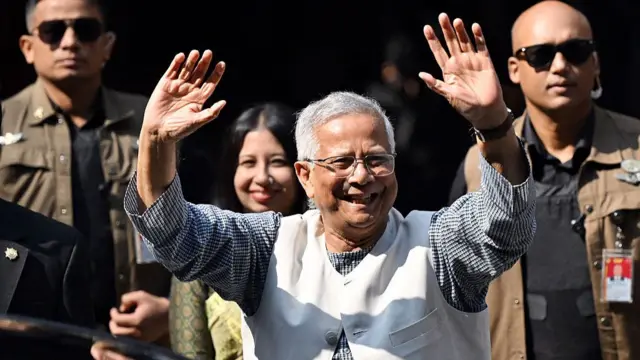
    Chief Adviser of Bangladesh's Interim Government, Muhammad YunusImage source, AFP via Getty Images

    Bangladesh's interim leader Muhammad Yunus has also voted at a polling station in Dhaka.

    Speaking to reporters after that, the 85-year-old Nobel laureate described the election as "a day of freedom".

    "Through this, we have ended the nightmare and begun a new dream," he said.

    Yunus was sworn in as chief adviser of the interim administration in August 2024. He will step down when the next government takes over.

  7. Gen Z toppled an autocrat. Why are the old guard dominating the ballot?published at 05:40 GMT 12 February

    Azadeh Moshiri
    South Asia correspondent

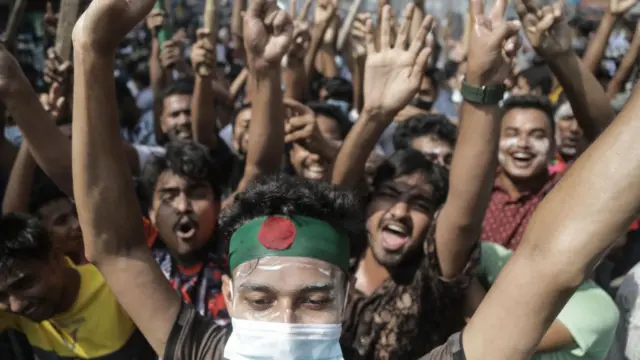
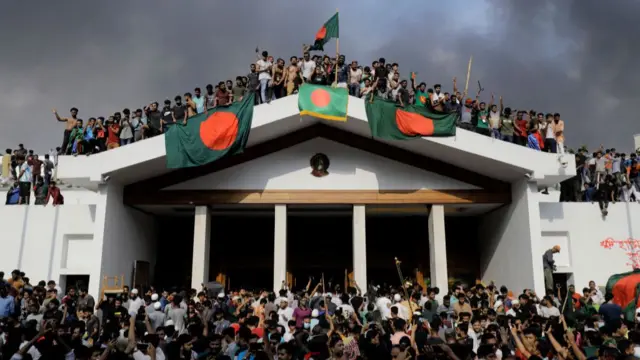
    People gather to celebrate the fall of Bangladesh Prime Minister Sheikh Hasina in August 2024 after a student-led protestImage source, Getty Images
    Image caption,

    A student uprising promised a new dawn in Bangladesh but old parties are tipped to win a landmark election

    Former PM Sheikh Hasina's downfall seemed to promise a new age for Bangladesh.

    Many student leaders from the youth-led uprising went on to hold key posts in the interim government and were expected to play a role in the future administration.

    But one young Bangladeshi told the BBC the interim government has failed to produce the "beautiful Bangladesh based on peace, equality, justice and fairness" it promised. Others feel the same way.

    In December, the student-led National Citizens Party (NCP) made a controversial choice to ally with Jamaat-e-Islami, a much-older Islamist party. This has helped Jamaat gain some ground among young voters, although some feel the alliance undermines the NCP's appeal.

    The front-running Bangladesh Nationalist Party, the largest party contending and one of the nation's most established, is further squeezing the student party.

    Does this mean dynastic politics are here to stay? Read more of my analysis here.

  8. A youth-dominated pollpublished at 05:26 GMT 12 February

    Bangladesh is one of the youngest countries in the world by demographic.

    About 45% of the 128 million registered voters are between the ages of 18 and 33, according to the Election Commission.

    Nearly 5 million of them are first-time voters, some of whom had opted out of the 2024 vote which was widely criticised as lopsided.

    The student-led uprising in 2024 also prompted younger aspirants to run in this year's election. The average age of candidates now stands at 51.8, down from 67 in the 2008 election.

  9. 'Nation votes, hope rekindled': The morning paperspublished at 05:15 GMT 12 February

    Soutik Biswas
    India Correspondent

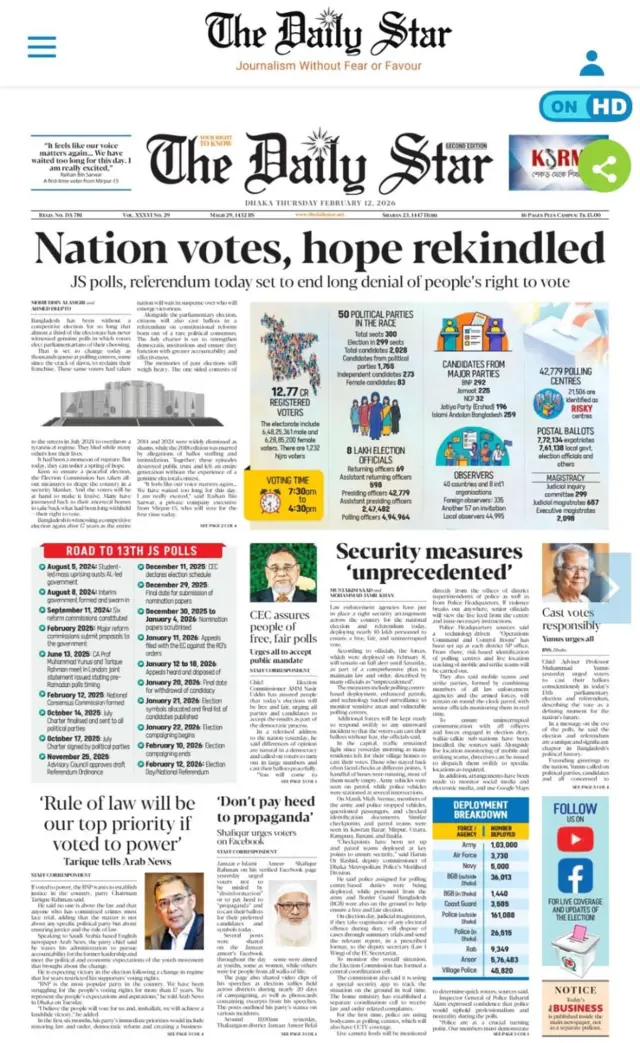
    The morning papers in Dhaka are buzzing with excitement.

    "Nation votes, hope rekindled" headlines the respected Daily Star.

    "Bangladesh has been without a competitive election for so long that almost a third of the electorate has never witnessed genuine polls in which voters elect parliamentarians of their choosing," the paper said in a front page report.

    Alluding to the 2024's July uprising during which the Gen-Z led protest ousted ruling prime minister Sheikh Hasina, the paper said: "It had been a monsoon of rupture. But today, they [voters] can usher a spring of hope."

    "Vote to restore democracy today" headlines the leading Bengali daily Prothom Alo.

    "After nearly a decade and a half, people are returning to the celebration of voting," the paper said. "The country’s democratic transition hinges on this election."

    Daily Star
  10. Who is Jamaat leader Shafiqur Rahman?published at 05:00 GMT 12 February

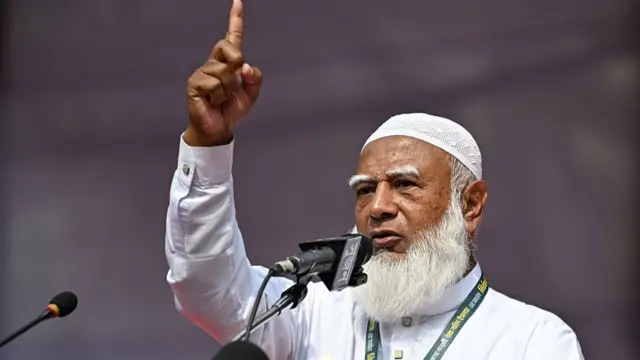
    Shafiqur Rahman, Jamaat-e-Islami party leader speaks during a Jamaat-led alliance rallyImage source, Getty Images

    Trained as a doctor, Shafiqur Rahman had an early start to his political career when he joined Jamaat-e-Islami's student wing at the age of 19.

    He formally joined Jamaat in 1984 and became the party's chief in 2020, when Jamaat was banned from politics under Sheikh Hasina's rule.

    Rahman and his party have long been on the sidelines of Bangladeshi politics. They saw an opportunity, however, after the 2024 protests left Bangladesh in a political vacuum, with Hasina exiled and her Awami League party banned.

    Jamaat describes its leader as one who "leads a modest, disciplined life grounded in simplicity and approachability", according to Reuters.

    Rahman's wife Amina Shafique was a former MP and also a doctor. Their son and two daughters are also doctors.

  11. Rival parties accuse each other of violationspublished at 04:52 GMT 12 February

    The two main parties, BNP and Jamaat-e-Islami, were still lobbing allegations against each other just hours before the vote.

    BNP filed 127 charges against Jamaat leaders and activists for buying votes with money the night before the election, casting fake votes, and threatening Hindu voters, among other allegations.

    The National Citizens Party (NCP), a Jamaat ally, in turn accused BNP of creating an atmosphere of panic in the polling stations the night before the election.

    Dhaka police say five people have been arrested and sentenced to various terms for violating the election code of conduct.

  12. Who is Tarique Rahman, the front-runner to be PM?published at 04:38 GMT 12 February

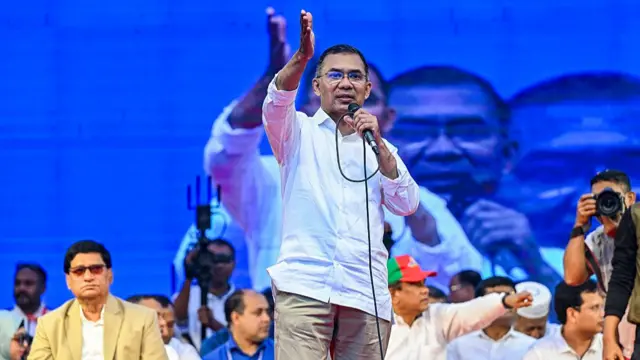
    Tarique Rahman gestures as he holds a microphoneImage source, LightRocket via Getty Images

    Tarique Rahman and his Bangladesh Nationalist Party (BNP) are eyeing a return to power when the country goes to the polls.

    Rahman, who has lived in London since 2008, is expected to become the country's new leader if the BNP emerges as the largest party.

    The 60-year-old is the figurehead of the influential Zia family and the son of former prime minister Khaleda Zia - who died in December - and Ziaur Rahman, who was assassinated while serving as president in 1981.

    Rahman had been the subject of various criminal investigations launched while Sheikh Hasina's Awami League party was in power, but he was cleared of all charges when her regime fell.

    Last December, he returned to the country after 17 years in exile.

  13. Leaders of main parties have votedpublished at 04:17 GMT 12 February

    BNP chairman Tarique Rahman, the PM frontrunner, has just voted at the Gulshan Model School and College in Dhaka.

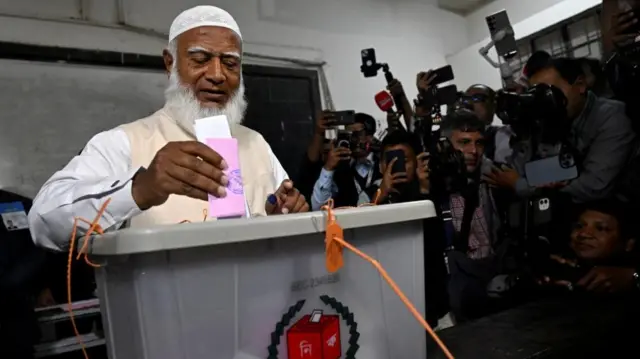
    Jamaat-e-Islami leader Shafiqur Rahman voted earlier on Wednesday at another high school in Dhaka. He told reporters after voting that the party will accept the outcome, whatever it is. "But others will have to accept it too," he added.

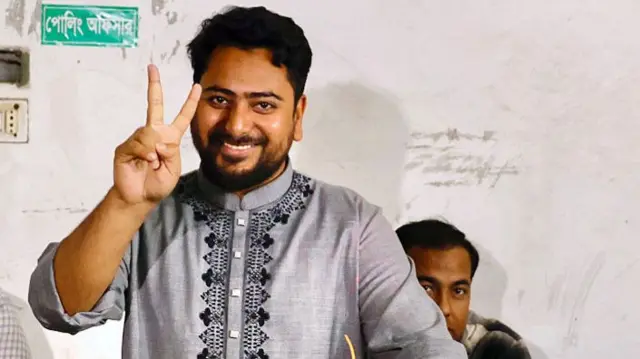
    Nahid Islam, the student leader who founded the youth-centred National Citizen Party last year, has also cast his vote.

    BNP chairman Tarique Rahman
    Image caption,

    BNP chairman Tarique Rahman

    Jamaat-e-Islami leader Shafiqur RahmanImage source, Reuters
    Image caption,

    Jamaat-e-Islami leader Shafiqur Rahman

    Nahid Islam, convener of the National Citizen PartyImage source, Getty Images
    Image caption,

    Nahid Islam, convener of the National Citizen Party

  14. Low turnout at Awami League strongholdpublished at 04:04 GMT 12 February

    BBC News Bangla
    Reporting from Gopalganj

    There are hardly any voters at the polling stations in former Awami League stronghold Gopalganj.

    Gopalgani is the birthplace of Bangladesh's former leader Sheikh Mujibur Rahman and his daughter, ousted former PM Sheikh Hasina.

    Hasina, who is also Awami League's president, used to vote from one of the constituencies in Gopalgani and the party would win it by huge margins in past elections. Her party, now banned from politics, had earlier called for a boycott of the vote here.

    There are about a million voters in this district and polling agents are hoping for a 50% turnout. But very few people had showed up when we visited polling centres there this morning.

    Despite the apparent apathy, the agents hope the turnout will improve as the day progresses.

    Low turnout at Awami League stronghold
  15. Awami League: The former ruling party that can't contest this electionpublished at 03:50 GMT 12 February

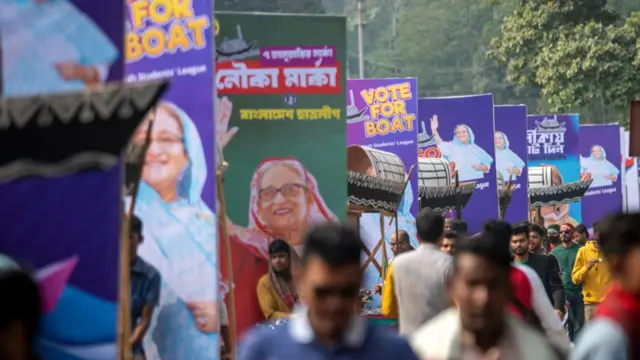
    A line of Sheikh Hasina banners on a streetImage source, NurPhoto via Getty Images

    As voters head to the polls today, one party is conspicuously absent: Sheikh Hasina's Awami League, a mainstay of Bangladeshi politics for decades.

    Founded in 1949, the Awami League was a key player in the country's struggle for independence from Pakistan in 1971.

    But in recent years, under the party's leadership, Bangladesh went through a period of democratic decline. Critics accused Hasina's administration of corruption and persecuting political opponents.

    After anti-government protests forced Hasina and other party members into exile, Bangladesh's interim government last May banned the Awami League from political activities. The ban is meant to last until a special tribunal completes its trial of the party and its leaders.

    While it has been barred from contesting in today's election, however, the Awami League retains loyal supporters in parts of Bangladesh.

  16. Unprecedented security for this year's electionpublished at 03:35 GMT 12 February

    Anbarasan Ethirajan
    Global Affairs Reporter

    Since taking charge in 2024, Bangladesh's interim leader Muhammad Yunus has been insisting on one thing: his administration will ensure a free and fair poll.

    The government, which has has been criticised over its failure to tackle incidents of mob violence, is aware that its credibility is at stake, so it’s leaving no stone unturned to prevent violence or irregularities.

    Nearly a million security personnel have been deployed across the country to maintain security until 14 February.

    There will be mobile and strike units that can be swiftly deployed, and all polling centres will be tightly guarded.

    In a rare move, the government has banned the use of motorcycles from midnight on 11 February for three days, and restricted the movement of other vehicles.

  17. More than a thousand killed in 2024 protest crackdownpublished at 03:23 GMT 12 February

    Anti-government protestors display Bangladesh's national flag as they storm Prime Minister Sheikh Hasina's palace in Dhaka on August 5, 2024Image source, Getty Images

    As many as 1,400 people were killed during 2024's weekslong anti-government protests, most at the hands of security forces, according to the UN. It said the killings could amount to "crimes against humanity".

    The UN report documented the shooting at point-blank range of some protesters, the deliberate maiming of others, arbitrary arrests and torture.

    The government maintained that officers only opened fire in self-defence or to protect state property.

    After the protests toppled then Prime Minister Sheikh Hasina, an interim government, led by Nobel laureate Muhammad Yunus, was tasked with preparing Bangladesh for a new election.

  18. What happened during the 2024 protests?published at 03:17 GMT 12 February

    The year 2024 was a turning point for Bangladesh.

    Protests began as peaceful demands from university students to abolish quotas in civil service jobs - a third of which are reserved for relatives of veterans from Bangladesh's 1971 war for independence.

    Campaigners argued the system was discriminatory when millions of young Bangladeshis were already contending with unemployment.

    The protests soon transformed into wider demonstrations against the government, which critics said was rife with corruption and intolerant of dissent.

  19. Finally our votes will count, says undergraduatepublished at 03:02 GMT 12 February

    Azadeh Moshiri
    Reporting from Dhaka

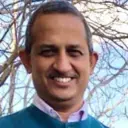
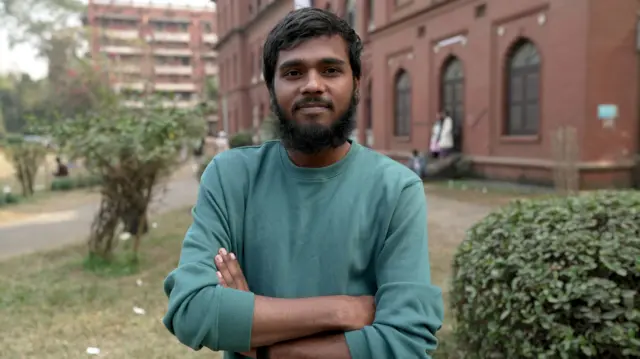
    Mizanur Rahman

    Many we’ve spoken to feel this is the first time their vote will truly count.

    Mizanur Rahman is excited about an election where all “voters from all levels of society can exercise their voting rights... that is what I want”.

    The 21-year-old undergraduate says his biggest wish today is that the elections proceed smoothly.

    Supporters of the Awami League, though, would argue that isn’t happening today.

    The party has been banned from politics after its leader, former PM Sheikh Hasina, was ousted in pro-democracy protests in 2024.

    "By excluding the Awami League, a free and fair election is in no way possible," a leader of the party told us.

  20. What happened to Sheikh Hasina, Bangladesh's ousted PM?published at 02:48 GMT 12 February

    Sheikh Hasina gestures as she speaks into a microphoneImage source, AFP via Getty Images

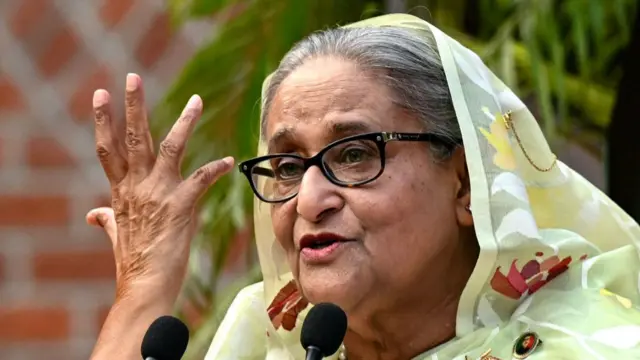
    Sheikh Hasina has been in self-imposed exile in India since 2024, after she was deposed by a student-led uprising.

    Bangladesh's longest-serving prime minister, who led the country during two stints in office totalling 20 years, began her political career as a pro-democracy icon. She and her Awami League party were credited with overseeing the South Asian country's economic progress.

    But in recent years she was accused of turning autocratic and clamping down on any opposition to her rule. Politically motivated arrests, disappearances, extra-judicial killings and other abuses all rose under her rule.

    Last November, a special tribunal in Dhaka sentenced her to death after convicting her of crimes against humanity over her crackdown on protesters - though the sentence can't be enforced since Hasina remains in India. She denied all charges against her.

    Meanwhile, her Awami League has been banned from politics until the Dhaka tribunal completes its trial of the party - which means it's absent in today's vote.

    Return to the latest post