Summary

  1. Crew speaking to Earth from spacecraftpublished at 03:49 BST 3 April
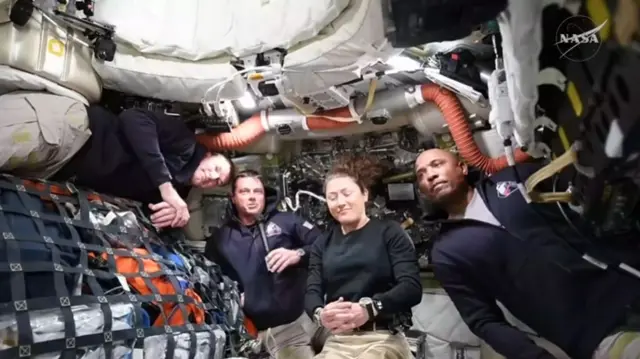
    astronauts in the capsule.Image source, NASA

    The four-piece Artemis II crew are now broadcasting from space – they have just gathered for their first meal since take-off and are speaking about teething issues with the spacecraft's toilet and sleeping in space, among other things.

    We're listening in and will bring you more details as we get them.

  2. Astronauts are 'glued to windows' taking photos of 'dark side of the Earth' lit by the moonpublished at 03:39 BST 3 April

    Now that the news conference has ended on the Artemis II mission updates, we're bringing you back to what is happening aboard the Orion spacecraft.

    The astronauts in space are excited and taking a lot of photos - so many that it's actually left the windows of the spacecraft dirty.

    "We are getting a beautiful view of the dark side of the Earth, lit by the Moon." Mission specialist Jeremy Hansen told Houston earlier.

    The crew were "glued to the windows" and taking photos instead of having lunch.

    Shortly after, Commander Reid Wiseman called back down to Houston to ask how to clean the windows, noting the astronauts' enthusiasm to see into space has left them dirty.

    Nasa ground crews just called back after looking for the proper procedures, instructing the crew to use some water and a dry wipe.

    Nasa will share the photos from the astronauts publicly once they are downloaded from space.

  3. Nasa makes clear, this is a test flight that is going 'flawless'published at 03:13 BST 3 April

    Pallab Ghosh
    Science correspondent

    For all the gorgeous images and historic headlines, Nasa keeps stressing that Artemis II is, above all, a test.

    And they've noted as much multiple times during tonight's news conference. This mission is about finding out how their Space Launch System, the Orion capsule and a human crew actually behave together in deep space, so they can one day send astronauts safely down to the lunar surface.

    At the news conference, which wrapped up a short time ago, Artemis science lead Dr Lori Glaze said Orion’s big burn to propel it to the Moon was “flawless”, and that the crew and spacecraft are healthy and “on the path we designed” – but she added that the next eight days are about squeezing “everything this vehicle can teach us” out of the flight.

    Engineers have already logged valuable data on ascent, on how Orion flies by hand during yesterday’s proximity‑operations demo, and on key life‑support hardware such as the carbon‑dioxide scrubbers, which all checked out.

    Ascent flight director Judd Freeling said the space launch system placed Orion precisely where it was meant to be in orbit and every major burn since – including tonight’s trans-lunar injection – has been carried out as planned. Orion manager Howard Hu equated it to “test‑driving the car” and said they met all their objectives for manual flying.

    So far, so good: there are niggles to work through, but by NASA’s own account they must be quietly delighted at how well both the rocket and Orion have performed so far on only the second test flight of the Artemis mission.

  4. Astronauts haven't spoken to their families from space yet - but could soonpublished at 02:29 BST 3 April

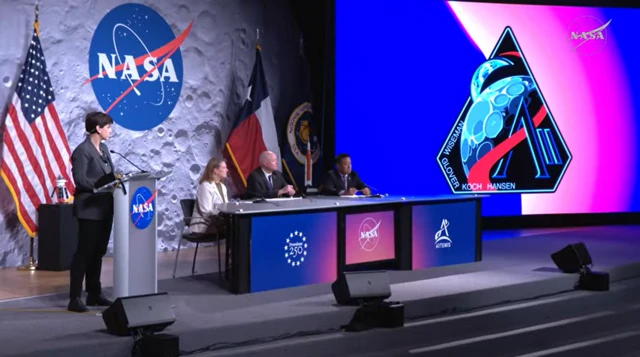
    A panel of Nasa leaders take questions from reporters on the status of the Artemis II missionImage source, NASA

    The four astronauts aboard the Orion spacecraft have not spoken to their families since they set off, Frieling says.

    "They've been really busy," he tells reporters.

    However, now that the trans-lunar injection burn is out the way, Nasa will "make time" for this to happen soon.

  5. Astronauts could break record for farthest humans have travelled from Earthpublished at 02:25 BST 3 April

    Before the trans-lunar injection burn that propelled the spacecraft towards the Moon, the predicted maximum distance from Earth that the astronauts were estimated to reach was 219,639 nautical miles.

    That was based on a "perfect" burn.

    Frieling says he has not since run the numbers to calculate the new distance but it could be historic.

    The current record for the farthest humans have travelled from Earth is held by the Apollo 13 crew who in 1970 reached about 216,000 nautical miles, Frieling adds.

  6. All astronauts are 'doing great' - including first-time space flier Jeremy Hansenpublished at 02:10 BST 3 April

    The Nasa panel is now being asked how the crew is doing, especially astronaut Jeremy Hansen, who is a first-time flier to space.

    Nasa flight director Judd Frieling says crew members are "doing great" and that there is "no indication they are having any problems at all".

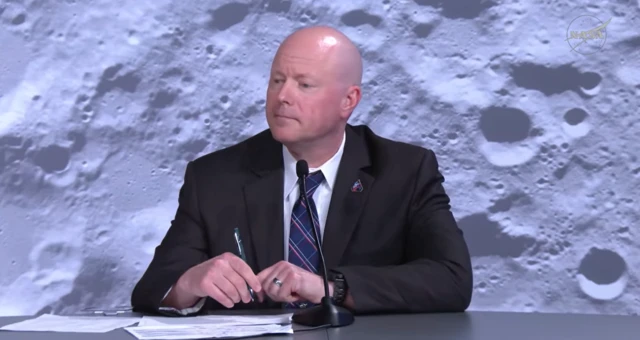
    NASA flight director Judd Frieling talks to reporters about the Artemis II missionImage source, NASA
  7. Life support system performing 'exactly as predicted'published at 02:09 BST 3 April

    Hu is now describing how Nasa demonstrated its readiness for trans-lunar injection before the burn that pushed it into space.

    He said that the unmanned craft Artemis I - the current mission's predecessor - allowed them to track a lot of systems and prepare accordingly.

    "The most important sub-system when we put humans on board is the life-support system," he notes.

    He says he was "happy to report" that the CO2 scrubber, which allows the spacecraft to remove carbon dioxide, gives it breathable air, and control temperature, is working "exactly as predicted, and in some cases better".

  8. 'We had a perfect ride uphill,' says Orion spacecraft managerpublished at 01:51 BST 3 April

    Howard Hu is seen talking behind a microphone to reportersImage source, NASA

    "Wow, what a great two days," says Howard Hu, who manages the Orion spacecraft.

    He tells the room that he hasn't slept very much in the past 24 hours as he follows the ins and outs of this mission.

    "We had a perfect ride uphill," he adds.

  9. Mission aims to 'learn as much as we can'published at 01:44 BST 3 April

    Glaze reminds us all that this mission is still a test flight and that NASA "continues to get lots of new data every day".

    She adds that they are "not tracking anything" of concern right now and "intend to learn as much as we can" about the spacecraft.

  10. 'Flawless' burn, says Artemis program leaderpublished at 01:43 BST 3 April

    Lori Glaze is seen at a news conference offering updates the Artemis II missionImage source, Reuters

    Nasa is now holding a news conference on the mission, what they've been learning and what comes next.

    This is the first time that humans have left Earth orbit since 1972.

    The engine burn that saw the crew head to the Moon was "flawless", Dr Lori Glaze, who leads development and operations related to Artemis, is explaining.

    "Our crew is healthy and our spacecraft is performing really well", she adds.

  11. News conference to begin shortlypublished at 01:33 BST 3 April

    A news conference on the status of the mission following the trans-lunar injection burn is due to begin shortly.

    Stay with us as we bring you the latest.

  12. What the 10-day Artemis II journey looks likepublished at 01:31 BST 3 April

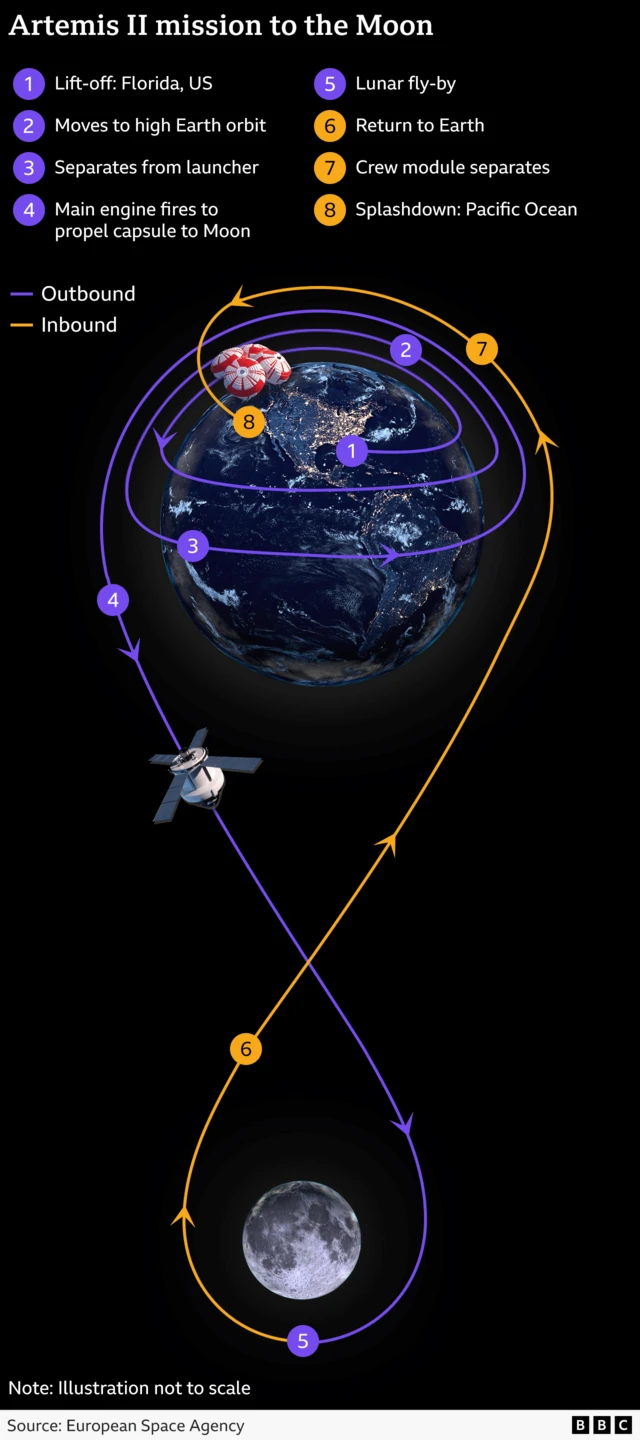
    The Artemis II is on a 10-day journey to the Moon and back. This is what the crew's journey looks like from start to finish.

    As a reminder: the main engine has just fired, propelling the crew out of Earth orbit towards the Moon. They are now heading to their lunar fly-by.

    Graphic showing the Earth and the Moon, with the spacecraft’s figure of eight orbital trajectory highlighted. Specific points are labelled. These are: 1. Lift-off at the Kennedy Space Centre, 2. Orbit around the Earth, 3. Rocket separation, 4. Main engine fires to take spacecraft to the Moon, 5. Lunar fly-by, 6. Return to Earth, 7. Crew module separates, 8. Splashdown in Pacific Ocean
  13. Meet the first non-American heading to the Moonpublished at 01:20 BST 3 April

    Media caption,

    Watch the BBC's interview with Artemis astronaut Jeremy Hansen

    Of the 24 astronauts in the history of the human race who have so far travelled to the Moon, all have been American.

    But now, a Canadian national is set to join the list.

    On board the spacecraft is Canadian astronaut Jeremy Hansen, who we heard from a few minutes ago as the crew began its push towards the Moon.

    Hansen began his career as a fighter pilot before joining the Canadian Space Agency (CSA). He is following in the footsteps of his hero Chris Hadfield, a Canadian astronaut who served as commander of the International Space Station (ISS), and today expressed his "pride" at seeing Hansen venture to space.

    When it was announced that Hansen would become the first Canadian to travel to the Moon, François-Philippe Champagne, the minister responsible for the Canadian Space Agency said it was "thanks to our longstanding collaboration with Nasa".

    Champagne added: "Canada’s participation in the Artemis program is not only a defining chapter of our history in space, but also a testament to the friendship and close partnership between our two nations."

    As he travels towards the moon, Hansen is donning a heptagonal patch, which he says is a way of recognising the Indigenous peoples in Canada during this historic mission.

  14. Hugs and smiles at Nasa as crew heads for the Moonpublished at 01:18 BST 3 April

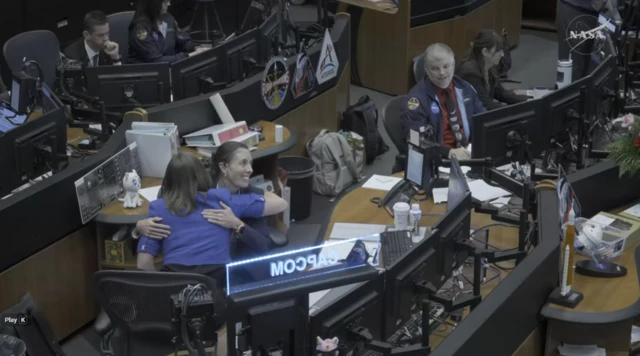
    It's all smiles at Nasa ground control as they hear from astronauts for the first time since the crew completed a critical engine burn that is now propelling them to the far side of the Moon.

    Two of the team hug as astronaut Jeremy Hansen spoke to the world.

    The crew are already 2780 miles away "from our home planet," the space agency said, from a burn launch position of 150 miles above the planet.

    Two women hug at ground control as Artemis II heads towards the Moon.Image source, NASA
  15. First words from astronauts as they head to the Moonpublished at 01:07 BST 3 April

    "The crew's feeling pretty good up here on our way to the moon," astronaut Jeremy Hansen tells the world on the Nasa live stream.

    The Canadian national - the first non-American to travel to the Moon - says they "firmly felt the power" of the perseverance it has taken for them to head out on this mission.

    "Humanity has once again shown what we are capable of," he says.

    "It's your hopes for the future that carry us now on this journey around the Moon."

    Return to the latest post
  16. 'Looks like a good burn', Nasa sayspublished at 01:01 BST 3 April

    For the first time in over 50 years, humans are headed around the Moon as the translunar injection has been completed.

    "Looks like a good burn," says one of the Nasa team members.

    Earth is slowly shrinking in the livestream from Orion.

    The spacecraft is now around 1,000 miles from Earth, Nasa says, adding that 10 minutes ago, the spacecraft was just 115 miles away.

  17. Astronauts begin push towards the moonpublished at 00:51 BST 3 April

    Houston, we have trans-lunar injection burn.

    This has been described by Nasa mission control as the "last major engine firing of the mission" and is what will send astronauts out of Earth orbit and around the Moon.

    The engines will be burning for exactly 5 minutes and 50 seconds.

    By committing to the burn, all four astronauts aboard the spacecraft are also tied into a splashdown, targeted for 10 April.

  18. What is a translunar injection burn?published at 00:33 BST 3 April

    Pallab Ghosh
    Science correspondent, reporting from Cape Canaveral

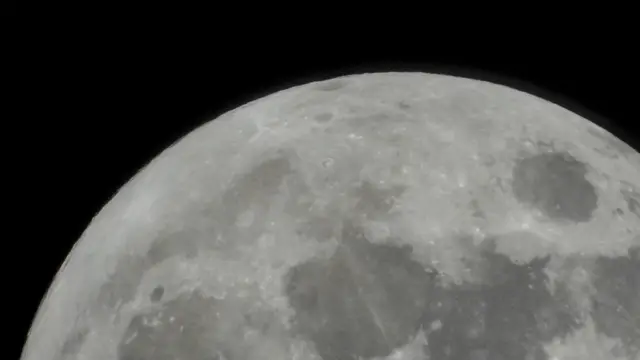
    The moon during its waxing gibbous phase over Ronda, Spain.Image source, Reuters

    Translunar injection - or TLI - is the space‑flight term for the big engine burn that pries a spacecraft out of Earth’s grip and sends it onto a path for the Moon. For Artemis II, that job falls to Orion’s main engine on its European‑built service module.

    After spending roughly a day in a stretched‑out “high Earth orbit”, looping the planet and checking engines, navigation and life‑support with the full crew on board, Orion will swing through the lowest point of that orbit and fire its engine for several minutes.

    Because the spacecraft is already moving fastest at this low point, the burn adds a huge amount of extra speed, enough to stretch its path into a long arc that will carry the four astronauts around the far side of the Moon and back toward Earth on a so‑called free‑return trajectory.

    If engineers were unhappy with any of Orion’s systems before this moment, they could simply wave off the burn and keep the spacecraft circling Earth until a safe route home is plotted.

    Even once TLI is complete, this is not a one‑way ticket.

    Orion programme manager Howard Hu says that, in an emergency, mission control can still command a kind of “handbrake turn” in space by firing the engine again to bend the trajectory back toward Earth.

    “Post‑TLI, we have a capability to return back to Earth at any point,” he explains, describing a continuous early‑return option that has been run through hundreds of thousands of computer simulations to prove it can get the crew home safely.

  19. Just under 30 minutes until astronauts are due to propel towards the Moonpublished at 00:25 BST 3 April

    Artemis II Commander Reid Wiseman and his team of astronauts are scheduled to start their engines for the flight around the Moon at 23:49 GMT.

    The team at Nasa have voted "go" for the push into outer space - but it is not yet a guarantee that it will happen.

    The Orion capsule has to be oriented at exactly the right angle and positioned at a precise point within Earth's orbit to be on its course, some 185km above our planet.

    If the burn does go ahead, Nasa says the engine will fire with enough thrust to accelerate a car from 0-60mph (0-96.5kmh) in about 2.7 seconds.

  20. What space does to your bodypublished at 00:08 BST 3 April

    Weightlessness is what astronauts love the most, but it's also what hurts them most, Kevin Fong, who used to work with Nasa on human spaceflight as a physician, tells BBC News.

    Despite astronauts' athleticism, when you send them into space they're weightless. "It's kind of like sending someone to bed for 10 days," he explains.

    "Your muscles waste, your bones waste, your heart deconditions, your sense of balance is thrown off".

    To keep themselves in shape and slow down muscle wastage, astronauts have to "do quite a lot of work".

    "If you look at their cruise schedules, quite a lot of their day is spent doing a bit of exercise on treadmills".

    Studies on the astronauts' health will also help Nasa to better understand how deep space travel influences the human mind and body, protecting astronauts on future lunar missions as well as travel to Mars.