Summary

  1. Why has Nasa sent astronauts to circle the Moon?published at 08:27 BST

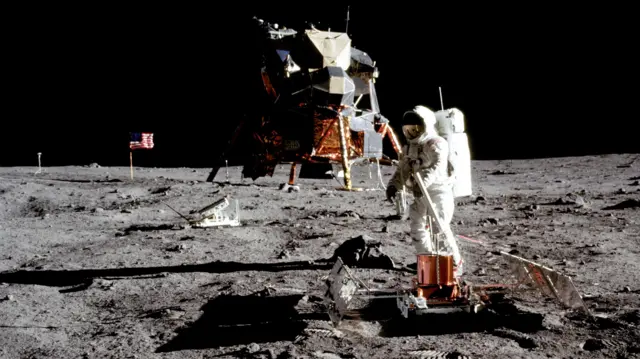
    A photo showing Buzz Aldrin in his spacesuit on the moonImage source, European Photopress Agency
    Image caption,

    The first moon landing took place in July 1969

    More than 50 years have passed since America's Apollo missions landed humans on the Moon for the first time in July 1969.

    And, while Nasa's Artemis II crew won't make a lunar landing themselves, their mission over the next 10 days will to pave the way for the next human footsteps on the Moon.

    During their trip the four astronauts will fly 6,400 miles (10,299km) beyond the far side of the Moon, which always faces away from the Earth - marking the first time this has taken place.

    Nasa says that during this three-hour period, the crew will "analyse and photograph geologic features, such as impact craters and ancient lava flow", which will help future missions to explore the Moon's South Pole region.

    Studies on the astronauts' health will also help Nasa to better understand how deep space travel influences the human mind and body, protecting astronauts on future lunar missions as well as travel to Mars.

    If the crew pass safely around the Moon on this trip, Nasa's goal is for Artemis IV and V to become lunar landing missions - and is aiming for both to happen in 2028.

  2. How do you sleep in space? It's not straightforward, aerospace professor sayspublished at 08:04 BST

    Professor Kevin Fong

    As we've been reporting, the Artemis II's crew of four astronauts are currently working through a "pre-sleep" stage, but what exactly does this involve?

    Speaking to BBC Radio 4, University College London aerospace professor Kevin Fong tells the Today programme that it largely means the crew is "winding down", though not in the same way you might on Earth.

    "It's not straightforward going to sleep up there, you've got to strap yourself into a sleeping bag, Velcro yourself to the wall," Fong explains.

    And that's before you've considered the adrenaline that will be coursing through the bodies of the four circling more than 30,000 miles above Earth.

    "I just don't know anyone who's going to sleep," Fong admits, as the astronauts ready for their four-hour sleep window.

    After hopefully getting some shut-eye, the crew will accelerate their way to the Moon's orbit - our science correspondent explains how.

  3. What it looks like on board - and the path the crew will followpublished at 07:49 BST

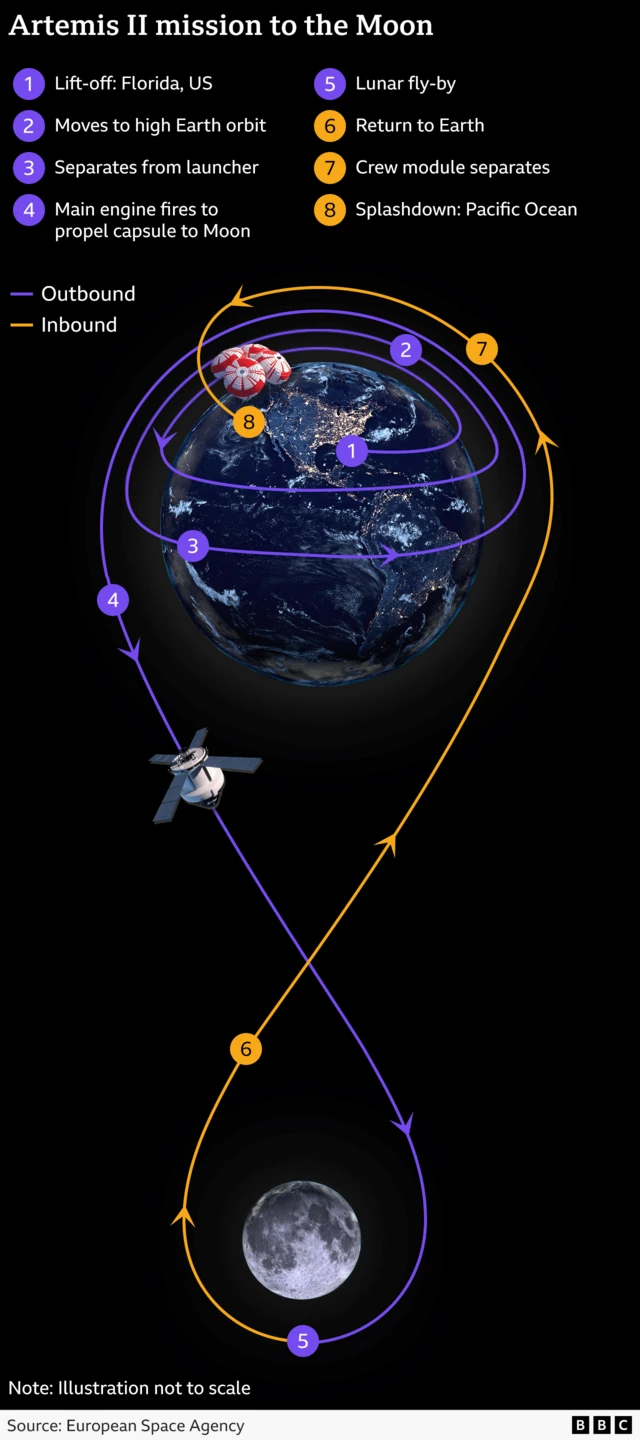
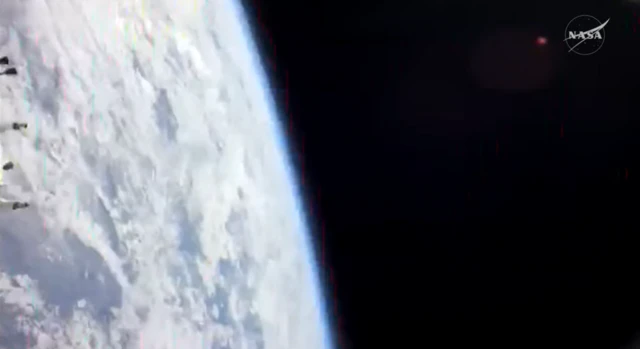
    With their rocket now far above the planet, the Orion spacecraft - which houses the crew - separated from its launcher and is now orbiting the Earth.

    The astronauts must now decide whether to continue the mission. While they are close to Earth, getting back is relatively straightforward if there are any issues that cannot be fixed.

    If all is well, Orion will fire its main engine to blast free of the Earth’s gravity and set a path to the Moon.

    Alt text: Graphic showing the Earth and the Moon, with the spacecraft’s figure of eight orbital trajectory highlighted. Specific points are labelled. These are: 1. Lift-off at the Kennedy Space Centre, 2. Orbit around the Earth, 3. Rocket separation, 4. Main engine fires to take spacecraft to the Moon, 5. Lunar fly-by, 6. Return to Earth, 7. Crew module separates, 8. Splashdown in Pacific Ocean
    Interior view of the Orion crew module highlighting a metal structure in the centre, labelled as a foldaway chair, another highlight shows the control panel mounted on the “ceiling”, while a third shows a panel labelled as a hatch door positioned over the toilet. The cabin includes padded wall sections, metal flooring, and equipment mounts. A small illustration in the corner shows an astronaut demonstrating how the foldaway chair is used.
  4. The next major steppublished at 07:41 BST

    Pallab Ghosh
    Science correspondent

    The Orion capsule is now safely in Earth orbit, where flight control teams are putting its engines, navigation and life support systems through their paces to make sure everything is working perfectly before committing to deep space.

    If all the checks are passed, they will later fire Orion’s main engine for 5 minutes and 45 seconds, a single burn that will accelerate the spacecraft fast enough to send the four astronauts on their way to the Moon.

    Orion’s next major milestone is still to come – the powerful engine burn that will sling the crew out of Earth orbit and on towards the Moon.

    The astronauts and ground teams need to make sure everything is working perfectly before committing to deep space.

    If engineers are not completely satisfied, they can simply cancel tonight’s so-called “trans-lunar injection” burn - which puts the spacecraft on the right trajectory to the Moon - and bring the astronauts home.

    Artemis II is seen shortly after lift off from Cape Canaveral. The orange rocket body is flanked by two white propulsion rockets, with bright fire coming from beneath them. a dark blue sky is seen behind.Image source, Reuters
  5. Checklist ongoing aboard spacecraft as we hear crackles from the radiopublished at 07:21 BST

    As the astronauts aboard Artemis II prepare to get some sleep, we're hearing snippets of the checks taking place on the spacecraft. You can listen too by tapping watch live at the top of the page.

    The radio occasionally crackles to life, as Commander Reid Wiseman and his team continue the process of "cabin containing".

    This means working through a checklist to make sure everything the astronauts have used is correctly stowed and configured for the rest of the mission.

    And, the details are so specific that they even communicate with the team on Earth about where they're putting their laundry - as we hear from one "stowage note".

    "We stored our used comfort garments in the block bags in the F4 locker," we hear the shuttle relaying to Nasa.

    "We copy," Nasa replies.

  6. 'You are go for launch' - how last night's historic launch unfoldedpublished at 06:53 BST

    Pallab Ghosh
    Science correspondent

    Media caption,

    Watch the moment Nasa's Artemis II mission blasts into space

    If you're just catching up on last night's launch, our science correspondent Pallab Ghosh has this look back at the moments just before Artemis II blasted off.

    In the hour before take-off there were issues which threatened launch concerning the Launch Abort System - which enables Nasa engineers to eject the astronauts and blow up the rocket if there is a malfunction.

    The countdown clock was held at 10 minutes while engineers resolved the problem – which they speedily did.

    Then came the staccato rhythm of the calls by each engineer responsible for the rocket’s critical systems.

    One by one the voices came back: “Booster, go”, “GNC, go”, “Range, go” – each reply, a tiny release of tension and a build-up of expectation.

    “Artemis II, this is Launch Director – you are go for launch,” the crew was told. "We go for all humanity", Commander Reid Wiseman responded.

    The four RS‑25 engines and twin solid rocket boosters lit with a sheet of flame that seemed to engulf the rocket, driving more than 8.8m lbs of thrust into the Florida evening sky.

    The pad erupted into a sheet of brilliant white flame and fury as the mightiest rocket ever built rose from its launch tower.

    Nasa’s Space Launch System (SLS) crept upwards majestically, slow at first, then gathering pace, riding on two blinding pillars of flame that crackled and roared with an impact we could feel watching three miles from the pad.

    SLS arced out over the Atlantic like a fiery white angel, shrinking to a single bright star as it chased the Moon.

  7. Crowds react to spectacular launchpublished at 06:36 BST

    People watch as rocket launches, with firepower and smoke visible beneath the rocket at lift-offImage source, Getty Images
    Image caption,

    Spectators at the launch said they could feel the power of the rocket through their entire body

    People gather on the day of the launch of the next-generation Moon rocketImage source, Reuters
    Image caption,

    Most were thrilled as the rocket shot into the sky - this baby less so...

    Children with ear defenders and toy rockets watch the launch of Artemis II in Cape Canaveral, FloridaImage source, Getty Images
    Image caption,

    Ear defenders and model rockets were the order of the day for these young spectators

    A couple looks at the Moon after the launch of the next-generation moon rocketImage source, Reuters
    Image caption,

    A couple was seen enjoying the view after a full Moon rose at the Kennedy Space Center

    A child dressed in an orange space jumpsuit. he holds a white helmet under his arm and is smiling, cheering. he has medium length black hair.Image source, Reuters
    Image caption,

    Over in Mexico, children watched a live broadcast at an event organised by the US consulate

  8. 'Spectacular!' - BBC journalist reacts to Artemis II launchpublished at 06:20 BST

    "Oh my goodness... That is spectacular!"

    Watch as the BBC's science editor Rebecca Morelle witnesses last night's launch.

  9. Astronauts orbiting the Earth after historic Moon mission launchpublished at 05:54 BST

    Katie Williams
    Live reporter

    Artemis II rocket launches from Kennedy Space CenterImage source, Reuters

    After a successful lift-off just over six hours ago, the Artemis II crew are now orbiting the Earth and have been conducting tests on their spacecraft. Here's a recap:

    Technical issues before launch

    A couple of technical issues in the lead-up made for a nervy couple of hours before launch.

    There were issues with both the flight termination system - which is designed to destroy the rocket if it goes off course - and a battery for the Launch Abort System - which would pull the crew capsule away from danger in case of an issue.

    It looked like take-off could've been delayed.

    But Nasa managed to resolve the issues by being "quick on their feet", an official told the media later. One was fixed by using hardware from the previous Space Shuttle programme.

    The roar of flames at lift-off

    Launch was met with giddy euphoria among Nasa employees, our science correspondent reports.

    You could hear the roar of the engines and cheers from the crowd as the rocket took off. The boosters were later seen separating from the rocket.

    We then had confirmation the astronauts had passed the Kármán line, entering space and Earth orbit.

    Epic views... and an issue with the loo

    The crew have been treated to "epic views", one astronaut said - but it hasn't all been plain sailing.

    There was a short-lived comms issue, which meant ground control couldn't hear the astronauts. And, among other things, there was an issue with the toilet - that's since been fixed.

    What happens next?

  10. Astronaut families aware launch 'is just the start'published at 05:31 BST

    Katie Williams
    Live reporter

    "While all the families and friends are certainly feeling a lot of relief after the successful launch, everyone is keenly aware that this is just the start of a very dangerous 10-day mission and a risky re-entry," says Stacey Morgan.

    She was at the launch supporting the Artemis crew members' family and friends. Her husband, astronaut Andrew Morgan, was a Nasa classmate of Reid Wiseman and Jeremy Hansen.

    Morgan adds: "There is relief and excitement but also the reality of what lies ahead. After all, we’re going to the Moon! And back!"

    Stacey Morgan and family watch her husband, Nasa astronaut Andrew Morgan, launch to the International Space Station in 2019Image source, Stacey Morgan
    Image caption,

    Stacey Morgan knows what it's like to see a loved one launched to space

  11. 'Happy to report that toilet is go for use' - mission controlpublished at 05:11 BST

    It appears that, after the problems reported earlier, the toilet is ready for use.

    "Happy to report that toilet is go for use," mission control says. "We do recommend letting the system get to operating speed before donating fluid".

    A little earlier, we heard that mission specialist Christina Koch had the happy job of troubleshooting the issue. It seems to have worked.

  12. 'We're going to try and get you to bed a little bit early' - mission control tells astronautspublished at 04:53 BST

    "It's been a great day guys, and we're going to try and get you to bed a little bit early," mission control says to the Artemis crew.

    There are a couple more operations to run through first, including troubleshooting the issue they've been having with the toilet.

    "I don't think it will take very long," mission control says.

    The astronauts' sleep will be divided into two slots. They are scheduled to get around four hours before waking to monitor something called the "perigee raise burn" - this will put Orion back in a stable orbit for the loop back towards Earth.

    After that, they are then scheduled to have another four and a half hours of sleep.

    Astronauts monitor screens inside the Orion capsuleImage source, NASA
  13. A new-look mission control to guide the astronauts on their trippublished at 04:39 BST

    Stephen Dowling
    Deputy editor, BBC science features

    The Orion Mission Evaluation Room (MER) is seen during a media tour at Johnson Space Center in Houston, Wednesday, Sept. 24, 2025.Image source, Getty Images

    You can watch live at the top of the page as the Orion crew continues tests in orbit. You'll also regularly see the view from Nasa's mission control - more on that below:

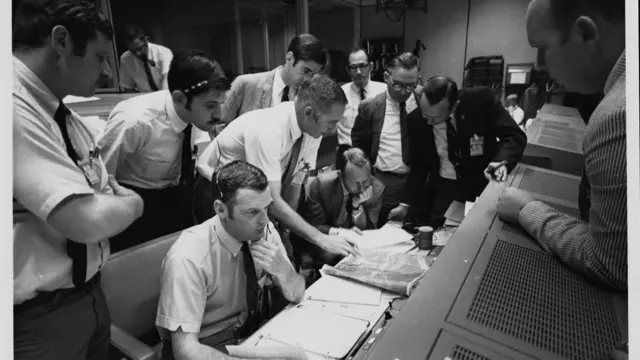
    Nasa's historic space missions succeeded or failed thanks to the help of mission control.

    Devised by Christopher Kraft for the Mercury programme of the early 1960s, the nerve centre of US space missions grew to become hives of activity by the time of the Apollo missions.

    Photos of white-shirted technicians frowning over cumbersome consoles became almost as iconic as the images of the Apollo 11 astronauts on the Moon.

    Now, Artemis mission control looks very different to those of 50 years ago. The massive consoles have given way to sleek terminals and overhead lighting that are reminiscent of tech start-up offices.

    But look behind the tech, and mission control now has the same job as half a century ago.

    "The structure that Chris Kraft put together as the first flight director has really stood the test of time," says Fiona Antkowiak, one of nine flight directors assigned to the Artemis II mission.

  14. Crew quietly trying to break their spacecraft - on purposepublished at 04:32 BST

    Pallab Ghosh
    Science correspondent, reporting from the launch

    Before Nasa commits Orion to the long burn that sends it away from Earth, the crew are spending hours quietly trying to break their spacecraft - on purpose.

    They cycle computers through different modes, switch radios between ground stations and relay satellites, and deliberately move around the cabin to see how the life‑support system copes as carbon dioxide and humidity build up.

    Engineers also command small thruster firings and check the European‑built service module responds exactly as the models predict.

    All of this is designed to answer a simple question: is the ship healthy enough to risk flying hundreds of thousands of kilometres from home with no quick way back?

    If any of these tests throws up something they do not understand, Nasa will not hesitate to call off the trans-lunar injection burn and use Orion’s engine to bring the astronauts straight back to Earth.

  15. What is a day in the life of an astronaut really like? 'Work from start to finish'published at 04:20 BST

    Leyla Khodabakhshi
    Reporting from the Kennedy Space Center

    Stephen smiling in a blue jumpsuit standing next to a model rocket

    Nasa astronaut Stephen Bowen says one of the first things you notice in space is something simple. You are floating.

    “Floating never gets old,” he told me. “And I actually sleep better in space than I do on Earth.”

    Bowen has been an astronaut for more than 25 years and has taken part in multiple missions, including 10 spacewalks.

    “On the space station, you strap yourself into a sleeping bag attached to the wall,” Bowen says. “You just float and sleep - there’s no real sense of up or down.”

    A typical day begins with breakfast and a check of the schedule. From there, Bowen says, it is work from start to finish.

    “You’re scheduled continuously from the time you wake up to the time you go to sleep,” he says. That includes hours of exercise, scientific experiments and maintaining the spacecraft.

    Even small things behave differently. Tears, for example, do not fall. “They just stay in your eyes,” he says, describing how a crewmate once found it hard to stop laughing as the tears built up.

    For Bowen, spacewalks are among the most extraordinary parts of the job. “You’re holding on to the space station, and the Earth is passing below you,” he says. “The view is absolutely unbelievable.”

  16. A few niggles on board Artemis IIpublished at 04:02 BST

    Pallab Ghosh
    Science correspondent, reporting from the launch

    The Artemis II crew are already discovering that even a trip to the Moon comes with very down‑to‑Earth plumbing problems.

    According to flight controllers, sensors in Orion’s waste‑management system – essentially the spacecraft’s toilet and urine‑processing gear – have thrown up some readings they did not expect, and engineers are now working with the astronauts to run extra checks and reconfigure the system.

    For now, Orion has plenty of backup options, from alternative collection bags to different ways of routing liquids, so this is more about comfort and long‑term reliability than an immediate health risk.

    But with ten days in deep space ahead, Nasa wants to be absolutely sure the system is behaving before committing to the burn that will send the crew away from Earth, and they say they won’t hesitate to cut the mission short if the problem worsens.

    Interior view of the Orion crew module highlighting a metal structure in the centre, labelled as a foldaway chair, another highlight shows the control panel mounted on the “ceiling”, while a third shows a panel labelled as a hatch door positioned over the toilet. The cabin includes padded wall sections, metal flooring, and equipment mounts. A small illustration in the corner shows an astronaut demonstrating how the foldaway chair is used.

    As well as toilet trouble, the astronauts have discovered a few other niggles with their brand‑new spacecraft.

    A valve linking two sets of water tanks was found closed when it should have been open - probably jostled by the violence of launch - and has had to be reset.

    Engineers have also seen a repeat of a minor electronics hiccup from Artemis I, where a component briefly tripped after a radiation hit before automatically recovering.

    None of these issues are classed as mission‑threatening, but they underline why Artemis II is very much a test flight.

  17. Watch: 'It's a historic day' - Americans react to Artemis II launchpublished at 03:55 BST

  18. Launch attracts spectators - and not just in Floridapublished at 03:47 BST

    Space enthusiasts gather for a watch party in TorontoImage source, Reuters
    Image caption,

    People gather for a watch party in Toronto, Canada - mission specialist Jeremy Hansen is the first Canadian to join a crewed Moon mission

    Children in Mexico react to a live broadcast of the Artemis II launchImage source, Reuters
    Image caption,

    Nasa hopes to inspire a new generation - and these children in Ciudad Juárez, Mexico looked impressed

    People in New York paused to watch the launch on screensImage source, Getty Images
    Image caption,

    In busy New York, people paused to watch the launch on screens outside the News Corp building

  19. Astronauts putting Orion through its first proper manoeuvrepublished at 03:40 BST

    Pallab Ghosh
    Science correspondent, reporting from the launch

    People sit behind panel filled with screensImage source, NASA

    The astronauts are currently putting the Orion capsule through its first proper manoeuvre in space.

    The capsule fires its small steering thrusters to drift a short distance away from the spent upper stage of the rocket, then slowly slides back in again, practising what Nasa calls “proximity operations” - controlled flying close to another object.

    This is designed to help perfect the techniques they will eventually need for docking with a lunar lander once it is built, and flying as part of later Artemis missions.

    Throughout the manoeuvre, computers track the distance and closing speed between Orion and the upper stage, while the astronauts practise taking manual control using hand‑controllers, in case the automated systems ever fail.

    Proving they can do this safely in low Earth orbit helps build confidence for future dockings around the Moon.

  20. Crew conduct tests on board Orion - watch livepublished at 03:35 BST

    The crew are now orbiting Earth and conducting a number of different tests - including practising manoeuvring the capsule.

    You can watch live at the top of the page.

    Media caption,

    Watch: First live view of Artemis II crew since arriving in space