Summary

  1. Trump urges countries reliant on Gulf oil to step inpublished at 02:26 BST 2 April
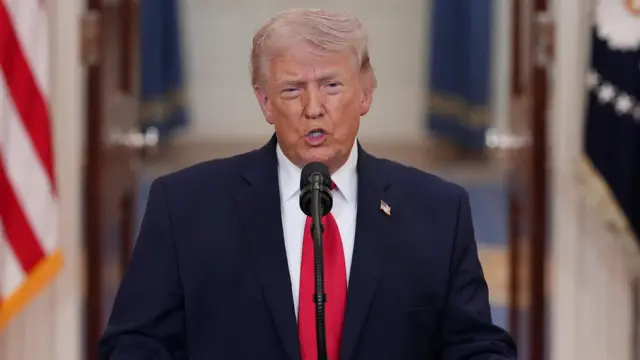
    Donald TrumpImage source, Reuters

    Trump also spoke about US and Venezuela's oil production, saying that the US does not need oil from abroad.

    He says that countries that need oil from the Middle East should now take the lead to keep the Strait of Hormuz open.

    Energy shipments from the Gulf have largely come to a standstill after Iran retaliated against the US-Israeli strikes by threatening to attack vessels that try to cross the Strait of Hormuz - a critical trade waterway.

    Trump says: "To those countries that can’t get fuel, many of which refuse to get involved in the decapitation of Iran… build up some delayed courage, go to the Strait and just take it. Protect it."

    Trump also calls for countries to buy US oil instead.

  2. US strategic objectives in Iran 'nearing completion'published at 02:24 BST 2 April

    Trump says the US is "systemically dismantling the regime's ability to threaten America or project power outside of their borders".

    He says Iran's navy, air force and missile production capabilities have been destroyed.

    "Tonight I am pleased to say that these core strategic objectives are nearing completion," he says.

    He says he has traveled to the Dover Air Force base to honour the 13 American soldiers who died in the war. "We salute them and now we must honour them by completting the mission."

    Return to the latest post
  3. Analysis

    Trump declares objectives are 'nearing completion'published at 02:19 BST 2 April

    Bernd Debusmann Jr
    White House reporter

    As expected, Trump declares the US is "nearing completion" of its various military objectives, and vows to "finish the job" in the near term.

    Trump has also sought to lay the blame for rising petrol prices - a key domestic issue - on the Iranian side.

    The president's promise that the US is "better prepared" than ever to deal with the economic ramifications of the war, however, will ring hollow for his detractors and those who have opposed the military operation and argued that those threats only began when US and Israeli strikes began.

    As he has in recent days, Trump also told US allies to build up the courage to secure shipping in the Strait of Hormuz, arguing that the US doesn't "need it".

    Some observers will immediately wonder whether any US withdrawal from the conflict in the coming weeks would mean that it essentially washes its hands of the task of ensuring freedom of navigation in the region.

  4. Trump thanks Israel and Gulf alliespublished at 02:18 BST 2 April

    Trump thanks US allies in the region, including Israel and the Gulf states.

    "They've been great, and we will not let them get hurt or fail in any way, shape or form," he says.

    Trump notes that Iran has attacked many of these countries and says this underscores that it should never have a nuclear weapon.

  5. Trump says he was honoured to terminate nuclear deal with Iranpublished at 02:16 BST 2 April

    Trump calls the nuclear deal negotiated by former US President Barak Obama a mistake, and says he was honoured to terminate it.

    The president then talks about a strike he ordered in June 2025, Operation Midnight Hammer, against Iran's nuclear programme.

    "Nobody's ever seen anything like it," he says.

    "We totally obliterated those nuclear sites."

  6. Iran were 'right at the doorstep' of making a nuclear weapon: Trumppublished at 02:15 BST 2 April

    Iran did not give up on its nuclear programme and was fast developing longer rang missiles, says Trump.

    They were "right at the doorstep" of developing a nuclear weapon, he says.

  7. A nuclear Iran an 'intolerable threat'published at 02:14 BST 2 April

    Trump says he's making this address to explain why Epic Fury is "necessary for the safety of America" and the world.

    Listing terrorist attacks and other acts carried out by Iran or its proxies over the past 47 years, he called the regime running the country thuggish and murderous - pointing also to a recent crackdown on protest in the country which killed thousands of citizens.

    Leaders like this cannot be allowed to obtain a nuclear weapon, he said.

    "I will never let that happen."

  8. Trump speaks about 2020 killing of Iranian commanderpublished at 02:13 BST 2 April

    Trump notes that in his first term he presided over the US assassination of Iranian military commander Qasem Soleimani, who he calls "the father of the roadside bomb".

    Trump says if Soleimani was still alive, "we would have had probably a different conversation tonight but you know what we would still be winning and winning big".

  9. Analysis

    Trump outlines justifications for war, but not the immediate needpublished at 02:11 BST 2 April

    Bernd Debusmann Jr
    White House reporter

    The beginning of Trump's televised address this evening has focused heavily on what he sees as the successes of this war, and the necessity for it.

    Within moments of beginning his remarks, Trump described "swift, decisive and overwhelming" victories in the war, including the deaths of senior Iranian leaders and a "dramatically curtailed" ability to launch missiles and drones.

    "America is winning, and winning bigger than ever before," Trump added.

    Trump quickly mentioned Venezuela, which he has repeatedly said in the past is a model for US military operations overseas. It was quick, "violent" and left an amenable government in place, he said.

    That has yet to happen in Iran, which has - at least publicly - refused to acknowledge that it has asked for a ceasefire or that talks are leading to an imminent end of hostilities.

    Notably, Trump has yet to address the immediate need for an operation earlier this year, instead blaming past administrations for failing to act against a regime that has been a thorn in the side of the US for nearly 50 years.

  10. Trump thanks troops for operation in Venezuelapublished at 02:09 BST 2 April

    Trump also thanks the US military for the swift operation to seize Venezuelan leader Nicolás Maduro, saying it was praised all over the world.

    He adds that the US and Venezuela are getting along well, describing them as "venture partners", and that they are no longer dependent on Middle Eastern oil but are for their allies.

  11. Trump turns to update on Iran warpublished at 02:07 BST 2 April

    Trump then marks one month since the star of Operation Epic Fury against Iran.

    "Tonight Iran's navy is gone, their air force is in ruins, their leaders, most of them… are now dead," he says.

    Trump adds that Iran's ability to launch missiles and drones is dramatically curtailed.

  12. Trump praises Artemis II crewpublished at 02:04 BST 2 April

    Trump started his address by congratulating the team at Nasa for the successful launch of Artemis II - and praising the "brave" crew travelling to the moon.

  13. Trump addresses nation on Iran warpublished at 02:02 BST 2 April
    Breaking

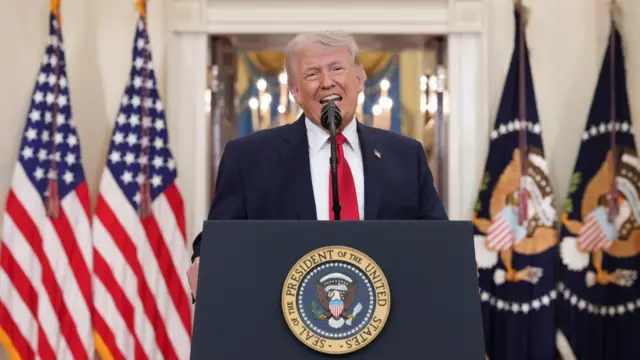
    U.S. President Donald Trump delivers an address to the nation about the Iran war at the White House in Washington, D.C., U.S. April 1, 2026.Image source, Reuters

    President Trump is speaking to the US public now to give an update on the Iran war.

    We will bring you the latest from his speech.

    You can watch live at the top of this page.

  14. Trump's White House address is about to beginpublished at 01:56 BST 2 April

    It's nearly 21:00 on the east coast of the US, and we're minutes away from President Donald Trump's address to the nation.

    The primetime televised speech will take place in the White House, and we're expecting Trump to give an update on Iran.

    Major US television networks will cut into their regular programming to show the speech.

    You can watch it live at the top of this page, and we will bring you the key updates in text as well.

  15. Troublesome polls for Trump ahead of Iran addresspublished at 01:47 BST 2 April

    Bernd Debusmann Jr
    White House reporter

    As we reported earlier, US president Donald Trump is expected to deliver an update on Operation Epic Fury - largely with a focus on its military successes dismantling Iran's military capabilities.

    From a purely military standpoint, the Trump administration clearly sees the operation as a win.

    Trump, however, faces a significant challenge in the US. Poll after poll has shown that Americans have very mixed feelings about the war.

    One poll released by CNN this afternoon found only about a third of the US public believes that the president has a clear plan for how to handle the situation. The same poll found that disapproval has risen to 63%.

    Another poll released by Reuters and Ipsos this week found that 66% of Americans want the war to end as soon as possible, even if it falls short of achieving the goals that the administration had set. Only 27% of respondents said they believe the US should continue to work to achieve this goals, even if it means a protracted conflict.

    The polling numbers are better among Republicans. The Reuters poll, for example, found that 57% of Republicans support continuing the operation for longer.

    Some polls, however, show that even backers of the president are anxious about the possibility of a wider war and more American casualties. One AP poll shows that while 67% of respondents supported the decision to strike, only 20% would support an operation involving ground troops.

    The president and his allies are also concerned by growing anxiety over petrol prices, which some have suggested may come to haunt Republicans in the upcoming midterm elections in November.

  16. Carney says he spoke to Trump about Artemis moon mission and Iran warpublished at 01:35 BST 2 April

    Canadian Prime Minister Mark Carney says he has spoken to President Trump this evening ahead of the US president's address to the nation.

    Carney says he congratulated Trump on the success of the Artemis II mission to the moon but they also spoke about the Iran war.

    "We discussed the courage of the astronauts, including Colonel Jeremy Hansen, the value of co-operation in space, and developments in the Middle East conflict," Carney says in a statement.

    Hansen is a Canadian astronaut and is travelling with the Nasa crew to the moon.

  17. Analysis

    Trump's comments this week: a preview of what's to come?published at 01:28 BST 2 April

    Bernd Debusmann Jr
    White House reporter

    While the White House has given us a broad outline of what President Trump will discuss tonight, it's worth looking back at his comments just yesterday and other recent remarks.

    They likely give an up-to-date picture of where Trump's thinking is going into today's address.

    Speaking to reporters in the Oval Office yesterday, Trump said that he expects that the US will "leave" Iran within two or three weeks - extending the conflict past the four-to-six deadline the administration cited at the beginning of Operation Epic Fury, but still leaving him without the sort of protracted campaign he campaigned against.

    Trump appeared to suggest that opening up the Strait of Hormuz is no longer a US objective, and that other countries should do more.

    Both he and Defence Secretary Pete Hegseth earlier in the day suggested that the US had created the conditions necessary for other countries to secure their own shipping.

    "If France or some other country wants to get oil or gas, they'll go up through the Strait... they'll be able to fend for themselves," he said. "I think it'll be very safe, actually, but we have nothing to do with that."

    That, however, stands in contrast with Trump's Truth Social post this morning, in which he vowed to continue "blasting" Iran "back to the Stone Age" unless the strait is "open, free and clear".

    Observers around the world will be watching closely for any remarks on US alliances - particularly Nato - as Trump's anger towards their perceived failure to help the US during the conflict has reached fever pitch.

  18. Trump has threatened to leave Nato before. Here's what he's said and why he probably can'tpublished at 01:19 BST 2 April

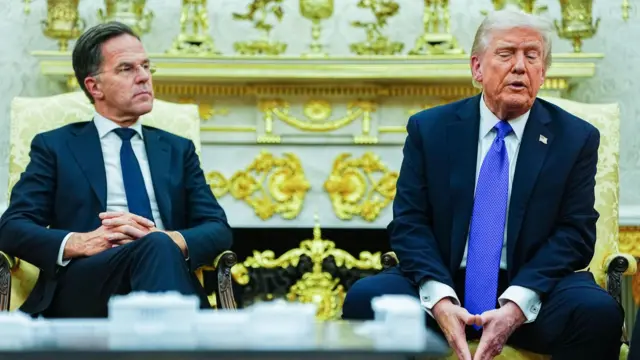
    Nato Secretary General Mark Rutte and US President Donald Trump sit for a meeting in the Oval Office wearing suits.Image source, EPA

    Trump has threatened to leave the Nato alliance - the defensive body that the US helped establish after World War Two.

    But he has said this before.

    Before the start of his first term as US president in 2017, he repeatedly dismissed Nato as a "paper tiger", described it as "obsolete", and said that it was "costing a fortune" for the US.

    In 2019, he showed "clear signs" that he was "preparing to act on his threat", former Nato Secretary General Jens Stoltenberg wrote in his memoir, On My Watch.

    Trump has long taken issue with Nato's military spending, showing dissatisfaction with a 2014 "guideline" that countries should spend 2% of their GDP on defence. Military spending has since ramped up by nearly all members, partly in response to Trump's threats and in part due to Russia's growing threat, writes Lyse Doucet, the BBC's chief international correspondent.

    Leaving the alliance isn't up to the president alone. The president cannot unilaterally withdraw from Nato without the approval of a two-thirds Senate majority or an act of Congress.

    The 2024 legislation was backed at the time by Trump's current Secretary of State Marco Rubio, who has been in near lock-step with the commander-in-chief on the Iran war.

    Appearing on Fox News on Tuesday, Rubio said the US is going to have to "re-examine" whether or the alliance is "still serving that purpose". Rubio also referred to it as "a one-way street where America is simply in a position to defend Europe".

    Earlier this year, Trump said Russia would have occupied all of Ukraine if the US had not acted as Nato's enforcer.

    For context: After the 9/11 attacks in 2001, Nato provided large scale support to the US under Article 5, which states that an attack on one member is considered an attack against all. It was the first use of Nato military assets under Article 5.

  19. Trump due to address the nation in an hourpublished at 01:00 BST 2 April

    President Donald Trump is due to address the US public with "an important update on Iran" in about an hour. Ahead of his speech, let's look back at today's developments.

    • The US Central Command says it has hit more than 12,300 targets in Iran a month into the war. It says US bombs have "damaged or destroyed" Iranian vessels, military command centres and ballistic missile sites
    • Iranian attacks on Gulf countries have continued. The United Arab Emirates and Qatar each responded to missile and drone strikes while British troops say they brought down 10 Iranian drones over several countries including Jordan, Bahrain and Cyprus
    • Iranian officials say reports the country has requested a ceasefire are "false and baseless". Ahead of Trump's speech, Iran's President Masoud Pezeshkian published an open letter to Americans describing the war as an "occupation and invasion" of his country before adding Iran has no ill will towards ordinary people in the US, Europe and Gulf Arab neighbours
    • In Europe, there is growing concern after Trump's comments suggesting the US will leave the Nato military alliance after allies refused his request to join American forces
    • The president's speech will be keenly watched and he is expected to repeat what he says are US military victories and assure a war-weary public that the operation in Iran will wind down in the coming weeks

    Stay with us as we bring you more updates and full coverage of Trump's speech from the White House.

  20. Death toll in war surpasses 5,000, according to human rights groupspublished at 00:31 BST 2 April

    The number of deaths in the US-Israel war against Iran has passed 5,000 according to the latest reports compiled by various agencies, and reported by Reuters.

    The BBC has not independently verified these numbers.

    Iran - 3,519

    US-based rights group HRANA says that 1,598 of those were civilians, including at least 244 children.

    The Red Cross and Red Crescent said on Friday that at least 1,900 people have been killed and 20,000 injured in Iran in the US-Israeli strikes so far, but it's unclear if those figures include at least 104 people who the Iranian military said were killed in a 4 March US attack on an Iranian warship off Sri Lanka.

    Lebanon - 1,318

    That number includes 124 children, Lebanese officials say. Israel launched strikes on Lebanon on 2 March and more than 400 fighters from Hezbollah have been killed since then.

    At least nine Lebanese soldiers have been killed and three UN peacekeepers from Indonesia were killed in separate incidents.

    Iraq - at least 107

    Iraqi health authorities say that number includes civilians, members of the Iran-affiliated Shi'ite Popular Mobilisation Forces, US-allied Kurdish Peshmerga fighters, police and army, as well as a foreign crew member who was killed in an attack on tankers near an Iraqi port. A French soldier providing counterterrorism training was killed in a drone attack.

    Israel - 19

    Israel's ambulance service says that missiles launched from Iran and Lebanon towards Israel have killed 19. The Israeli military also says that 10 of its soldiers were killed in southern Lebanon. Separately, an Israeli farmer died near the border on 22 March when Israeli forces misfired.

    United States - 13

    Six service members were confirmed dead after a US military refuelling aircraft crashed in Iraq. Seven others were killed in action during operations in Iran, the US military has said.

    Fatalities across the region

    Deaths have also been recorded in the United Arab Emirates (11), Qatar (7), Kuwait (7), The West Bank (4), Syria (4), Bahrain (2), Oman (2), and Saudi Arabia (2).