Wales to go into 'firebreak' lockdown from Fridaypublished at 17:48 BST 19 October 2020
People in Wales told to stay home from Friday, with pubs and restaurants ordered to close.
Read MoreThe number of hospital admissions rose by 40 and now stands at 754. There are 61 in ICU, which is two fewer. Today's positive case report stands at 993
The Scottish and UK governments are at odds over the reasons for a delay to the publication of Covid test results
Only 316 new cases were recorded in Sunday’s figures - after 1,167 on Saturday
The under reported cases should be included in today's and tomorrow's figures, First Minister Nicola Sturgeon said at her briefing
Some of Scotland's biggest universities did not reduce the capacity of their student halls despite the need for physical distancing, a BBC investigation finds
Ministers will this week publish a strategic framework for tackling the virus and will include a tiered alert system similar to that put in place in England last week
People in Wales told to stay home from Friday, with pubs and restaurants ordered to close.
Read MoreThat's all for today from our live coverage of the first minister's Covid briefing.
Thanks for joining us. We'll be back with more tomorrow. Stay safe.
The Scottish government says there have been capacity issues, but the UK government says this is "categorically untrue".
Read MoreRichard Leonard says people are looking for more evidence that the restrictions brought in are justified.
Quote MessageThere are still questions about the 10pm curfew and the 6pm curfew. There are still questions about whether lumping together all parts of the hospitality industry is justified. In order to retain public trust, more evidence-sharing and more openness is required.
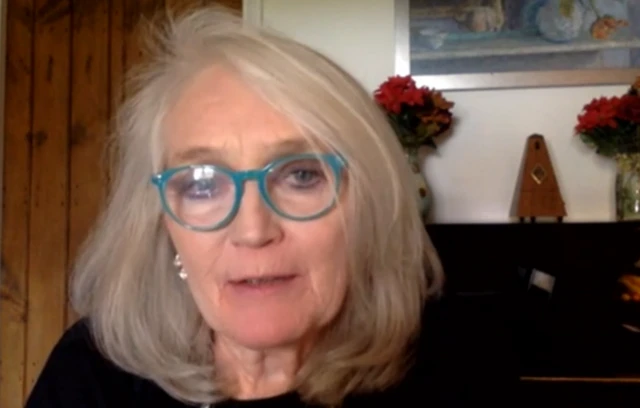
Prof Sian Griffiths, Emeritus Professor at the Chinese University of Hong Kong and an association board member of Public Heath England, says testing is the "bedrock of how you manage to control an epidemic".
She says it is important in the longer term to understand what has gone wrong at the Lighthouse lab in Glasgow so it doesn’t happen again.
Prof Grifiths says it sounds like a "logistics glitch" that needs to be ironed out, but believes there has been a lack of transparency around the Lighthouse labs compared with those run by the NHS or Public Health England or Scotland.
"The Lighthouse labs were established within the private system and had quite a lot of teething problems," she tells BBC One Scotland.
"It is not clear how positive results have gone into the Track and Trace system and we need greater transparency and greater local public health engagement in supporting the labs."
Mr Leonard says there has been a "slight dip" in the number of tests carried out by the Scottish government testing centres in the last couple of weeks - while UK numbers have gone up. "We need co-operation at this time above all else," he says.
He adds: " Because this is a national emergency, we will do whatever we can to support measures that keep on top of this pandemic.
"I have told the first minister that the Scottish government needs to follow the advice of Sage (the UK government's scientific advisory group) and they have said that testing needs to be given greater priority than it is currently receiving.
"But they also spoke about the importance of retaining public trust by having proper engagement with those most affected by any changes that are brought in."
Mr Leonard says this includes trade unions and the hospitality industry.
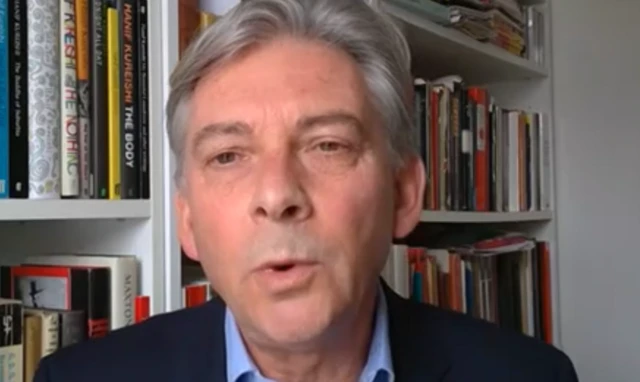
Scottish Labour leader Richard Leonard focuses on the testing delays over the weekend and calls for more co-operation between the Scottish and UK governments.
"Any squabbling about whose fault it is and whose fault it isn't is just unhelpful," he says. "What we need is a robust, effective testing system and a tracing system that will go along with it.
"We've said for some time that there needed to be more investment in testing by the Scottish government - looking at local testing centres in particular. That has got to be where the priority must be."
Allow X content?
This article contains content provided by X. We ask for your permission before anything is loaded, as they may be using cookies and other technologies. You may want to read X’s cookie policy, external and privacy policy, external before accepting. To view this content choose ‘accept and continue’.
Allow X content?
This article contains content provided by X. We ask for your permission before anything is loaded, as they may be using cookies and other technologies. You may want to read X’s cookie policy, external and privacy policy, external before accepting. To view this content choose ‘accept and continue’.
Allow X content?
This article contains content provided by X. We ask for your permission before anything is loaded, as they may be using cookies and other technologies. You may want to read X’s cookie policy, external and privacy policy, external before accepting. To view this content choose ‘accept and continue’.
The first minister ends with a reminder of the FACTS advice:
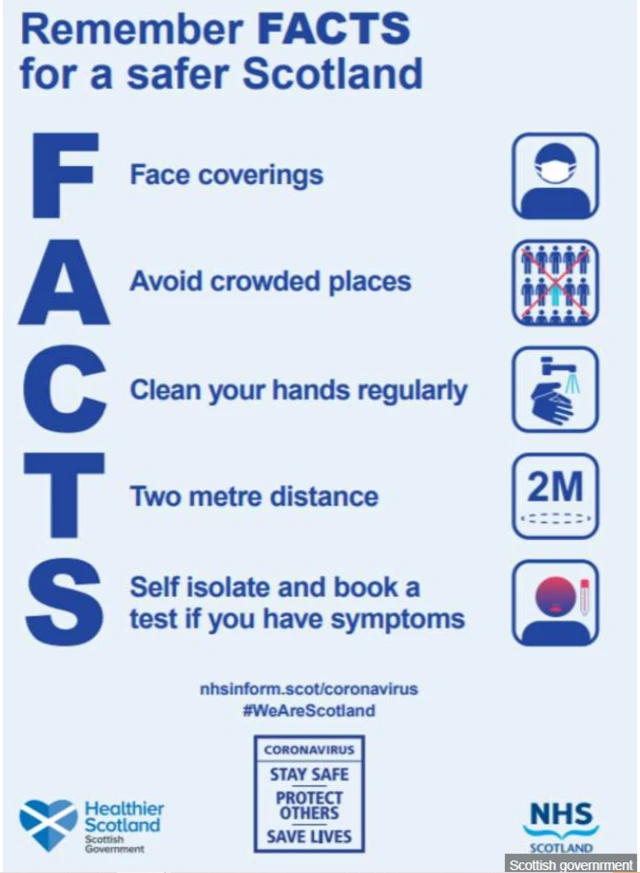 Image source, Scottish government
Ms Sturgeon says there will also be further details on how businesses will be supported so they can comply with all they are being asked to do - either now or in the future.
Quote MessagePublication of the framework is an important step as we look ahead to the winter and prepare to manage the virus over what I would expect to be a very challenging period. But it's worth stressing that many of the basic elements of our approach will not change.
Nicola Sturgoen, First minister
"We will also indicate, based on the latest advice from our clinical advisers, what levels should apply to different parts of the country once the current temporary restrictions on hospitality come to an end on the 26th of October," the first minister adds.
The framework will go on to highlight the effectiveness of the existing measures to curb Covid - including how the government will look to improve compliance through FACTS advice.
Looking to the week ahead, Ms Sturgeon says the government will publish its new "strategic approach to tackling the virus".
She says she will discuss this tomorrow with the other party leaders in the Scottish parliament. The framework will be published by the end of the week with a parliamentary debate next week.
One of the things the framework will set out is the different tiers or levels of restrictions which may be applied either locally or nationally.
The first minister goes on to explain a "quite technical but important" point about a change to the percentage figure of people who have tested positive.
Previously, Ms Sturgeon says, the figure has only concerned the percentage of people newly tested for the virus, which has been an important metric for determining the spread of the virus and has been consistent in terms of the number of hospital admissions and number of people dying.
This method has become "less reliable over time" however as more people have been tested - more than one-seventh of Scotland's population has been tested in the past seven months.
Under that measure, none of those people will ever count again as a newly-tested person, but a positive test would be counted, she says.
Over time, as more and more people who have already been tested go for further tests (for example 40,000 care home workers are tested every week), the proportion of positive tests will be "artificially high".
From now on, the figure reported will calculate the percentage of positive tests based on the total number of results that day, not just newly-tested ones.
So although today's figures were 17.1% of newly-tested people, they were only 6.4% of the total number, Ms Sturgeon says.
The new calculation will "give us a better picture of the virus over the coming weeks and months," she adds.
As politicians clash over testing at a major lab in Scotland, we explain how the testing system works.
Read MoreMs Sturgeon says the diverted tests included those for people who had gone to drive-through or walk-in testing centres.
Quote MessageIt stands to reason these people are more likely to test positive than asymptomatic people who are being tested, for example, as part of routine care home testing. That might help to explain why yesterday's number was probably artificially low.
Nicola Sturgeon, Fist minister
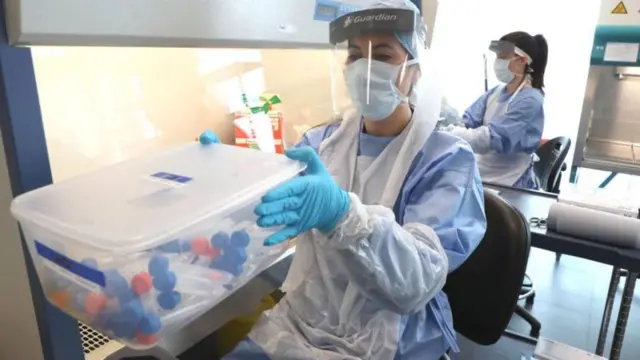
Turning to the reporting of daily statistics, Ms Sturgeon says the government reported only 316 new positive cases yesterday - far lower than on previous days.
She says this might be because, from Friday onwards, "quite a large number of tests" were diverted from the Lighthouse lab in Glasgow to be processed elsewhere in the UK network.
"Our understanding is that this was done to make sure the Lighthouse lab didn't handle more tests from across the UK than it had the capacity to deal with promptly", the first minister says.
Nicola Sturgeon says it seems clear, anecdotally, that people stuck to the rules over the weekend - including household gatherings. She says stopping households meeting indoors is crucial to slowing the spread of the virus.
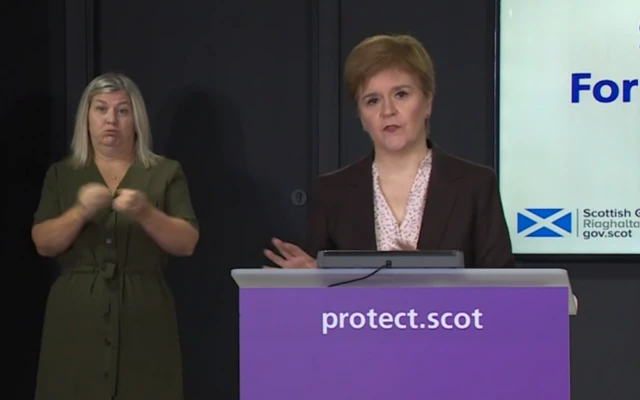 Image source, bbc
Quote MessageI want to say thank you to everyone who has played a part by following the rules. You are a making a difference and please be assured of that.
Nicola Sturgeon, First minister