Summary

Media caption,

Watch: Pakistan releases footage they claim shows strikes on Kabul

  1. We are pausing our live coveragepublished at 10:26 GMT 27 February

    Pakistan bombed Afghanistan's capital Kabul as well as two other provinces on Friday, after the Afghan Taliban announced a major offensive against Pakistani military posts near the border on Thursday night.

    Friday's events escalated a long-running conflict that has had the UN, China, Iran, Turkey and Saudi Arabia calling on both sides to stop fighting.

    Here's a rundown of what happened today:

    We are pausing our live coverage for now. Thank you for joining us.

  2. Analysis

    'It's a serious escalation, but it's not new'published at 10:13 GMT 27 February

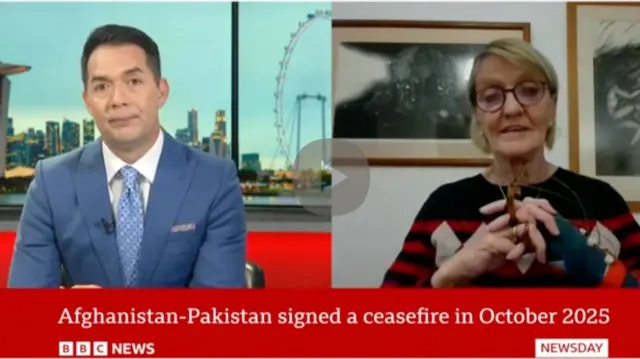
    Split-screen screen capture of BBC News broadcast showing anchor Steve Lai interviewing jounalist Kathy Ganon formerly of the AP on recent fighting between Pakistan and Afghanistan

    We're bringing you more analysis from experts who have spoken to BBC's Newsday.

    Today's air strikes are a "serious escalation, but it's not new", says journalist Kathy Ganon, former news director of the Associated Press for Afghanistan and Pakistan.

    Ganon tells our anchor Steve Lai that the tit-for-tat violence is "really problematic" for the region and what comes next is hard to predict.

    Consider two things - shifting political alliances and militant groups in the region.

    Ganon says Afghanistan has been drawn closer to India, Pakistan's historic rival.

    Militant groups in the region are being used by countries to attack other countries, she adds.

    "It's hard to understand where do we go from here and what's the next step."

    "It's a really difficult siuation and as it escalates, it's difficult to know where does it go from here, who else gets involved and what does that involvement look like."

  3. We are expecting official updates from both sides shortlypublished at 10:12 GMT 27 February

    Our teams on the ground say both sides will hold press conferences in the next hour or so.

    On the Pakistan side, Lieutenant General Ahmed Sharif Chaudhry is due to hold a briefing at 16:00 local (11:00 GMT).

    In Afhganistan, a spokesman for the Taliban government will give a statement at 15:00 local (10:30 GMT).

  4. Pakistan thwarted drone strikes in key cities - Information Ministerpublished at 10:02 GMT 27 February

    Pakistan's Minister for Information Atta Tarar has tweeted that Pakistan has thwarted Afghan Taliban attempts to launch small drones to attack targets in Abbottabad, Swabi and Nowshera.

    "Anti Drone Systems have brought down all the drones. No damage to life," his tweet added.

    Abbottabad is a military garrison city that houses the Pakistan Army's military academy.

    Tarar's statement comes after Taliban's Ministry of Defence spokesman Zabihullah Mujahid claimed to have launched "airstrikes" targeting a military camp near Faizabad in Islamabad, a military base in Nowshera, military positions in Jamrud, and additional locations in Abbottabad.

    The Taliban statement added that the "aerial operation was successfully executed, targeting key Pakistani military bases, command centres, and strategic facilities. The strikes were carried out in response to the aerial incursions conducted last night by Pakistani forces in Kabul, Kandahar and Paktia."

  5. Analysis

    What does Pakistan's 'open war' statement mean?published at 09:44 GMT 27 February

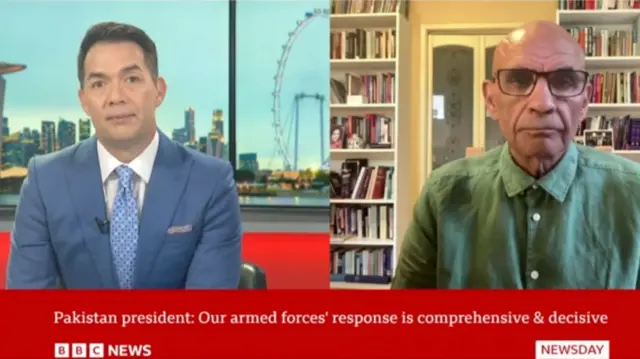
    Split screen of BBC Newsday broadcast showing anchor steve lai interviewing Afhganistan expert Amin Saikal

    Pakistan's defence minister has declared "open war" against Afghanistan following this morning air strikes by its military in Kabul and two other provinces.

    But what does this mean?

    It's a "very serious development" and Islamabad is signalling that it wants to "punish" the Afghan Taliban, whom it accuses of backing militants behind recent attacks in Pakistan, Amin Saikal, an expert on Afghanistan tells the BBC's Newsday programme.

    "The two sides have been at loggerheads for a long period of time. Now, the Pakistanis decided to go for the jugular. They wanted to really punish the Taliban for supporting the Pakistani Taliban who have carried out a number of attacks on Pakistani targets and killed a lot of people in the last year or two," says Saikal, founder of the Australian National University's Centre for Arab and Islamic Studies.

    The escalation would be disastrous for the Afghan people who are facing their own economic difficulties, says Saikal, who also wrote the book Modern Afghanistan.

  6. Pakistani and Turkish foreign ministers discuss conflictpublished at 09:21 GMT 27 February

    Pakistan's foreign minister, Ishaq Dar, has discussed the conflict with his Turkish counterpart, Hakan Fidan, Dar's office says on X.

    Dar has told Fidan by phone that Pakistani forces responded to "unprovoked Afghan aggression", Pakistan's foreign ministry says.

    "Both leaders emphasized the importance of peace and stability in the region and agreed to stay closely engaged on evolving developments," the ministry adds.

    As we reported earlier, Dar has held a similar conversation with his Saudi counterpart, Faisal bin Farhan Al Saud.

  7. Afghan TV says three killed in Paktikapublished at 09:00 GMT 27 February

    Afghanistan National TV is reporting that three people - including a woman and two school children - were killed by Pakistani air strikes in Paktika province.

    Seven others were also wounded after a bomb hit a civilian residence, the report said.

    An important reminder that the BBC is not able to independently verify any claims around casualties and injured.

  8. How do Pakistan's and Afghanistan's militaries stack up against each other?published at 08:49 GMT 27 February

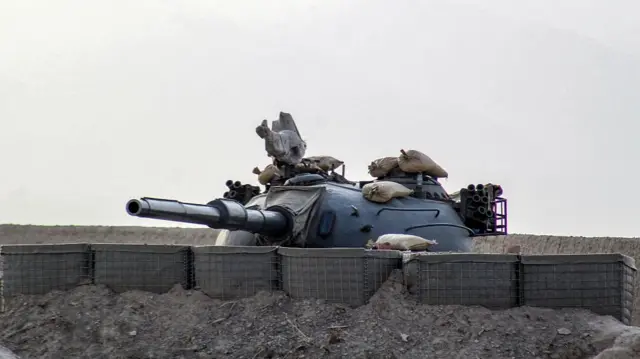
    A Pakistani army tank
    Image caption,

    A Pakistani army tank

    There's a significant disparity in military capability between Pakistan and the Afghan Taliban.

    Pakistan's armed forces, which are nuclear-armed, have consistently been ranked in the world's top 15 in military strength.

    The Afghan Taliban, on the other hand, lack the same military resources and face their own challenges.

    The weapons owned by the Taliban military largely come from three sources: those left by the former Afghan army, those from foreign forces that have withdrawn, and new weapons they have obtained from sources including the black market.

    Experts say videos of past border clashes suggest the Taliban forces have mostly used light weapons against Pakistani forces.

    However, the Taliban have extensive experience in guerrilla warfare, analysts say.

  9. Afghans will 'defend their beloved homeland' - former president Karzaipublished at 08:27 GMT 27 February

    Hamid Karzai, who served as president of Afghanistan from 2002 to 2014, released a statement earlier today responding to Pakistani strikes on Kabul, Kandahar and Paktia.

    "The Afghans will defend their beloved homeland with complete unity in all circumstances and will respond to aggression with courage," he wrote on X.

    Pakistan "must change its own policy and choose the path of good neighborliness, respect, and civilized relations with Afghanistan", he wrote.

    Karzai is one of the few senior Afghan politicians to remain in the country since the Taliban takeover in 2021.

  10. Pakistani strikes on government facilities is significant development - expertpublished at 08:03 GMT 27 February

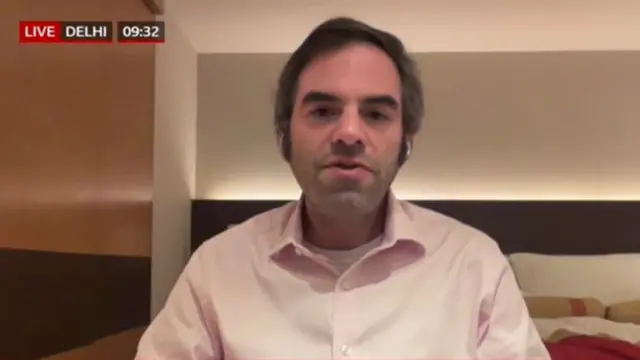
    Michael Kugelman speaking at the camera

    What makes the latest round of Pakistani strikes significant is that they have targeted Taliban government facilities instead of terrorist targets in Afghanistan, Michael Kugelman, a senior fellow for South Asia at the Atlantic Council, told the BBC's Newsday programme.

    This means "it's now targeting the regime itself", he said.

    Pakistan claims that the Afghan Taliban is harbouring terrorists to stage attacks on Pakistan. While there have been diplomatic steps taken to ease the tensions, they have not led to a lasting solution.

    Meanwhile rhetoric from the Taliban suggests it is committed to "staging relentless attacks" on the Pakistani side of the border, he said, adding that this was a "precarious situation" which could lead to an actual conflict.

  11. China calls for 'dialogue and negotiation' to end conflictpublished at 07:39 GMT 27 February

    China is "deeply concerned" about the escalating tensions along the Afghanistan-Pakistan border, its foreign ministry said, calling on both sides to "settle differences and disputes through dialogue and negotiation".

    It added that China has been "working for mediation on the conflict via its own channels, and stands ready to continue playing a constructive role for de-escalation and improvement of bilateral ties".

    "As a neighbour and a friend, China is deeply concerned over the escalation and is saddened by the casualties caused by the conflict," ministry spokesperson Mao Ning said, adding that "any escalation will inflict harm and losses on both sides".

    The statement added that ending hostilties was "in the fundamental interests of the two countries and peoples, and can help keep the region peaceful and stable".

  12. Gunfire heard near key border crossing - AFPpublished at 07:29 GMT 27 February

    Gunfire and shelling were heard earlier today at a major border crossing between Afghanistan and Pakistan, the news agency AFP reported.

    The Torkham crossing, which connects the Pakistani city of Torkham and Afghanistan's Nangarhar province, is a key transport route for people and goods between the two countries.

    The land border between the two countries has mostly been closed since border clashes erupted last October, except for the Torkham crossing which is one of the few places that has remained open. Many Afghans have used the crossing to return home from Pakistan, where they have faced mounting pressure and deteriorating living conditions.

    A camp housing returnees near the crossing was struck overnight by a mortar shell which wounded seven refugees - one of them with serious injuries - a provincial official told AFP.

    An Afghan returnee told AFP he "saw blood" and wounded children and women, while another said everyone fled in a hurry.

  13. Pakistan strikes hit target in Daman district - Taliban spokespersonpublished at 07:18 GMT 27 February

    Mahfouz Zubaide
    News producer

    Pakistani strikes have hit a target in Daman district, Kandahar province, the Taliban's spokesperson told the BBC.

    There were no casualties, he said.

    The Daman district is home to a base for Taliban border guards.

    The BBC has been unable to independently verify claims around damages and casualties.

  14. Afghan Taliban claims to have killed 50 Pakistani soldierspublished at 07:11 GMT 27 February

    Yama Bariz
    Afghan service correspondent in Kabul

    The Taliban authorities in Afghanistan say they have carried out retaliatory strikes against Pakistani border posts in the east and south east of the country.

    A spokesman for the Taliban government, Zabiullah Mujahid, told the BBC that Afghan forces had destroyed 19 Pakistani border posts and detained a number of Pakistani soldiers.

    He also claimed that more than 50 Pakistani troops had been killed.

    There has been no independent confirmation of those figures.

    Meanwhile, Pakistan claims it has destroyed 27 border posts belonging to the Afghan Taliban and said it had inflicted heavy casualties on Taliban forces.

  15. What we know so farpublished at 06:52 GMT 27 February

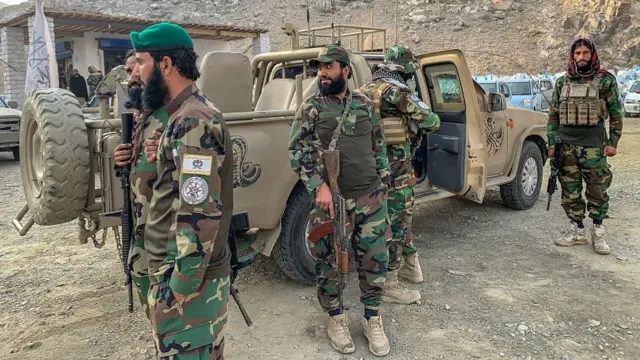
    Afghan soldiers in full battle gear standing beside a military truckImage source, Getty Images

    Pakistan's air force bombed Afghanistan's capital this morning following months of tit-for-tat fighting close to their long mountainous border. Here's what you need to know.

  16. Afghan Taliban attacks on Pakistan have stopped in some areaspublished at 06:38 GMT 27 February

    Sources are telling the BBC's Afghan service that attacks by the Taliban against Pakistan from the provinces of Kandahar and Helmand have stopped.

    Following Pakistani air strikes this morning, retaliatory strikes were launched in these areas, a spokesman for the Taliban government had earlier said.

    We have yet to confirm independently if there are casualties.

  17. The latest escalation after months of hostilitiespublished at 06:22 GMT 27 February

    Yogita Limaye
    South Asia & Afghanistan correspondent

    This is the latest escalation in violence between Pakistan and Afghanistan after months of hostilities.

    The last serious flare up was in October 2025, after which a diplomatic process had begun with Turkey and Qatar attempting to mediate between the two sides.

    A fragile ceasefire followed but negotiations failed to reach a broader agreement between the two sides for a complete ceasing of hostilities.

    Both sides blamed each other for not engaging seriously with the diplomatic process.

    Pakistan accuses Afghanistan’s Taliban government of supporting ‘anti-Pakistan terrorists’ who it blames for carrying out suicide attacks in Pakistan including the recent attack at a mosque in Islamabad. Pakistan says its strikes against Afghanistan have been targeted at militant hideouts not at civilians.

    This is a claim disputed by the Taliban government which has repeatedly said the territory of Afghanistan is not being used to threaten the security of any foreign country.

    It accuses Pakistan of carrying out unprovoked attacks in which civilians have been killed.

  18. 'We thought it was an earthquake, then we heard a loud explosion' - Kabul residentpublished at 06:08 GMT 27 February

    Mahfouz Zubaide
    News producer

    A resident of Dashti Barchi in Kabul’s District 6, which is near the area reportedly targeted by last night’s Pakistani airstrike, told me that his house shook violently due to an explosion caused by one of the strikes.

    “First, we thought it was an earthquake, because there was an earthquake in Kabul a few days ago,” he said. “Then we heard a loud explosion.”

    The resident, who is not being named for safety reasons, added that people in Dashti Barchi immediately rushed outside and stayed awake throughout the night. “No-one slept after that. Everyone was afraid."

    He said that jets were seen flying over Kabul shortly after the explosion.

    “When we saw the jets overhead, we realized they were Pakistani aircraft."

    The targeted area, was about 4 to 5 kilometres from his home, he said.

    “My wife and my parents were very scared. We were all awake the entire night.

  19. Pakistan says it carried out precision strikespublished at 05:59 GMT 27 February

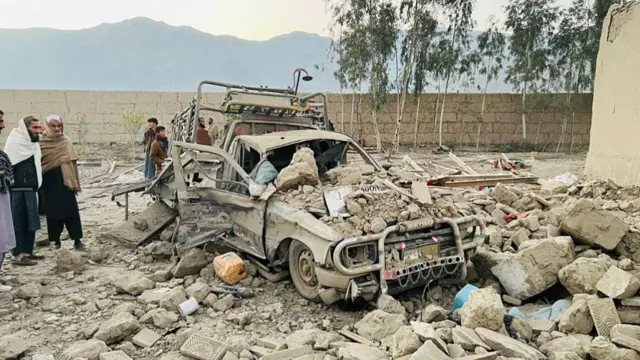
    A group of men in Afghanistan examining the ruins of a vehicle hit by Pakistani air strikesImage source, Getty Images

    We're getting more statements from officials in Islamabad, this time from Federal Minister for Information and Broadcasting Attaullah Tarar, who tells PTV that Pakistan was responding to unprovoked aggression by the Afghan Taliban.

    “Pakistan’s armed forces have once again demonstrated that any aggression or hostile designs against the country will be met with an iron hand,” he says, confirming Pakistani strikes in Kandahar province, Kabul and Paktika.

  20. Calls for de-escalation are growingpublished at 05:47 GMT 27 February

    Now, the UN Special Rapporteur for Afghanistan, Richard Bennett, is appealing for "calm and respect for international human rights & humanitarian law, in particular the protection of civilians".

    "Immediate de-escalation is essential," Bennett says on X.

    Similar calls have been made earlier by UN Secretary General Antonio Guterres and UN Human Rights chief Volker Turk.