Watch live: Trump speaks in Oval Officepublished at 15:57 GMT 17 March
Donald Trump is now speaking in the Oval Office. He's just been asked about Iran and we will bring the latest in a moment - you can also watch live above.
This page is no longer being updated. You can continue to follow our coverage at our new live page here
Iran's army chief says there will be a "decisive" response to the killing of security chief Ali Larijani in overnight Israeli strikes
Larijani is the most senior Iranian official to be killed since Supreme Leader Ali Khamenei - read more about the impact of his killing here
In Israel, two people are dead after an Iranian missile strike in Tel Aviv
Meanwhile, Donald Trump criticises Nato and other US allies, saying he has been told they "don't want to get involved" in the Iran war
It comes after a growing list of nations turned down his request to help protect the Strait of Hormuz - our diplomatic correspondent analyses the situation
A top US counterterrorism official has resigned over the ongoing conflict, saying "Iran posed no imminent threat to our nation"
For many Iranians, total repression and air strikes have them in constant fear, with one woman telling the BBC's Fergal Keane that if she leaves her home "it is like gambling with my life"
Donald Trump is now speaking in the Oval Office. He's just been asked about Iran and we will bring the latest in a moment - you can also watch live above.
More now from Trump, who says in a lengthy post on Truth Social that "most" Nato allies have said "they don’t want to get involved with our Military Operation" against Iran.
Trump says he is "not surprised by their action" and that he has always considered Nato "to be a one-way street".
He says: "Because of the fact that we have had such Military Success, we no longer 'need,' or desire, the NATO Countries’ assistance — WE NEVER DID! Likewise, Japan, Australia, or South Korea.
"In fact, speaking as President of the United States of America, by far the Most Powerful Country Anywhere in the World, WE DO NOT NEED THE HELP OF ANYONE!"
The post comes after Trump requested the help of Nato allies to help reopen the Strait of Hormuz - which he does not specifically mention in his post.
Donald Trump says the US has been told by "most" of its Nato allies that "they don’t want to get involved with our Military Operation against the Terrorist Regime of Iran, in the Middle East".
We'll have more on this shortly.
Benjamin Netanyahu says Israel is weakening the Iranian regime "in the hope of giving the Iranian people an opportunity to remove it", during a video address in which he says central regime figure Ali Larijani is dead.
"It will not happen all at once, and it will not happen easily. But if we persist, we will give them the chance to take their destiny into their own hands," the Israeli prime minister says.
He describes Larijani as the head "of a gang of gangsters that runs Iran".
Earlier, Israel's foreign minister, Gideon Saar, said "Iranians are safer" without Larijani and Basij commander Gholamreza Soleimani, who Israel also said it had killed. Defence minister Israel Katz said the IDF had been instructed "to continue hunting down the leadership" of Iran.
Iran has not confirmed whether Larijani has been killed or injured.
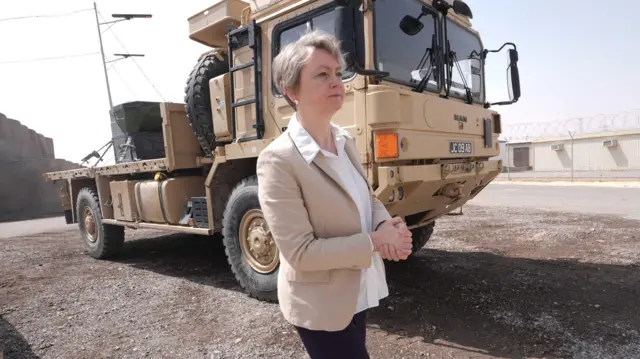 Image source, PA Media
Yvette Cooper visited a British base in Saudi Arabia last week
We've just been hearing an update from Foreign Secretary Yvette Cooper, who's said in the House of Commons that the UK "will not be drawn into a wider war, nor will we outsource our foreign policy". Here's a summary of what else she said:
On evacuation of UK citizens:
On defensive operations:
On Lebanon:
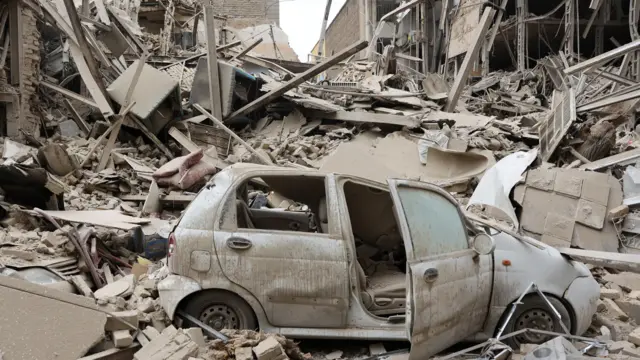 Image source, Reuters
A destroyed car in Tehran on Monday
In the face of an ongoing internet blackout across much of Iran, it can be difficult to hear residents' experiences of the war. But BBC Persian has managed to speak to some people inside the country.
One man describes witnessing night-time strikes in the capital Tehran: "Suddenly the house would light up, and then the sound would come."
He was woken by his windows rattling and a boom, which he says was "about five to six times louder" than thunder.
Elsewhere in Iran, a woman in her 20s says she is still taking medication to deal with the trauma from when the US attacked Iranian military sites in June 2025.
"That's why I wasn't in favour of the war at all," she explains. "But when they hit Khamenei (Iran's former supreme leader), I felt happy - it gave me a bit of hope."
"But now, it's really destroying my nerves. I really hope the war ends. It might be selfish, but my nerves are a complete wreck," she says.
BBC Persian is the Persian language service of BBC News, used by 24 million people around the world - the majority in Iran - despite being blocked and routinely jammed by Iranian authorities.
 Azadeh Moshiri
South Asia correspondent, in Dubai
Again, another phone alert in Dubai warning us of "potential missile threats" and to "immediately seek a safe place", followed by another alert half an hour later that the situation "is currently safe".
So far the UAE has dealt with 45 drones and 10 ballistic missiles today, according to the defence ministry.
That means its air defence system has had to reckon with more than 2,000 drone and missile attacks since the start of the war.
This morning, we reported a missile was intercepted and debris killed a Pakistani national.
Eight people have been killed in the UAE since the start of the war. Most civilians killed have been of South Asian origin, a reflection of how diverse the population is, with only 10% made up of Emirati citizens.

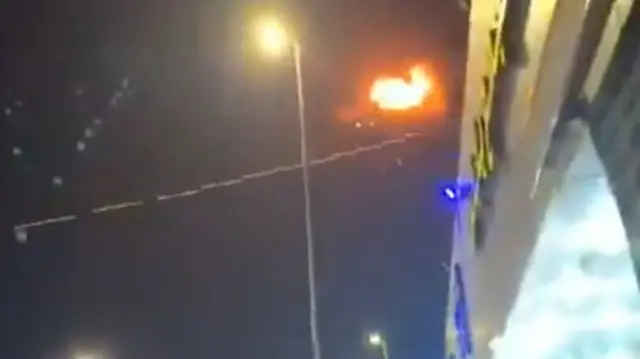 Image source, X
By Emma Pengelly and Thomas Spencer
Verified videos show air defences were used near the US embassy in the Iraqi capital overnight during a reported Iranian attack.
An Iraqi security official told the AFP news agency that “three drones and four rockets” attacked the embassy in Baghdad with "at least one drone crashing inside it".
One eyewitness video we’ve verified shows what appears to be machine gun fire and then an explosion overhead. In another eyewitness video, filmed about 1km (0.8 miles) to the south, we see what appears to be a drone flying in the direction of the US embassy before it is intercepted and explodes.
The rapid rate of fire from the interceptions would suggest the use of the C-R, externalam, external air defence system, external which has a Gatling gun that shoots down aerial threats. It’s been reported that the US had deployed the system to Baghdad to protect the Green Zone where its embassy is located.
The UAE's defence ministry has said in the past hour that it is intercepting drones and missiles from Iran.
It follows a similar update from Qatar's defence ministry, which said around two hours ago that it had intercepted a wave of missiles targeting the state.
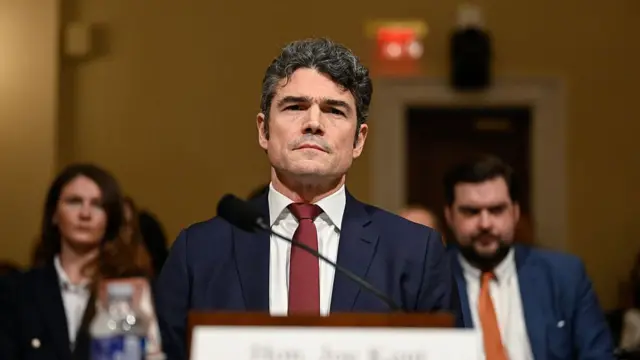 Image source, Bloomberg via Getty Images
The director of the US's National Counterterrorism Center has announced his resignation on social media - saying he "cannot in good conscience support the ongoing war in Iran".
The Senate confirmed Joe Kent as Trump's pick for the role last July.
Addressing Trump in his resignation letter, Kent says: "Iran posed no imminent threat to our nation, and it is clear that we started this war due to pressure from Israel and its powerful American lobby.
"I support the values and the foreign policies that you campaigned on in 2016, 2020, 2024, which you enacted in your first term.
"Until June of 2025, you understood that the wars in the Middle East were a trap that robbed America of the precious lives of our patriots and depleted the wealth and prosperity of our nation.
"As a veteran who deployed to combat 11 times and as a Gold Star husband who lost my beloved wife Shannon in a war manufactured by Israel, I cannot support sending the next generation off to fight and die in a war that serves no benefit to the American people nor justifies the cost of American lives."
 Bernd Debusmann Jr
Reporting from the White House
There's a busy day ahead for US President Donald Trump, who will be spending much of it at a series of St Patrick's Day events in Washington.
At 10:45 EDT (14:45 GMT), Trump will greet Irish Taoiseach Micheál Martin at the White House, which will be followed by a meeting between the two leaders and a "Friends of Ireland" lunch at the US Capitol.
These meetings are expected to focus heavily on economics, particularly Irish investment into the US.
Iran, however, may well come up. Those events will be on-camera, and while questions are by no means guaranteed, they are possible - particularly at the Oval Office meeting.
Just yesterday, Martin said that Ireland was hoping for a "peaceful resolution" to the conflict, which he said had caused "huge concern about the economic implications globally".
Back home, Martin is also facing intense domestic pressure - particularly from Sinn Féin - to do more to condemn the US-Israeli strikes on Iran.
Observers in both the US and Ireland will be watching to see how the two leaders handle the issue.
Later in the afternoon, Trump is scheduled to meet with Deputy First Minister of Northern Ireland Emma Little-Pengelly, before a reception.
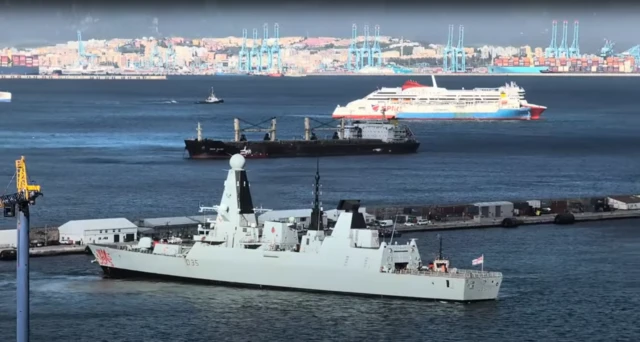 Image source, David Parody
By Rob Corp
BBC Verify has been sent images showing the UK Royal Navy Type-45 destroyer HMS Dragon in Gibraltar this morning as it makes its way to Cyprus on the eastern side of the Mediterranean.
HMS Dragon was deployed following a suspected drone attack by the Iran-backed Lebanese group Hezbollah on the Royal Air Force base at Akrotiri in Cyprus on the second day of the US-Israel war with Iran. Two more drones were intercepted the following day.
The UK government says the ship, which is armed with Sea Viper missiles that can intercept aerial threats, will bolster existing defences at Akrotiri.
According to Gibraltar-based photographer David Parody, who took these pictures, the destroyer is expected to take on fuel and supplies while docked at the British overseas territory on the southern tip of Spain.
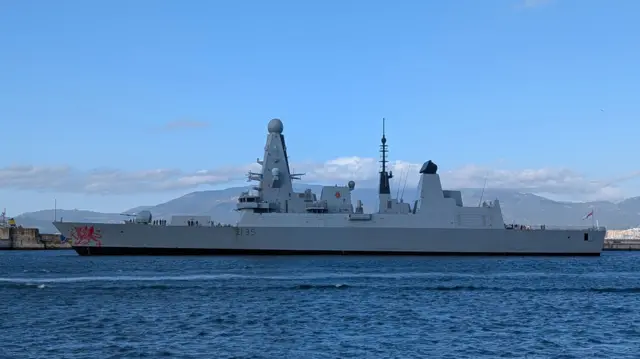 Image source, David Parody
 Gabriela Pomeroy
Live reporter
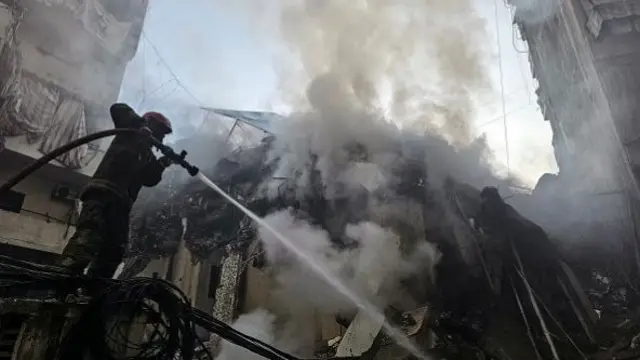 Image source, Getty Images
Firefighters at the scene of a missile strike on Beirut's al-Kafaat neighbourhood on 17 March
Here's a recap of today's key developments in the war.
In Iran
Israel says it has killed Iran's security chief Ali Larijani, saying he was effectively Iran's top leader. His death, if confirmed, would be a "massive body blow" to the regime, says Jeremy Bowen.
The commander of the Basij militia, Gholamreza Soleimani, was also killed in an overnight strike, Israel said. The much-feared militia is a plain-clothes section of Iran's Revolutionary Guards Corp, which was involved in the brutal crackdown of anti-government protests earlier this year.
In Israel
Iran launched missile attacks on Israel, causing craters and damage to houses. Sirens sounded across several Israeli cities.
In Lebanon
Israel launched more airstrikes on the capital Beirut and told residents of southern Lebanon to evacuate. The IDF said its operations aimed to stop the Iran-backed group Hezbollah, which has launched hundreds of missile and drone attacks into Israel.
The Lebanese authorities said more than 880 people have been killed in Israeli strikes during this round of fighting.

 Jeremy Bowen
International Editor
Ali Larijani’s death, if confirmed, is undoubtedly a massive body blow to the regime in Tehran.
I first came across him in Geneva in the 1980s when he was involved in various negotiations taking place at the UN.
Back then, he was a diplomat who you could see was intelligent and sought different angles on matters of discussion.
In recent decades he has become a key figure inside the regime of the Islamic Republic, particularly since the killing of the former Supreme Leader Ali Khamenei.
But he was also seen as a pragmatic figure. While he said some tough, war-like things in recent weeks, over the years he's been seen as a man of flexibility, a man you can do business with.
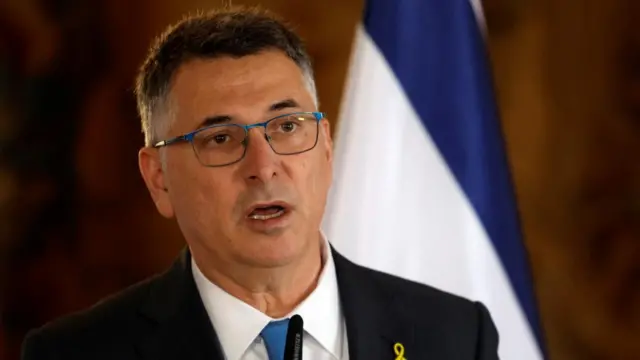 Image source, Reuters
Saar, who says Israel is weakening Iran's "repression mechanism", pictured speaking in January
Israel's foreign minister, Gideon Saar, says "Iranians are safer" without top security official Ali Larijani and Basij commander Gholamreza Soleimani, after the Israeli military says it killed both of them in strikes.
Speaking in Jerusalem, Saar says Israel is weakening Iran's "repression mechanism". He adds that the regime can only be toppled by the Iranian people but that cannot be done without external help.
In wide-ranging remarks, Saar also says Iran's effective blocking of the Strait of Hormuz is a "global problem" following US President Donald Trump's call for other countries to help stabilise the shipping channel.
Israel says it has killed Iran's security chief Ali Larijani in a strike, and will "continue hunting down" the leaders of the country. As the graphic below shows, many of the country's pre-war senior figures have been killed.
Supreme Leader Ayatollah Ali Khamenei's death was announced on 28 February, following the first day of US-Israeli strikes on Iran.
Also killed in the first wave of strikes were security adviser Ali Shamkhani, defence minister Amir Nasirzadeh, Revolutionary Guards commander General Mohammad Pakpour, and armed forces chief of staff Abdolrahim Mousavi.
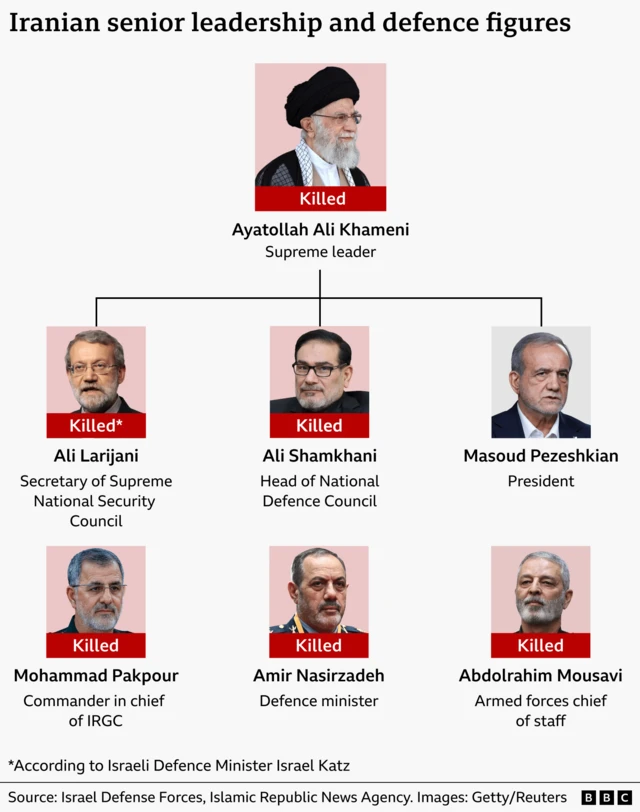
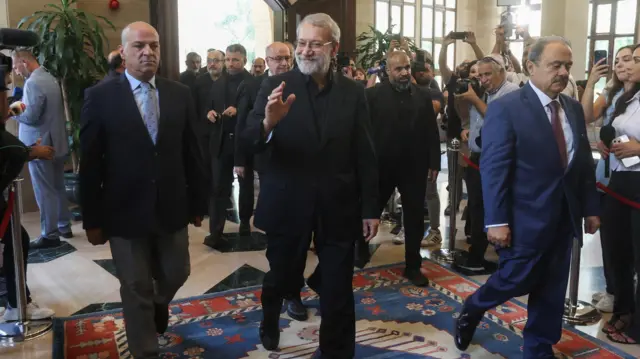 Image source, Reuters
The Israel Defense Forces (IDF) says Ali Larijani was "one of the most veteran and senior figures within the Iranian regime leadership" after announcing the Iranian security chief had been killed in a strike.
After Supreme Leader Ayatollah Ali Khamenei was killed, the IDF says, Larijani "functioned as the leader of the Iranian regime" and led its combat against Israel and neighbouring countries.
The Israeli military also links Larijani with a crackdown on anti-establishment protesters in Iran, suggesting he "advanced violent enforcement measures and repression operations".
Iran is yet to confirm Larijani's death, and state media has published a photo of a handwritten message said to have been issued by him, which was also posted on his social media accounts.
 Paul Adams
Diplomatic correspondent
A statement from Ali Larijani, posted by Iranian media outlets earlier this morning, seems to be nothing more than a message written to mark the funeral of Iranian sailors killed almost two weeks ago.
In an earlier statement, issued hours before Israel claimed to have killed him, Larijani bemoaned the lack of support for Iran from fellow Muslim countries.
"No Islamic government stood alongside the people of Iran," he complained, "except in rare cases and limited to political positions."
The language of the message, addressed to Muslims worldwide, suggested that the top security official believed Iran’s cause might resonate on the streets of Muslim nations, even if their governments had largely turned their backs.
"The United States and Israel on one side and Muslim Iran and the forces of resistance on the other," he wrote. "Which side of this battle do you stand on?"
Larijani reserved special scorn for Gulf countries which have hosted American forces or conducted rapprochements with Israel.
"Is Iran expected to sit idly by while American bases in your countries are used to attack it?" he asked.
 Ghoncheh Habibiazad
Senior reporter, BBC Persian
Iran's Ministry of Intelligence says in a statement that it has confiscated "hundreds of Starlink devices sent by the enemy" - referring to the US and Israel, Iranian news outlets are reporting.
The statement says that according to law, acquiring and using Starlink is a "crime" and during the war anyone doing so will be dealt with at the "highest penalty".
Using Starlink in Iran carries a punishment of up to two years in prison.
It is still very difficult to contact those inside Iran during the internet outage that has been in place since the start of the war, but tech-savvy residents have been using SpaceX's Starlink devices and sharing their connections with others.
A member of the United Nations Iran fact-finding mission says investigators are seeking access to the site of a deadly strike on a school carried out at the beginning of the conflict.
Max du Plessis says the UN has credible reports at least 168 people were killed in the strike, in Minab in southern Iran, and the majority were female students - many as young as seven-years-old.
Du Plessis says the UN is trying to find out who is responsible, what the reason for the attack was, and what the legal consequences, "if any", may be.
"We're in the early stage of the investigation," he says.
The US is carrying out its own investigation into the strike, and du Plessis says while the team hasn't yet spoken to anyone from the US, they would welcome any information provided, though stresses the UN's "independent" obligation to determine the facts.
"We've requested access to Iran and we'll continue to seek that access," he says.