Summary

Media caption,

Martial law, protests and a president tried for insurrection: How did South Korea get here?

  1. What to expect todaypublished at 05:18 GMT 19 February

    Jake Kwon
    Seoul correspondent

    In just under an hour, South Korea will find out if impeached ex-president Yoon Suk Yeol is guilty of insurrection.

    Yoon is already serving jail time after he was sentenced last month for abusing his power when he declared martial law and obstructing justice by evading arrest, among other things.

    Whatever the verdict, it will be difficult for South Koreans to move on from it.

    As prosecutors have pointed out, Yoon’s martial law attempt deeply divided the country and polarised its politics.

    He has never been able to provide evidence of his justification for imposing it, which is that the opposition party and foreign forces have stolen past elections. But what was considered a fringe conspiracy theory is now in the realm of mainstream politics.

    Around 20% to 30% of Korean voters believe that Yoon is not guilty of insurrection. So whatever the court decides, the challenge of bringing this country together remains.
  2. What is insurrection?published at 05:07 GMT 19 February

    Insurrection refers to the act of revolting against or overthrowing an established government or an authority of a nation state, often by violent means.

    Here's how South Korea’s criminal code defines it: “[an] act raising a riot to overthrow government organs established by the Constitution or to make render the exercise of their functions impossible by force”.

    Under South Korea's constitution, sitting presidents are immune from criminal persecution, except for charges of insurrection and treason.

  3. What did Yoon do?published at 05:04 GMT 19 February

    A group of soldiers in combat uniform and helmets are confronted by civiliansImage source, Getty Images
    Image caption,

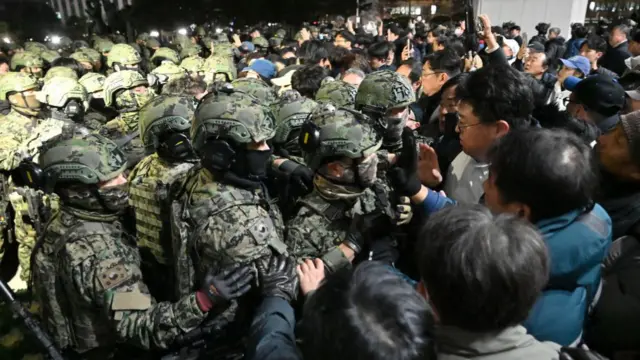
    Soldiers try to enter the National Assembly building in Seoul on December 4 2024

    On 3 December 2024, Yoon shocked his nation by declaring martial law on live television.

    Shortly after, he mobilised troops and police to seal off the National Assembly compound to prevent lawmakers from blocking his decree, and even ordered the arrests of the National Assembly speaker and then-leaders of the main political parties.

    He said he wanted to impose military rule to protect the country from "anti-state" forces that sympathised with North Korea, but it soon became clear Yoon was spurred by his own political troubles.

    He rolled back the attempt within hours, after lawmakers voted to overturn it.

    What followed were months of protests, Yoon’s impeachment, a string of indictments against him and other political leaders and a yet more polarised nation.

  4. 'Martial law was wholly justified' - pro Yoon supporter outside courtpublished at 04:58 GMT 19 February

    Leehyun Choi
    Reporting from Seoul

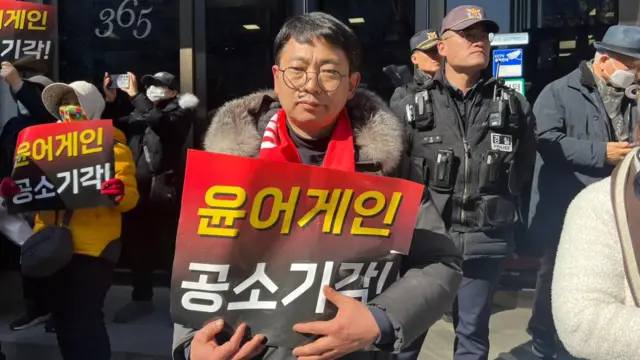
    A man holding a sign with Korean words and looking into the cameraImage source, BBC/Leehyun Choi

    Lee Ki-ju, 55, drove five hours from the port city of Ulsan to Seoul to show his support for Yoon today.

    "I came here to see the court drop the charges against our president. The future of our country and the survival of its liberal democratic structure depends on this verdict," Lee told the BBC.

    "He can’t be found guilty, because martial law was wholly justified."

  5. 'I want Yoon to get the death sentence - he has no remorse'published at 04:47 GMT 19 February

    Hosu Lee
    Reporting from Seoul

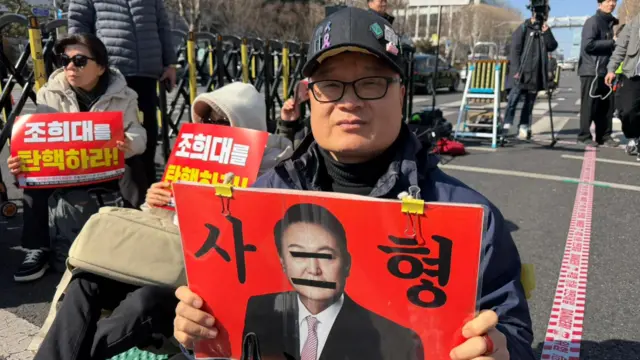
    Park holding a sign with Yoon's face and the words "execute"Image source, BBC/Hosu Lee
    Image caption,

    Park holding a sign with Yoon's face and the words "execute"

    "I want Yoon to get the death sentence. He has no remorse. I firmly do not believe he will walk away innocent," says Park Han-gyu, 55, from an anti-Yoon rally near the court.

    "If he is sentenced to death it will show that this country will never again stand for a self-coup, martial law, and insurrection like this."

  6. Police bus cordons and 1,000 officers deployed outside courtpublished at 04:40 GMT 19 February

    Leehyun Choi
    Reporting from Seoul

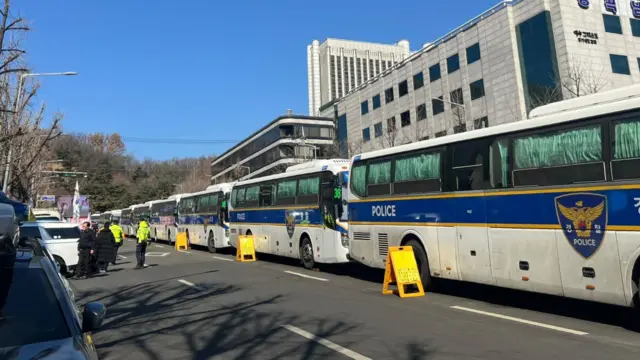
    Outside the Seoul Central District Court, dozens of police buses have formed a security cordon to restrict public access. Local media has reported that around 1,000 officers have been mobilised for security operations today.

    A line of police buses parked along a road outside a South Korea court where Yoon Suk Yeol will receive his verdictImage source, Leehyun Choi/BBC
    Image caption,

    Police buses form a cordon outside the South Korea court where Yoon will receive his verdict shortly

    The atmosphere is mostly calm – though there have been small scuffles between Yoon’s supporters and critics who have gathered here.

    Yoon’s supporters are demanding that the court to “dismiss the charges” today.

    Meanwhile, anti-Yoon protesters are hoisting banners saying “death sentence to Yoon the insurrection leader”.

    Supporters of South Korea's impeached former president Yoon hold banners outside the courtImage source, Leehyun Choi/BBC
    Image caption,

    Supporters of South Korea's impeached former president Yoon hold banners outside the court

  7. Hundreds of Yoon supporters gather outside courtpublished at 04:31 GMT 19 February

    Jake Kwon
    Seoul correspondent

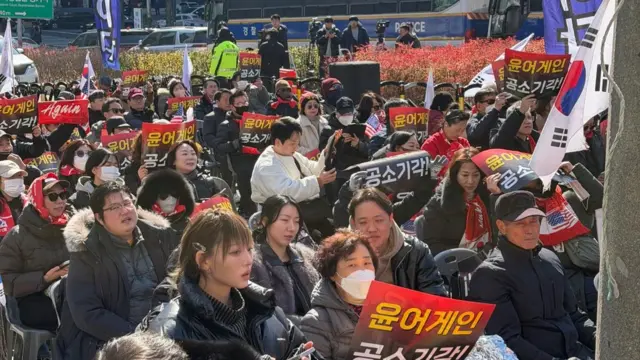
    A crowd holding pro-Yoon banners sitting down on a road near the courtImage source, BBC/Jake Kwon

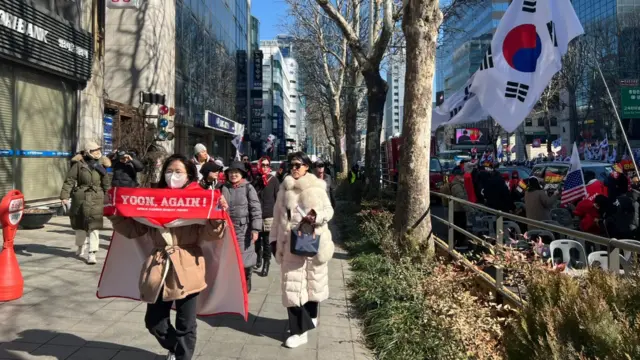
    Hundreds of Yoon's supporters have gathered here outside the courthouse. This is a much larger crowd than his other verdict last month.

    Most signs say: "Yoon again, dismiss charges" or "There was no insurrection".

    Another sign reads, "Martial law was justified".

    Lots of loudspeakers from both sides are blaring.

  8. A huge moment in South Koreapublished at 04:23 GMT 19 February

    Jake Kwon
    Seoul correspondent

    Today's verdict is a huge moment in South Korea, which has experienced an unprecedented year or so since Yoon Suk Yeol's short-lived martial law order in December 2024.

    Although he has been impeached and jailed, Yoon still faces more trials. Today's is the most significant because the charge - leading an insurrection, or overthrowing the authority of the state - is the most serious of them all.

    Prosecutors have asked for the death penalty. They argued that a lesser sentence may not send a strong enough message to those who may wish to attempt something similar - impose military rule.

    Yoon will be in the same courtroom where another leader, Chun Doo-hwan, was sentenced to death about 30 years ago.

    Chun, who seized power in a military coup in 1980 and ruled as a dictator through much of the 1980s, was pardoned after serving just two years in prison.

    Even if Yoon gets the death sentence, it will, in effect, be a life sentence because South Korea no longer carries out executions.

  9. Yoon is already serving jail time for abuse of powerpublished at 04:15 GMT 19 February

    Close up of former South Korean president Yoon Suk YeolImage source, epa

    In January, Yoon was jailed for five years for obstructing his own arrest and falsifying documents.

    In the first of several trials in relation to his martial law bid, he was convicted of using presidential bodyguards to prevent his arrest; failing to consult his entire cabinet before declaring martial law; as well as drafting and then destroying a falsified document claiming the martial law bid had been endorsed by the prime minister and defence minister.

    It took some 3,000 police officers and more than two attempts to take Yoon into custody in January 2025.

    A large group of security officers had formed a human wall inside his residence to block the arrest, a move that a special prosecutor investigating the charge said was unprecedented.

    Yoon, however, argued that the Corruption Investigation Office that was attempting to arrest him lacked the jurisdiction to investigate insurrection charges.

    Return to the latest post
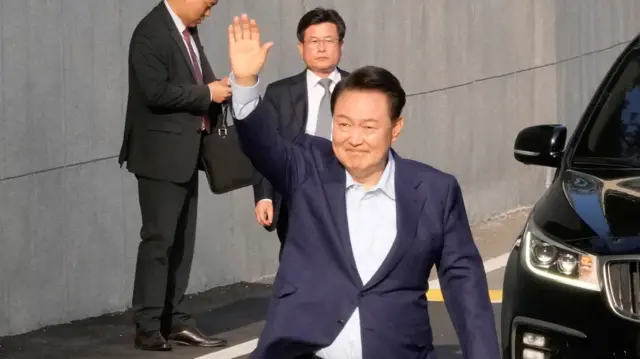
  10. Who is Yoon Suk Yeol?published at 04:02 GMT 19 February

    Former South Korean president Yoon Suk Yeol waving with security and a black car in the backgroundImage source, EPA

    Yoon was a relative newcomer to politics when he won the presidency in 2022.

    Formerly the country’s prosecutor general, he had risen to national prominence for prosecuting the corruption case against disgraced former President Park Geun-hye in 2016.

    In 2022, the political novice narrowly beat his liberal opponent Lee Jae-myung by less than 1% of the vote, the closest result the country had seen since direct elections started to be held in 1987.

    Some analysts say people had high hopes for Yoon when he was elected.

    He had some success in foreign policy, notably improving his country's historically fraught relationship with Japan.

    But he was also mired in scandal, much of it centered on his wife Kim Keon Hee, who was recently convicted of bribery.

    Read more about the beleagured former president here.

  11. How did we get here?published at 04:01 GMT 19 February

    Jake Kwon
    Seoul correspondent

    Yoon is accused of leading an insurrection in December 2024.

    That Tuesday night he declared that the country was under military rule and outlawed all political activity.

    He is accused of sending troops to parliament to arrest lawmakers who were gathering to vote down his order. He denies this, saying the troops were there to maintain order, and the martial law was a symbolic gesture to bring attention to the wrongdoings of the opposition.

    Martial law was short-lived, lasting only six hours. It ended when lawmakers voted it down. Thousands of citizens had already come out to blockade the troops and protest against the shock move.

    It has been a long 443 days since that dramatic night. Yoon was arrested and impeached, while the fallout battered his party. The result showed in the election, when South Koreans emphatically voted for the opposition - and elected a new president.

    While Yoon still has his supporters, so many people have been waiting for today's verdict - they want closure so they can draw a line under all the political turmoil of the recent past.

  12. South Korea’s impeached president faces insurrection verdictpublished at 04:00 GMT 19 February

    Ayeshea Perera
    Live editor

    Former South Korean president Yoon Suk Yeol seated in court with a blue backgroundImage source, Getty Images

    A court in Seoul will rule on ex-president Yoon Suk Yeol’s insurrection charges this afternoon, in a verdict that will be broadcast live across South Korea. Yoon, 65, has been accused of trying to subvert the constitution with his martial law attempt in December 2024.

    Prosecutors have sought the death penalty for Yoon, arguing that he is “unrepentant”. Though short lived, Yoon’s martial law attempt threw the country into political crisis and left it hamstrung by a leadership vacuum for months.

    If convicted, he faces either the death penalty or life imprisonment.The hearing starts at 15:00 local time (06:00 GMT) and we expect the verdict to come soon after.

    Stay with us as we bring you the latest updates.