Summary

  1. China congratulates Dhaka on 'smooth and successful' electionpublished at 07:02 GMT 13 February

    Padmaja Venkataraman
    BBC Monitoring

    The Chinese embassy in Bangladesh has congratulated Dhaka on what it described as a “smooth and successful” parliamentary election and the BNP for taking the lead.

    In a Facebook post on Friday, the embassy said it looks forward to working together with the new government and “writing new chapters of China-Bangladesh relations”.

    Chinese state media's coverage of the vote count has widely cited local media projections of a BNP victory.

    Beijing has been strengthening ties with Dhaka since the interim government took over in August 2024, boosting investments to bring in $800 million. The two countries have also stepped up cooperation in the defence and medical sectors.
  2. BNP on track to landslide winpublished at 06:54 GMT 13 February

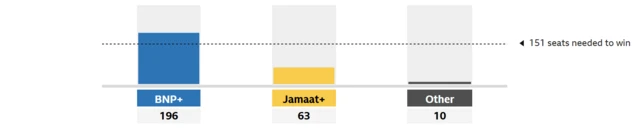
    The BNP is on track to secure at least a two-thirds majority of parliamentary seats. Official results show it has won 196 seats, just five seats away from a two-thirds majority.

    Jamaat-e-Islami is in second place with 63 seats.

    Bangladesh election resultsImage source, BBC Bangla
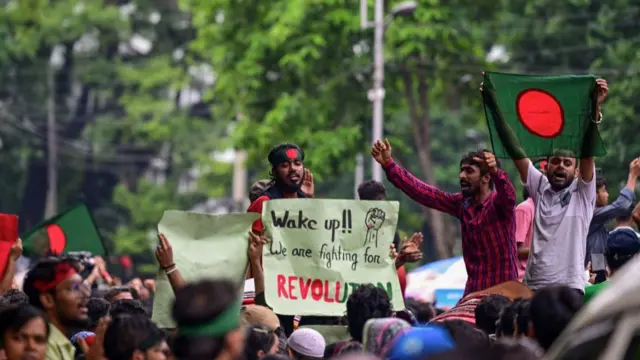
  3. Are Bangladesh's youth turning against India?published at 06:27 GMT 13 February

    People holding up the Bangladesh flag and protest bannersImage source, AFP via Getty Images

    At Dhaka University, the words "Dhaka, not Delhi" are splashed across the walls: a slogan that encapsulates a core issue for many young Bangladeshis casting their vote today.

    Delhi's perceived role in enabling Bangladesh's democratic erosion has fuelled a sharp rise in anti-Indian sentiment.

    "The young generation feels India has been intervening in our country for many years," Mosharraf Hossain, a 24-year-old sociology student, told the BBC.

    Sheikh Hasina's flight to India after the 2024 violence remains an especially sore point.

    Delhi is broadening its outreach to the contesting political parties in Bangladesh, but observers say these efforts have done little to arrest the broader slide.

    India-Bangladesh relations, once touted as a model of neighbourhood diplomacy, are now at their lowest ebb in decades.

    Read this story about the rise of anti-Indian sentiments in Bangladesh.

  4. Scenes from Dhaka as BNP wins electionpublished at 06:16 GMT 13 February

    Here are scenes from Dhaka as official results confirm a victory by the Bangladesh Nationalist Party.

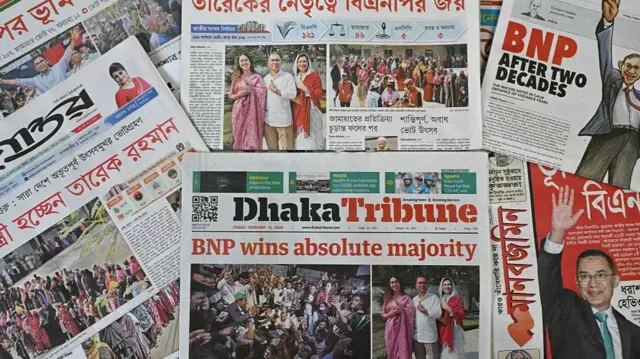
    A stack of newspapers in Banglasdesh with the BNP's win as headlineImage source, Getty Images
    Image caption,

    Newspapers headline on the BNP's looming victory

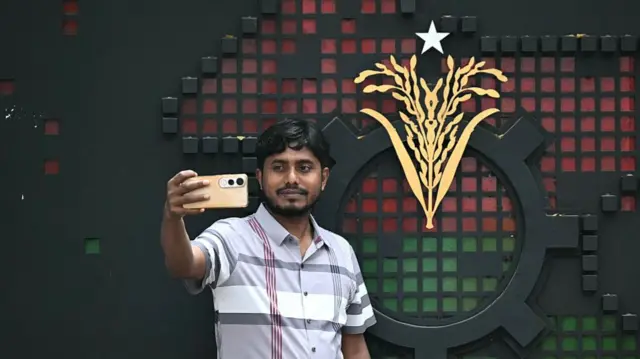
    Man takes selfie outside office of the BNP in DhakaImage source, Getty Images
    Image caption,

    A man takes a selfie outside office of the BNP in Dhaka

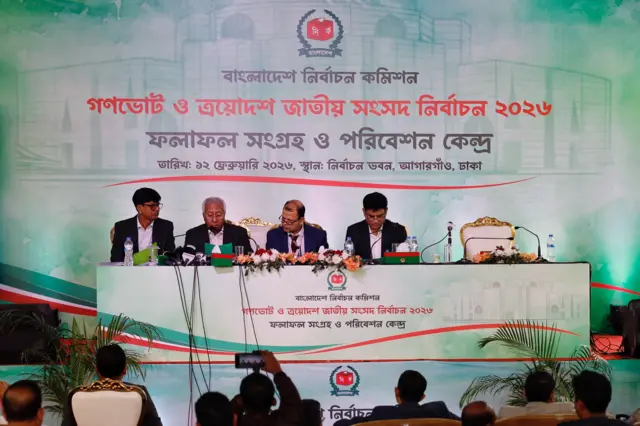
    A row of speakers behind a podium announcing election resultsImage source, Reuters
    Image caption,

    The Election Commission has been releasing official results

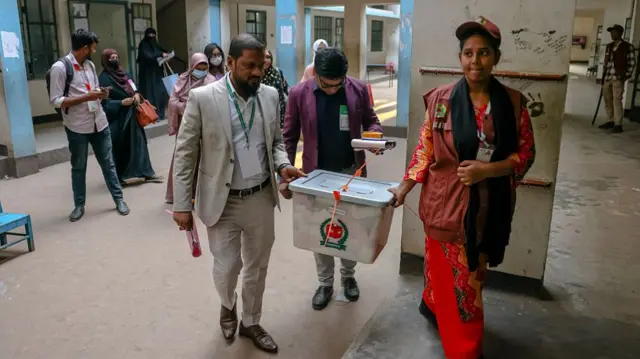
    Two people holding a box full of ballotsImage source, NurPhoto via Getty Images
    Image caption,

    Election workers were deployed to more than 40,000 polling stations across the country

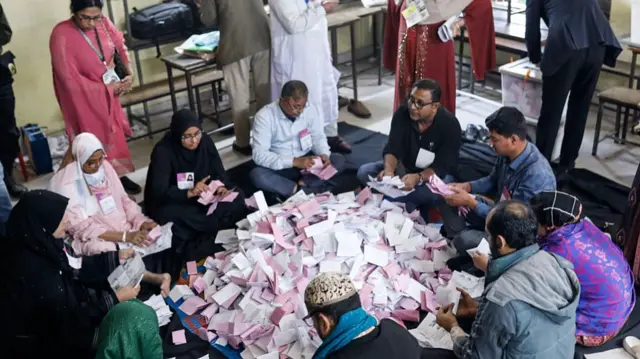
    People sitting in a circle on the ground with a pile of pink ballot paper in the middleImage source, NurPhoto via Getty Images
    Image caption,

    Vote counting began at polling stations on Thursday once polling ended at 16:30 local time

  5. Voter turnout for the election was 59.44% - Election Commissionpublished at 06:07 GMT 13 February

    The Election Commission has just announced that close to 60% of voters turned up for yesterday's exercise.

    Stay with us as we keep you updated on the counting and other official announcements from Dhaka.

  6. Bangladesh's economy needs to be a high priority for the BNPpublished at 06:00 GMT 13 February

    Suranjana Tewari
    Asia Business Correspondent

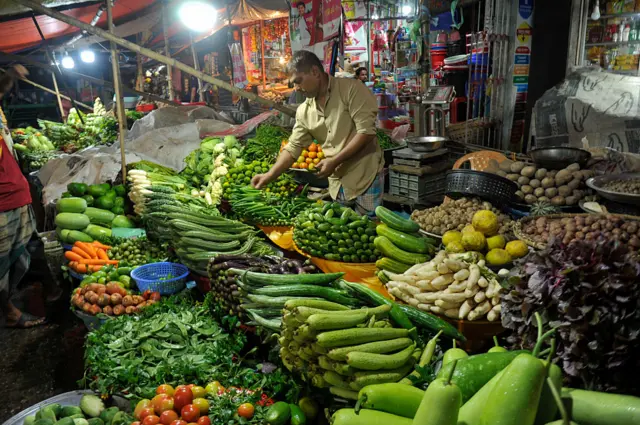
    A local vegetable market in SylhetImage source, Getty Images

    The BNP will now face the task of steering economic recovery.

    Before the pandemic, Bangladesh was one of the fastest growing countries in Asia, with forecasts suggesting it would overtake several larger emerging neighbours within a few years.

    But disruptions to the country's vital export industries because of Covid-19 pulled back growth.

    The political upheaval that followed the ouster of former Prime Minister Sheikh Hasina in August 2024 further dented business confidence. Instability weighed on business and slowed investment.

    Bangladesh's new leadership will take the helm at a time of stubborn inflation and a prolonged slowdown.

    Inflation stands at 8.5% - the highest in South Asia - pushing up the cost of living and so prices have been a central issue for voters.

    US tariffs have also hit Bangladesh's crucial garment industry - which accounts for roughly 80% of exports.

    Trump first imposed a 37% tariff on Bangladeshi imports last year, later easing it in stages before agreeing to a reduced 19% just this week under a new trade deal.

  7. BNP claims it has secured a two-third majoritypublished at 05:52 GMT 13 February

    BNP's secretary-general Mirza Fakhrul Islam Alamgir claims his party has secured a two-third majority in the elections.

    He also told reporters at a party press conference that Sheikh Hasina's party - the now banned Awami League - is "responsible for the rise of Jamaat-e-Islami" in Bangladeshi politics.

    A quick recap: Jamaat-e-Islami is the largest Islamist party in Bangladesh, and the BNP's ally-turned-rival. It was previously barred from elections but with Awami League banned this time around, has become the only large alternative on the ballot.

    "Whenever democracy is suppressed, when it is obstructed, other extremist forces start to rise. That is what happened. The rise of Jamaat-e-Islami today is because of the Awami League," Mirza Fakhrul says.

  8. Election commission lauds 'neutral and credible' electionpublished at 05:37 GMT 13 February

    Bangladesh's election commission has called the election a "neutral and credible" one.

    "I am feeling good. We promised to present an election in a festive atmosphere. We promised to present a completely neutral and credible election to the nation and we do believe we have achieved it. Everyone is recognising this," Chief Election Commissioner Nasir Uddin told reporters.

    Uddin also thanked the voters, political leaders, and journalists. "With the overall cooperation of all, we have been able to present an acceptable election," he says.

    However supporters of the former ruling party, Sheikh Hasina's Awami League, had called for a boycott of the vote as the party has been banned from contesting.

  9. Why Jamaat delivered its strongest showing yetpublished at 05:26 GMT 13 February

    Soutik Biswas
    India Correspondent

    Bangladesh Jamaat-e-Islami’s surge this election reflects a mix of structure, strategy and sentiment.

    With the Awami League barred, Jamaat was effectively the only large alternative on the ballot besides the BNP and its allies.

    For voters unwilling to back BNP, Jamaat became the default option - translating into its biggest-ever seat share.

    Its previous high-water mark was 18 seats in the 1991 election with some 6% of the vote. This election represents a significant jump - 58 seats already.

    The party also ran an early, savvy social media campaign, amplified by what critics call "misinformation".

    Religion featured prominently in its messaging. In several constituencies, rebel BNP candidates split the anti-Jamaat vote, further boosting its tally.

    As Shafqat Munir of Bangladesh Institute of Peace and Security Studies (BIPSS), a think tank, puts it: “Use of social media, use of religion and being the second largest party on the ballot are the three main reasons for the party's surge.”

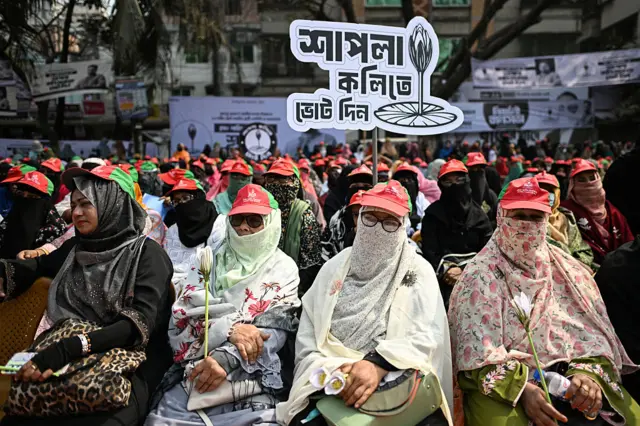
    Jamaat-e-Islami party-led alliance supporters attend a rally ahead of Bangladesh's general election in Dhaka on February 8, 2026. (Photo by Sajjad HUSSAIN / AFP via Getty Images)Image source, AFP
    Return to the latest post
  10. A dramatic turnaround for a man who spent 17 years in exilepublished at 05:16 GMT 13 February

    Tarique RahmanImage source, Getty Images

    This result is a dramatic turnaround for the BNP and its leader Tarique Rahman, who is now on track to become Bangladesh's next prime minister.

    In the previous election just two years ago, Rahman was in self-imposed exile in London, while many of the BNP members and supporters were thrown behind bars under Sheikh Hasina's administration.

    Rahman's political career has been mired in controversy. He was arrested for corruption in 2007, and left for London the next year. He was sentenced to life while in absentia over an earlier attack on a Hasina rally, which Rahman has dismissed as politically motivated. The ousting of Hasina in 2024 saw several of his convictions and charges overturned, enabling his return to Bangladesh.

    His father Ziaur Rahman, was one of the leading figures in Bangladesh's fight for independence. He served as the country's president until he was assasinated in 1981.

    Tarique Rahman's mother Khaleda Zia was a three-time prime minister, although she was also arrested several times and imprisoned during Hasina's Awami League government.

    Zia had intended to contest this election but died in December, a few days after Rahman returned home from London.

  11. Pakistan 'looks forward to working closely with new leadership'published at 05:09 GMT 13 February

    Anbarasan Ethirajan
    Global Affairs Reporter

    Pakistan's PM Shehbaz Sharif has also congratulated Tarique Rahman on "leading the BNP to a resounding victory" in the elections.

    "I look forward to working closely with the new Bangladesh leadership to further strengthen our historic, brotherly multifaceted bilateral relations and advance our shared goals of peace, stability, and development in South Asia and beyond," he wrote on X.

    Bangladesh and Pakistan forged close ties after Sheikh Hasina’s fall. Late last month, a commercial airliner flew from Dhaka to the Pakistani city of Karachi, the first direct flight between the two countries in 14 years.

    Months earlier, Pakistan's foreign minister visited Dhaka for the first time in 13 years. Several senior Bangladeshi and Pakistani military officials have also made bilateral visits discussing security cooperation, while trade rose by 27% in 2024-25.

    It all showed the dramatic turnaround of Dhaka’s relationship with its one-time foe Pakistan. Relations between Dhaka and Islamabad had been frosty during Hasina's 15-year rule.

  12. BNP secures 151 seats to form governmentpublished at 04:57 GMT 13 February
    Breaking

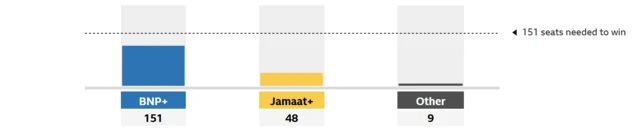
    The BNP has now secured 151 out of the 300 seats – the number needed for it to form the next government.

    Jamaat-e-Islami is in second place with 46 seats.

    Bangladesh election resultsImage source, BBC Bangla
  13. Main rival Jamaat questions election resultspublished at 04:50 GMT 13 February

    The BNP's main rival Jamaat-e-Islami has again raised questions about the vote-counting process.

    "We are not satisfied with the process surrounding the election results," the Islamist party said in a statement today, according to AFP news.

    It also urged everyone to "remain patient".

    The BNP has claimed victory in the country's historic election with results showing it is headed for a majority.

  14. Dhaka papers greet 'landslide' winpublished at 04:41 GMT 13 February

    Soutik Biswas
    India Correspondent

    daily star
    Image caption,

    daily star

    Dhaka’s front pages are buoyant after the country's historic election.

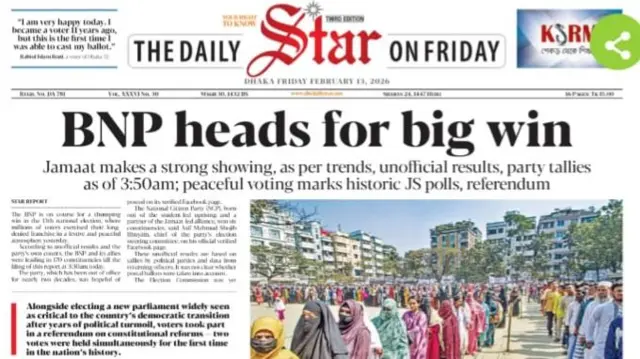
    “BNP heads for big win,” declares The Daily Star, saying the party is on course for a “thumping win” in the 13th national election, marked by festive queues and millions casting long-denied ballots. New Age calls it a “landslide victory.”

    The respected Prothom Alo led with: “BNP on the path to certain victory.”

    But amid the euphoria, a note of caution.

    Writing in The Daily Star, commentator Altaf Parvez warned, external that the incoming government’s first test will be restoring law and order.

    Reform, he argued, will falter unless the mob violence of the past 18 months is curbed.

    Women and minorities have borne the brunt, social cohesion has frayed, and signs of armed extremism are surfacing, Parvez writes.

  15. Official results: BNP secures 130 seatspublished at 04:32 GMT 13 February

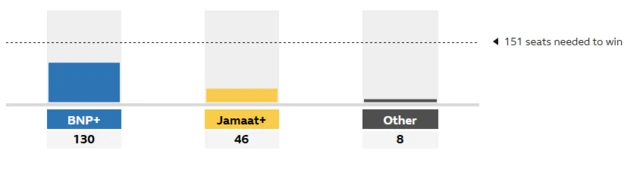
    Official results now show that the BNP has secured 130 seats which is just 21 seats away from the majority needed to form Bangladesh's next government.

    Jamaat-e-Islami is in second place with 46 seats.

    Graphic showing BNP with 130 seats and Jamaat with 46
  16. Bangladesh's 'relationship with any country will be based on mutual respect and interest' - BNP leaderpublished at 04:18 GMT 13 February

    Yogita Limaye
    Reporting from Dhaka

    When asked what relationship the new Bangladeshi government wants with India, Chowdhury declined to address a specific country.

    Instead, he says, "Our relationship with any country will always be based on mutual respect, mutual interest, and one of non-interference and strategic autonomy."

    Many Bangladeshis believe India had a role in enabling Sheikh Hasina’s authoritarian rule in their country. Hasina is now in exile in India, which has further complicated the relationship between the South Asian neighbours, with tensions heightening in recent months.

    "Bangladesh doesn't have any country centric policy. That has been a problem for the previous government," Chowdhury says.

  17. What next for Bangladesh-India relations?published at 04:08 GMT 13 February

    Anbarasan Ethirajan
    Global Affairs Reporter

    Bangladesh and Pakistan have been re-establishing relations since the fall of Sheikh Hasina in 2024.

    It is a relationship that Delhi - which sits between the two nations - will be watching closely.

    It considers Pakistan its arch-rival, while ties with Dhaka have been frosty since the Bangladeshi uprising drove former Prime Minister Sheikh Hasina to flee to India, where she remains.

    Historically, the Bangladesh Nationalist Party has maintained closer ties with Pakistan than Hasina's Awami League, and is aware they can’t ignore its key trading partner and the regional power.

    The BNP has said they want friendly and constructive relations with all neighbouring countries. But the fact is that they will have to walk a tight diplomatic rope to balance ties with Delhi and Islamabad.

  18. 'Stability and peace is what Bangladesh needs right now', says BNP leaderpublished at 03:57 GMT 13 February

    Yogita Limaye
    Reporting from Dhaka

    The senior BNP leader Amir Khasru Mahmud Chowdhury, who earlier told me the party was confident of forming the next government, also said its top priority will be to put the country’s institutions back in order.

    "All the democratic institutions and financial institutions which have been destroyed over the last decade need to be put back in order," he says.

    "Stability and peace is the first thing Bangladesh needs right now... We are not taking this as a victory, but as trust put by the people in the party to serve the country."

  19. India will 'continue to stand in support of a democratic Bangladesh' - PM Modipublished at 03:53 GMT 13 February

    Congratulations are coming in from neighbouring India, with Prime Minister Narendra Modi saying "India will continue to stand in support of a democratic, progressive and inclusive Bangladesh".

    He also said "[the BNP's] victory shows the trust of the people of Bangladesh" in party leader Tarique Rahman's leadership.

    "I look forward to working with you to strengthen our multifaceted relations and advance our common development goals," Modi wrote in a post on X.

  20. BNP confident of forming new government, party leader tells BBCpublished at 03:38 GMT 13 February
    Breaking

    Yogita Limaye
    Reporting from Dhaka

    A top BNP leader has just told the BBC they are confident of forming the government.

    "We have got the majority and when the full result is out we would have done even better," says Amir Khasru Mahmud Chowdhury.

    "Tarique Rahman is our leader, our chairman and absolutely will be the prime minister of Bangladesh when the BNP forms the government”, he added.

    "We are looking at February 14,15,16 for the MPs to take their oaths and form the government," he says.