Summary

  1. UN secretary general welcomes ceasefire in Middle Eastpublished at 05:19 BST
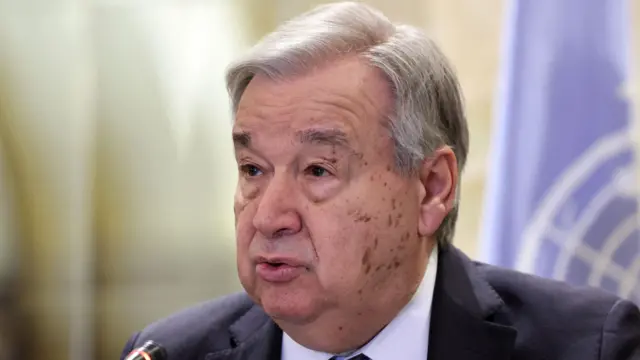
    Secretary-General of the United Nations Antonio Guterres speaks during a press conference in Beirut, Lebanon, 14 March 2026.Image source, EPA
    Image caption,

    António Guterres pictured in Beirut last month

    UN Secretary General António Guterres "welcomes the announcement of a two-week ceasefire by the United States and Iran", his spokesperson has said.

    "He calls on all the parties to the current conflict in the Middle East to comply with their obligations under international law and to abide by the terms of the ceasefire in order to pave the way toward a lasting and comprehensive peace in the region," the statement read.

    Guterres expressed "sincere appreciation for the efforts of Pakistan and other countries in facilitating the ceasefire".


  2. Analysis

    The war of narrativespublished at 04:58 BST

    Behrang Tajdin
    Economics correspondent, BBC Persian

    Regardless of what happened on the ground in the past 39 days, the most important thing for Iran is how this ceasefire and any possible future deal is framed.

    As soon as the ceasefire was announced, the Iranian side tried to paint it as a victory, as they say the United States and Israel failed to defeat them completely.

    For the Islamic Republic, the state media and their allies in the "axis of resistance" that’s a win.

    So while Donald Trump has accepted Iran’s 10-point plan as the basis for further negotiations, the Supreme National Security Council says the Americans have agreed to all of their demands, without divulging what Iran has proposed to do in return, apart from the two-week reopening of the Strait of Hormuz.

    In other words, for the two sides to reach an agreement, both Trump and Iran need to reach a point where they can claim this whole process as a victory.

    That is probably more important than any details of a possible peace agreement.

  3. Death toll in Lebanon surpasses 1,500published at 04:31 BST

    The death toll in Lebanon during more than a month of war between Israel and the Iran-backed militant group Hezbollah reached 1,530 people on Tuesday, Agence-France Presse reported.

    The figure, which the outlet said was issued by Lebanon's health ministry, included 102 women and 130 children.

    It added that a further 4,812 people have been wounded in the conflict.

    In reference to the recently announced ceasefire, Israel said: "The two-weeks ceasefire does not include Lebanon."

    Pakistan and Iran said the ceasefire did include Lebanon.

  4. 'Total and complete victory,' says Trumppublished at 04:10 BST

    U.S. President Donald Trump attends a press conference in the James S. Brady Press Briefing Room at the White House in Washington, D.C., U.S., April 6, 2026Image source, Reuters

    Donald Trump says there is no question the US had won a "total and complete victory" after agreeing a two-week ceasefire deal with Iran.

    In an interview with Agence France Presse after his announcement, he said that Iran's enriched uranium would be "perfectly taken care of" under the deal.

    "Or I wouldn't have settled," Trump said, without giving any specifics about what would happen to the uranium.

    When asked if he would go back to his original threats to destroy to Iran's civilian power plants and bridges if the deal fell apart all he would say was: "You're going to have to see."

    Trump, who is due to travel to China next month to meet his Chinese counterpart Xi Jinping, said: "I hear yes" when asked if Beijing was involved in getting its key ally Tehran to negotiate on a truce.

  5. Israel supports ceasefire, but it 'does not include Lebanon'published at 03:53 BST
    Breaking

    Daniel De Simone
    Reporting from Jerusalem

    Israel has just issued an official statement on the ceasefire with Iran. Here it is in full:

    Israel supports President Trump's decision to suspend strikes against Iran for two weeks subject to Iran immediately opening the straits and stopping all attacks on the US, Israel and countries in the region.

    Israel also supports the US effort to ensure that Iran no longer poses a nuclear, missile and terror threat to America, Israel, Iran's Arab neighbors and the world.

    The United States has told Israel that it is committed to achieving these goals, shares by the US, Israel and Israel's regional allies, in the upcoming negotiations.

    The two-weeks ceasefire does not include Lebanon.

    • For context: Earlier, Pakistan and Iran said the ceasefire did include Lebanon.
  6. Big moment for oil but fall in fuel prices will take timepublished at 03:42 BST

    Osmond Chia
    Business reporter, in Singapore

    A petrol station attendant helps a customer top up his vehicle while keeping an eye on the pricing meterImage source, Getty Images

    Oil prices have fallen sharply since President Trump's ceasefire announcement, now trading well under $100 a barrel.

    Traders had been watching this moment "extremely closely" for a "concrete commitment" to reopen the Strait of Hormuz, Ye Lin from research firm Rystad Energy told the BBC.

    She said much of the recent oil price surge, driven by risks to Gulf shipping, "collapsed almost instantly" after the announcement.

    "Every headline over the next 48 hours about whether the first tanker has safely transited the strait will move prices," Ye added.

    But it will take time for drivers to feel the relief at the pump.

    Not all countries adjust petrol prices daily, Ye noted, so how quickly oil prices fall will largely depend on how much Gulf oil supply is released as shipping resumes.

  7. White House claims victorypublished at 03:25 BST

    White House Press Secretary Karoline Leavitt speaks to reporters in the briefing room of the White House.Image source, EPA

    The White House has claimed victory after the ceasefire announcement with Iran, even as Israel has not yet made a formal response.

    "This is a victory for the United States that President Trump and our incredible military made happen," White House Press Secretary Karoline Leavitt said in a social media post, adding that he "got the Strait of Hormuz reopened".

    Leavitt notes that the president said from the start that "Operation Epic Fury" would be a four to six week operation, adding that the US "achieved and exceeded our core military objectives in 38 days".

    US Defence Secretary Pete Hegseth and General Dan Caine, the chairman of the Joint Chiefs of Staff, are expected to speak Wednesday morning, Leavitt said.

    "The success of our military created maximum leverage, allowing President Trump and the team to engage in tough negotiations that have now created an opening for a diplomatic solution and long-term peace," she wrote.

  8. Strikes continue despite ceasefirepublished at 03:09 BST

    Strikes have been reported in a number of countries since the ceasefire was announced.

    In Iran:

    US media outlets are reporting that Israel is still attacking Iran as of Wednesday morning, citing an Israeli official.

    It comes despite an apparent White House confirmation to Agence France-Presse (AFP) that Israel had also agreed to the ceasefire deal.

    There has been no official response yet from Israel to the ceasefire announcement by the US and Iran.

    In Israel:

    Strikes have been reported in Jerusalem, with BBC journalists in the city saying they have heard and felt multiple explosions. Alerts have gone out to residents.

    In Bahrain:

    The Ministry of Interior says "the siren has been sounded", urging residents to seek shelter.

    In Qatar:

    Missiles headed for the country were intercepted, the Qatari Ministry of Defense wrote on social media.

    In the UAE:

    The United Arab Emirates' Ministry of Defence says in a statement the country is "currently dealing with missile attacks and incoming drones from Iran".

    In Saudi Arabia:

    Saudi civil defence officials have issued at least two warnings in the last couple of hours, with an all-clear signal given on the first alert, according to social media posts by the Saudi Directorate of Civil Defence and a BBC journalist in Riyadh.

  9. Analysis

    Still no word from Israel on ceasefirepublished at 02:41 BST

    Daniel De Simone
    Reporting from Jerusalem

    There has been no official response yet from Israel to the ceasefire announcement by the US and Iran.

    It is unclear how involved Israeli Prime Minister Benjamin Netanyahu was in the decision-making by Donald Trump.

    Pakistan's prime minister Shehbaz Sharif, who has been negotiating between the US and Iran, has said the ceasefire includes Lebanon, where Israel has a ground force.

    Israel’s leadership has been stating they will not leave Lebanon until the threat from Hezbollah has been removed.

    There is no indication from Israel that it has agreed to halt its operations in Lebanon, or elsewhere.

    It is unlikely that Netanyahu will be able to claim victory in the same way the US and Iran have.

    In a speech announcing the war on 28 February, he said: "The goal of the operation is to put an end to the threat from the Ayatollah regime in Iran" and that "this operation will continue as long as necessary".

    As things stand, the Iranian military is still able to pose a threat and the government is very much in place.

    Even as I write, there have been missile alerts and the sound of explosions here in Jerusalem, with the Israel Defense Forces saying multiple missiles were fired from Iran.

    Netanyahu seems to have overestimated the ability of Israel and US to defeat the Iranian military and bring about a change of system.

    An end to the war, if it is based on the "10-point proposal from Iran" that Trump referenced today, will be widely seen as a strategic success for Tehran.

    It is possible that far-right members of Netanyahu's cabinet will reject any ceasefire agreement or end to the war, particularly if it does include Lebanon, creating a political challenge for him in an election year.

    Return to the latest post
  10. Analysis

    Mixed reactions in Iran after long nightpublished at 02:12 BST

    Khashayar Joneidi
    BBC Persian correspondent in Washington

    It's been a long night for Iranians.

    Many people were anticipating heavy US bombardment of power plants, roads and bridges, as Donald Trump had threatened.

    They were all waiting for the deadline, which was about 03:00 in Tehran.

    The ceasefire announcement came around 01:00 in Tehran, but many people were still awake waiting for the attacks.

    There have been mixed reactions.

    In the past few days people were buying groceries, food and candles and storing water because they were afraid that there would be no electricity.

    Now they have now some sort of relief that power plants are not going to be attacked.

    At the same time, many of the people who were against the regime believe that this war, amid all of its horror and its damages, would result in a regime change.

    That hasn't happened.

    Now they are going to be dealing with a regime who has been injured in this war, and the economy has collapsed.

    The regime is more angry, and they have to face it again.

  11. Analysis

    Negotiations are going to be very difficultpublished at 02:03 BST

    Khashayar Joneidi
    BBC Persian correspondent in Washington

    There's a deficit of trust between the US and Iran with another round of talks set to begin.

    Iran and the US have negotiated twice in the past year. Both times in the middle of negotiations a war has started.

    No matter how victorious Iran portrays themselves in state media, it is in a very weak position.

    Its army has been heavily battered, its economy is in shambles, and the regime has unfinished business with the opposition and the people.

    In the past few days, the government has started executing some of those people who were arrested during the protests in January

    The regime has to harden its grip on power inside the country. It's in a bad situation, but at the same time its demands are difficult for the Americans to address.

    The US says it has accepted the ceasefire under the condition that there will be free flow of traffic in the Strait of Hormuz.

    Iran is mentioning that it wants to have control over maritime traffic in the Strait of Hormuz because of its geographic location - that's its number one priority.

    There is going to be difficult negotiations over Iran's nuclear programme.

    Iranian state media are saying that the US has agreed to uranium enrichment in Iran.

    The US has said it wants no enrichment being done in Iran.

    It's going to be a very hard two weeks.

  12. Fire at Abu Dhabi gas-processing facilitypublished at 01:46 BST

    A fire has broken out at the Habshan gas-processing facility, the Abu Dhabi Media Office says.

    Authorities are dealing with the incident and more information will be provided soon, they add in the post on X.

  13. Oil prices continue to fallpublished at 01:40 BST

    Osmond Chia
    Business reporter

    Oil prices have continued to tumble over the past hour after US President Donald Trump announced a conditional two-week ceasefire.

    The price of global benchmark Brent crude fell about 13.6% to $94.50 (£70.58) a barrel.

    US-traded oil has dropped by around 14.3% to $96.80.

    Both benchmarks were trading well above $100 a barrel on Tuesday.

    The conditional ceasefire agreement was likely a surprise to traders, explaining the sharp fall in oil prices, said Ichiro Kutani from Japan's Institute of Energy Economics.

    But prices are still unlikely to return to pre-war levels of around $70 a barrel due to the damage sustained in the region, he said.

    Markets also jumped in early trade in Asia. Japan's Nikkei 225 index gained by 4% while the ASX 200 in Australia rose by nearly 3%.

    Read more here

  14. Analysis

    Iran considers itself victorious because it survivedpublished at 01:34 BST

    Khashayar Joneidi
    BBC Persian correspondent in Washington

    The Iranian government and state media are portraying this as a big victory for the regime.

    The statement put out by the Supreme National Security Council of Iran (SNSCI) says that Iran has reached almost all of its objectives in this war, and that the enemy is facing a historic failure.

    Amid this statement and Iran posing as the victor, there is another point that is very important for the Iranian government - this war started with the killing of Ali Khamenei, the leader of the Islamic Republic and senior generals within the Islamic Revolutionary Guard Corps.

    This was an existential threat, an existential war for the regime.

    Therefore, they would consider themselves victorious because they survived this 30-plus days of war with the United States and Israel.

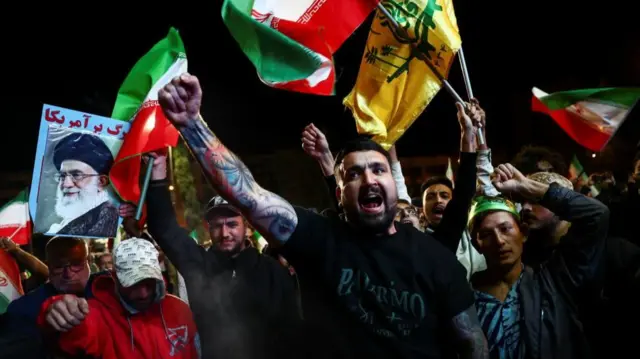
    People shout slogans as they gather after a two-week ceasefire in the Iran war was announcedImage source, Reuters
    Image caption,

    People in Tehran gathered to celebrate the two-week ceasefire deal

  15. Strikes reported in the UAE as Saudi Arabia advises residents to shelterpublished at 01:16 BST

    Though a ceasefire has been called, strikes on US Gulf allies may still be ongoing.

    The United Arab Emirates' Ministry of Defence said in a statement about 45 minutes ago that the country is "currently dealing with missile attacks and incoming drones from Iran".

    Air defence systems are intercepting the missiles, the statement says.

    Saudi Arabia says emergency alerts have been activated across the eastern region of the country, including in Riyadh.

    The alerts warn of "a potential danger", and residents are advised to shelter.

  16. Minutes before Trump's deadline Pakistan says ceasefire agreedpublished at 01:09 BST

    US President Donald Trump had set a deadline of 20:00 EDT (01:00 BST) to reach a ceasefire deal with Iran and threatened nationwide attacks should one not be reached.

    Just ten minutes before it was set to expire, Pakistan's Prime Minister Shehbaz Sharif said a ceasefire was "EFFECTIVE IMMEDIATELY".

  17. Pakistan PM praises 'wisdom and understanding' of US and Iranpublished at 01:03 BST

    Sharif continues: "Both parties have displayed remarkable wisdom and understanding and have remained constructively engaged in furthering the cause of peace and stability."

    "We earnestly hope, that the 'Islamabad Talks' succeed in achieving sustainable peace and wish to share more good news in coming days," he signs off.

  18. Ceasefire 'EFFECTIVE IMMEDIATELY' says Pakistanpublished at 01:01 BST
    Breaking

    Pakistan's Prime Minister Shehbaz Sharif, who has been mediating negotiations, says the ceasefire is effective immediately.

    "With the greatest humility, I am pleased to announce that the Islamic Republic of Iran and the United States of America, along with their allies, have agreed to an immediate ceasefire everywhere including Lebanon and elsewhere, EFFECTIVE IMMEDIATELY."

    He welcomes the move and invites the delegations to Islamabad on Friday, 10 April, "to further negotiate for a conclusive agreement to settle all disputes".

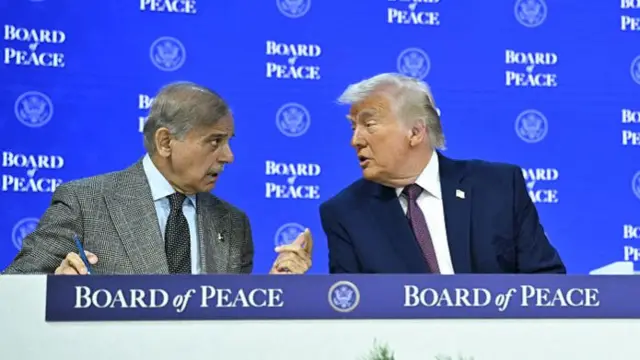
    Sharif and Trump seen speaking together during a Board of Peace meeting in Davos in JanuaryImage source, Getty Images
    Image caption,

    Sharif and Trump seen speaking together during a "Board of Peace" meeting in Davos in January

  19. More explosions heard in Jerusalempublished at 00:52 BST 8 April

    Daniel De Simone
    Reporting from Jerusalem

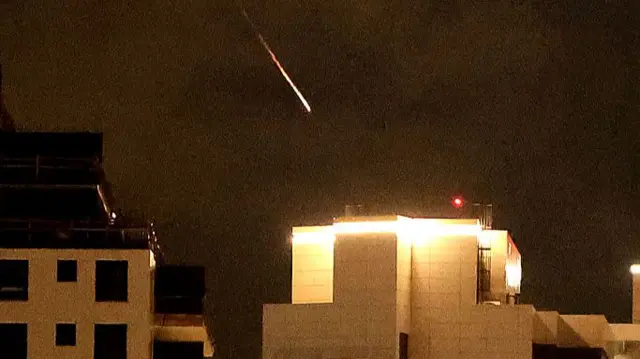
    Rockets over Netanya, Israel, after US President Donald Trump said he had agreed to postpone striking Iranian infrastructureImage source, Getty Images
    Image caption,

    Rockets over Netanya, Israel, after US President Donald Trump said he had agreed to postpone striking Iranian infrastructure

    Minutes after President’s Trump posted on social media, the Israeli military said missiles had been identified heading to Israel from Iran, with missile warning alerts sent to people’s mobile phones.

    Shortly afterwards, sirens sounded across Jerusalem.

    There were then two loud explosions, which could be felt where I am in the city.

    The alert then ended.

    Around 30 minutes later, the Israel Defense Forces (IDF) said further missiles had been identified being fired from Iran towards Israel. Booms were heard again in Jerusalem.

    And now, a few minutes after that, further loud booms can be heard in Jerusalem - the third time tonight.

  20. Iran says negotiations to be held in Pakistanpublished at 00:47 BST 8 April

    Ghoncheh Habibiazad
    Senior reporter, BBC Persian

    Iran's Supreme National Security Council (SNSC) has said in a statement following the announced conditional ceasefire that negotiations will be held in Pakistan’s capital Islamabad within a maximum period of 15 days for the details to be "finalised". The statement has said that the negotiations will be held so that "Iran's victory in the field would also be consolidated in political negotiations".

    The statement has gone beyond the 10-point plan that had been announced by state TV, and the statement has said that the US has agreed to:

    • Guarantee not to repeat its "aggression" against Iran
    • The continuation of Iran’s control over the Strait of Hormuz
    • Acceptance of [uranium] enrichment
    • Lifting of all primary and secondary sanctions
    • Termination of all resolutions of the [UN] Security Council and International Atomic Energy Agency
    • Payment of compensation to Iran
    • Withdrawal of US combat forces from the region
    • And the cessation of war on all fronts, including against the "Islamic resistance of Lebanon"