Summary

  • This live coverage has finished - follow this link for the latest updates

  • US Secretary of State Marco Rubio says America is not at war with Venezuela, a day after US strikes on the country

  • Venezuelan President Nicolás Maduro and his wife Cilia Flores, who were captured by the US, are set to appear in court on Monday, according to a spokesperson

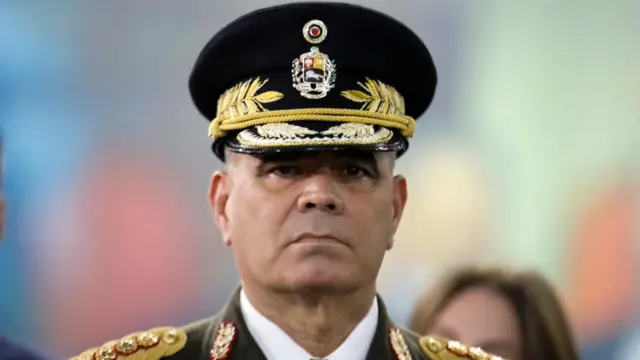
  • Venezuela's Defence Minister Vladimir Padrino says a large part of Maduro's security team and "innocent civilians" were killed in the US operation

  • Venezuela has denounced the "military aggression", and the army says it backs interim President Delcy Rodríguez

  • This is important because it is a confirmation that - despite Donald Trump saying the US will now run the country - Maduro's allies are still in charge, writes our South America correspondent

  • Donald Trump tells The Atlantic that Rodríguez will "pay a big price" if she "does not do what is right". The president also told reporters aboard Air Force One that Venezuela was "our area" invoking the Monroe Doctrine

  • Venezuelans have been sharing their worries about the uncertainty and prospects for a peaceful transition of power with the BBC

  1. 'The military and police are on the streets' - Caracas local tells BBCpublished at 21:45 GMT 4 January
    Alice Cuddy
    Reporting from Cúcuta, Colombia

    We've been speaking to people in Caracas about life there since the US action.

    Twenty-four-year-old manicurist Katherine says things are feeling "calmer" again though remain uneasy.

    "Some people have gone out to buy groceries and whatever else they can. The military and police are on the streets," she says.

    She describes the night of the US strikes as "distressing and scary".

    "It was agonising not knowing what was going to happen in that moment," she recalls.

    She says there is now confusion about what will happen next.

    "The vice president here says one thing and President Trump announces another," she says.
  2. Watch: Ros Atkins answers some key questions on Venezuelapublished at 21:36 GMT 4 January

    What does a "safe, judicious transition" - in US President Trump's words - mean for Venezuela in practice? Who will be in power, and who maintains security there? And who is controlling Venezuelan oil?

    BBC Verify's Ros Atkins takes a look at some of the key questions in the aftermath of the US capture of Venezuelan President Nicolás Maduro.

  3. What we've learned so far todaypublished at 21:11 GMT 4 January

    If you're just joining our live coverage, here's a recap of what has happened so far today, one day after the US ordered a military attack in Venezuela and captured President Nicolas Maduro and his wife, taking them to New York to face drug and weapons charges.

    • Early Sunday morning, we saw the first images and videos of the destruction in Venezuela from the US attacks. It still remains unclear exactly how many people may have been injured or killed
    • Pope Leo spoke for the first time and stressed the importance of "guaranteeing the sovereignty" of Venezuela
    • Secretary of State Marco Rubio spoke to multiple media outlets this morning and was asked if the US is running Venezuela, responding that the US is "running the direction" that makes things move forward
    • He was also asked if he thinks Interim President Delcy Rodríguez is now the legitimate president of Venezuela, and avoided a direct response by saying "this is not about the legitimate president" as the US does not believe the regime in place is legitimate

    Stick with us, and we'll continue to bring you the latest.

  4. Venezuelan says border with Colombia unusually quietpublished at 20:46 GMT 4 January

    Alice Cuddy
    Reporting from Cúcuta, Colombia

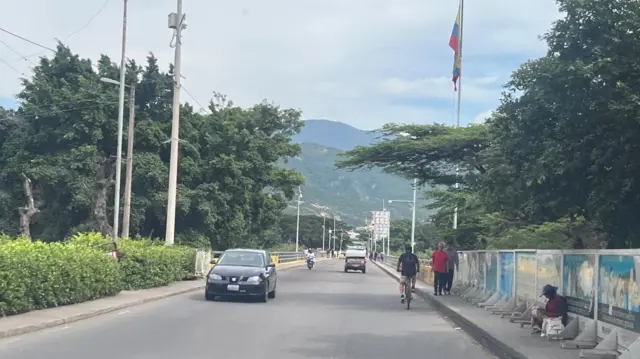
    A road near the Venezuela-Colombia border

    It is extremely quiet at the border crossings between Venezuela and Colombia today.

    I met 24-year-old Milton Estrada from Mérida in Venezuela as he was making the crossing by foot.

    He told me he makes this journey regularly but that today was the "first time" he'd seen it "this quiet".

    His cousin lives in Caracas and he said he spoke to him as soon as he saw the news of the US action.

    "He said the situation was stressful and terrifying, and the bombing felt like earthquakes," he recalled.

    Milton said there was "a lot of uncertainty" but he was hoping that this period of transition would be smooth.

  5. EU urges 'calm and restraint by all actors to avoid escalation'published at 20:30 GMT 4 January

    A blonde woman speaks at a microphone in front of an EU flagImage source, EPA-EFE/Shutterstock
    Image caption,

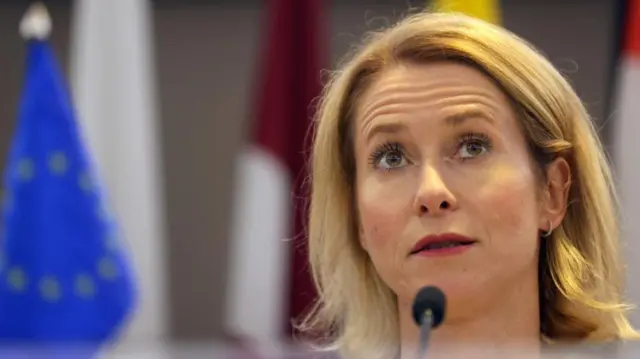
    EU foreign policy chief Kaja Kallas

    The EU is calling for "calm and restraint by all actors, to avoid escalation" in the aftermath of the US intervention in Venezuela.

    In the new statement by the EU's top diplomat, Kaja Kallas, and signed by all EU member states except Hungary, it says that "the right of the Venezuelan people to determine their future must be respected."

    "Respecting the will of the Venezuelan people remains the only way for Venezuela to restore democracy and resolve the current crisis" it says.

    There has been no comment yet from Hungary's representation to the EU as to why the country did not sign the statement.

  6. Draped in Venezuelan flags, opposition supporters rally in streets across the worldpublished at 20:15 GMT 4 January

    Mimi Swaby
    Global affairs reporter

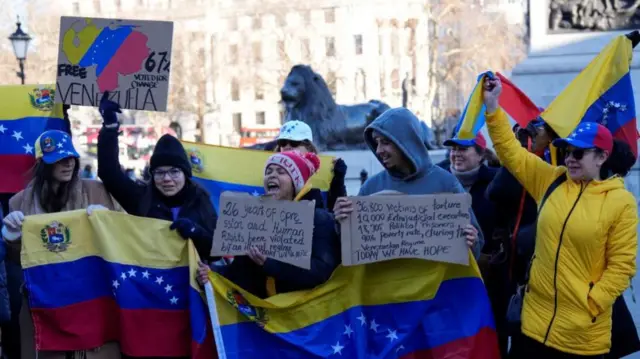
    People hold placards and Venezuelan flags during a rally calling for a democratic transition in VenezuelaImage source, Reuters
    Image caption,

    People in London's Trafalgar Square hold placards calling for a democratic transition in Venezuela

    More opposition supporters have gathered in cities across the world to demand that Edmundo González assumes the presidency and that all political prisoners are freed.

    The opposition, led by María Corina Machado, called for global mobilisations today - uniting for a “transition, democracy and freedom”.

    We have seen demonstrations across Europe and Latin America including in Santiago, Lille, Madeira and Munich.

    One of the largest so far has been in Barcelona. Flags and signs filled the air above the crowd gathered under the city’s Arc de Triomf. One man held a sign stating “Yes María you have support”. More are expected across cities in the United States later.

    The mobilisations are explicitly aimed at the Venezuelan diaspora – an estimated 8 million people who have left since Nicolas Maduro first took power in 2013 – not within the country.

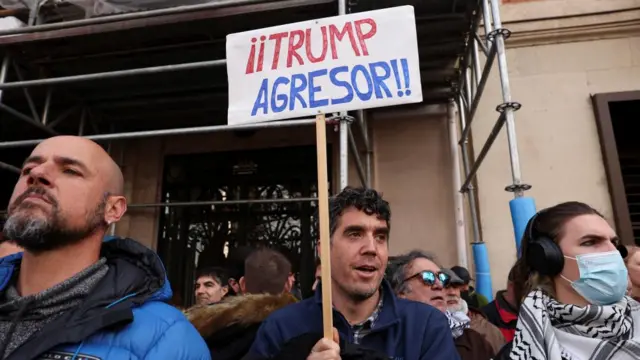
    A man holds a placard reading "Trump the aggressor" as demonstrators protest outside the U.S. Embassy in Madrid against the US strike on VenezuelaImage source, Reuters
    Image caption,

    Demonstrators protest outside the US embassy in Madrid against the US strike on Venezuela

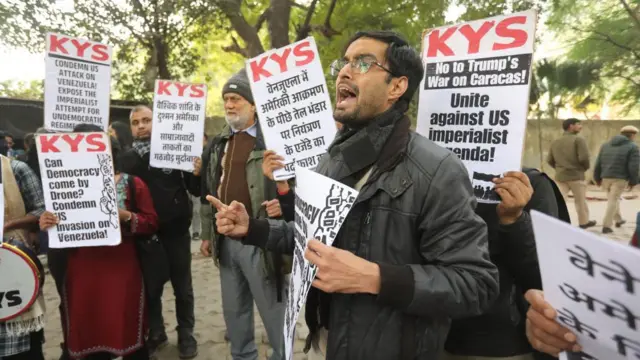
    Supporters of Indian left parties hold placards during a protest against US military actions in Venezuela, in New DelhiImage source, EPA
    Image caption,

    Supporters of Indian left parties hold placards during a protest against US military actions in Venezuela in New Delhi

  7. Six countries say the US has set 'extremely dangerous precedent' in Venezuelapublished at 20:01 GMT 4 January

    The governments of Brazil, Chile, Colombia, Mexico, Uruguay and Spain have released a statement, accusing US of setting "an extremely dangerous precedent for peace and regional security and endanger the civilian population".

    The countries say they want a solution to the Venezuela situation to come from peaceful means such as dialogue and negotiation.

    They also express concern about external control that is "incompatible with international law" and "threatens the political, economic, and social stability of the region".

    "We express our deep concern and rejection of the military actions carried out unilaterally on Venezuelan territory, which contravene fundamental principles of international law, particularly the prohibition of the use and threat of force, and respect for the sovereignty and territorial integrity of States, enshrined in the Charter of the United Nations," the statement says.

  8. Worried about Venezuela's destabilised regime, Colombia has deployed its military to the borderpublished at 19:50 GMT 4 January

    Will Grant
    Central America and Cuba correspondent

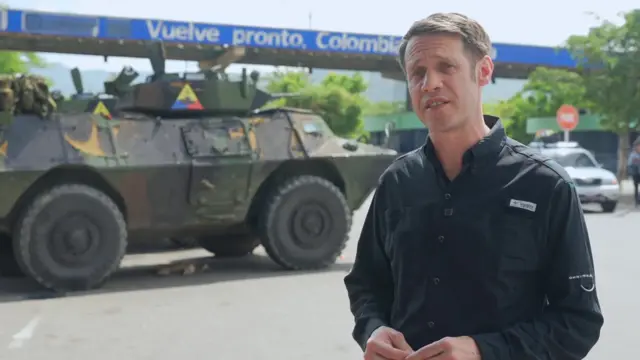
    Will Grant stands in front of a tank at the border of Colombia and Venezuela

    Few places are as affected by events in Venezuela as its neighbour Colombia.

    And here, on the border between the two countries, the Colombian government has translated its fears about a destabilised regime into military deployment.

    They've strengthened their troop numbers, worried in part over increased activity by left-wing rebel groups which move back and forth across the porous, forested border.

    The ELN rebel group has traditionally had close allegiance with - and enjoyed protection from - the Maduro government and may be prepared to wade into an armed conflict with US troops.

    At the border crossing, I spoke to the lieutenant general of the battalion deployed to the region who remained largely tight-lipped over the specifics of their orders.

    Still, it's clear that the government of President Gustavo Petro in Colombia is also concerned that more American intervention in Venezuela could lead to greater influxes of migrants and refugees - passing into Colombia as they eventually try to reach the United States itself.

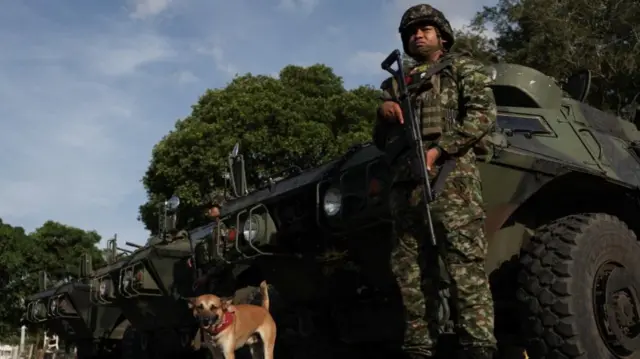
    A soldier with a gun stands by a tankImage source, Reuters
    Image caption,

    A soldier stands at the Venezuela-Colombia border

  9. Bondi says Maduro arrest took months of planningpublished at 19:38 GMT 4 January

    Attorney General Pam Bondi has just put out a new statement saying the operation to capture Maduro "required months of coordination, detailed planning, and seamless execution across multiple components of the federal government".

    "This was a perfectly executed operation with intensive cooperation and trust among President Trump’s team," she said. "The mission was conducted to support an ongoing criminal prosecution tied to large-scale narcotics trafficking and related offenses that have fueled violence, destabilized the region, and contributed directly to the drug crisis claiming American lives."

    Bondi notes that the US pursued "every lawful option" to resolve the issue "peacefully" but those offers were rejected by Maduro.

    She added that the resposnsiblity for what happened lands with those who chose to commit criminal acts.

  10. 'We've been watching an invasion against a sovereign nation,' academic sayspublished at 19:22 GMT 4 January

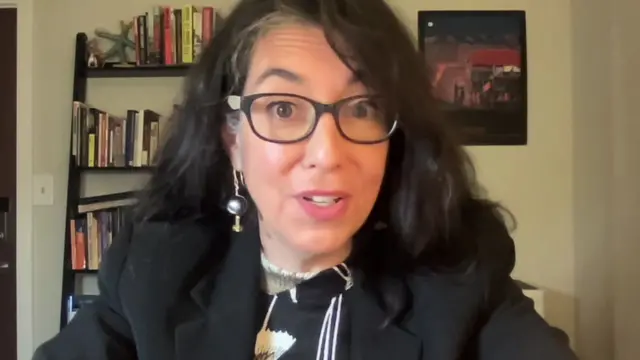
    Angela Marino from the University of California, Berkeley, speaks to BBC NewsImage source, BBC News

    Angela Marino from the University of California, Berkeley, says what we saw yesterday was a "crime of invasion, a crime of kidnapping, a crime of murder".

    "We've been watching boats blow up; we've been watching an invasion against a sovereign nation," she tells the BBC. "Where is the criminality in this?"

    Donald Trump has indicated he took action to protect the American people, and Maduro and his wife have been indicted on drugs and weapons charges.

    But Marino says this is "clearly not" about drugs, democracy or human rights.

  11. Analysis

    Where does Nobel Peace Prize winner María Corina Machado stand now?published at 19:01 GMT 4 January

    Daniel García Marco
    BBC Mundo Editor

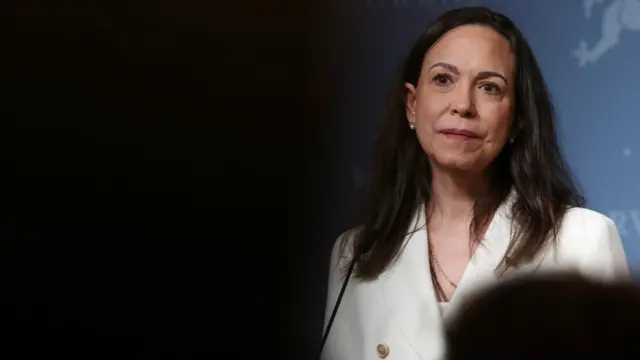
    Among the many things that surprised people on Saturday, one was Donald Trump’s comments about María Corina Machado, the leader of Venezuela’s opposition and a Nobel Peace Prize winner.

    Trump gave details of Nicolás Maduro’s arrest and said that the United States would oversee Venezuela. He spoke of a transition, but not of elections or of Venezuela’s opposition leaders.

    Delcy Rodríguez, a loyal ally of Maduro, would assume the presidency, he said. He confirmed a change of leader, but not a change of government.

    Trump was then asked about Machado. But the US president surprised many by saying that the Nobel Peace Prize winner does not have the support or respect of the majority of Venezuelans.

    The opposition has spent years demanding and fighting to overthrow Maduro and the Chavista government. Trump gave them only part of what they wanted.

    So where does that leave Machado and the opposition? The opposition leader is in Oslo after leaving the country to receive the Nobel Prize.

    Nobel Peace Prize laureate and Venezuelan opposition leader Maria Corina MachadoImage source, Reuters

    And Edmundo González, whom many consider the president-elect following the 2024 elections, remained silent on Saturday and is still in Spain.

    The long-awaited transition sought by the opposition will not, for now, be led by either Machado or González. Instead, Trump will oversee it, with Delcy Rodríguez serving as interim president.

    In this way, Trump secures an orderly and stable transition aimed at preventing further Venezuelan migration.

    He will likely demand oil contracts for US companies - something that could be facilitated through legislation by a new parliament set to be sworn in this Monday, 5 January, and which is controlled by the ruling party.

    For now, however, there is no talk of elections or of the opposition assuming leadership of the country, as reflected in the July 2024 vote.

    Maduro is no longer in power. But the regime change the opposition has sought for years has yet to arrive.

  12. How did Maduro rise to power?published at 18:45 GMT 4 January

    Vanessa Buschschlüter
    Latin America editor

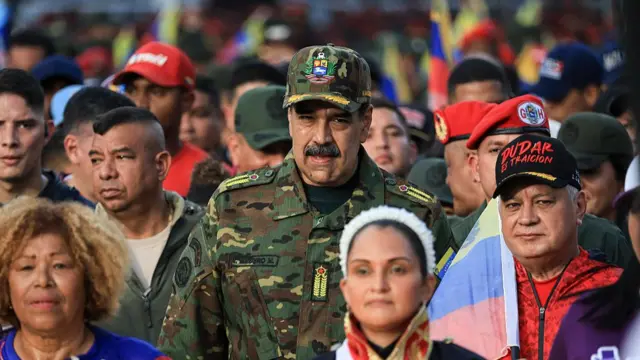
    Maduro walking among a parade of people, wearing military uniformImage source, Getty Images

    Nicolás Maduro rose to prominence under the leadership of left-wing President Hugo Chávez and his United Socialist Party of Venezuela (PSUV).

    Maduro, a former bus driver and union leader, succeeded Chávez and has been president since 2013.

    During the 26 years that Chávez and Maduro have been in power, their party has got control of key institutions including the National Assembly, much of the judiciary, and the electoral council.

    In 2024, Maduro was declared winner of the presidential election, even though voting tallies collected by the opposition suggested that its candidate, Edmundo González, had won by a landslide.

    González had replaced the main opposition leader, María Corina Machado, on the ballot after she was barred from running for office.

    She was awarded the Nobel Peace Prize in October for "her struggle to achieve a just and peaceful transition from dictatorship to democracy".

    Machado defied a travel ban and made her way to Oslo in December to collect the award after months in hiding.

    She said that she planned to return to Venezuela, a move which would put her at risk of arrest by the Venezuelan authorities, who have declared her a "fugitive".

    Media caption,

    Who is captured Venezuelan President Maduro?

  13. Maduro and wife to appear in court on Mondaypublished at 18:31 GMT 4 January
    Breaking

    We've just had an update from our partner CBS News.

    Venezuelan President Nicolás Maduro and his wife Cilia Flores are due to appear in federal Manhattan court on Monday, according to a court spokesperson.

    The hearing is set for 12:00 local time (17:00 GMT), the spokesperson says.

  14. Analysis

    Trump's action could set precedent for authoritarian powers across globepublished at 18:18 GMT 4 January

    Jeremy Bowen
    International Editor

    With the seizure of Venezuelan leader Nicolás Maduro, Donald Trump has demonstrated more powerfully than ever his belief in the power of his will, backed by raw US military force.

    On his orders the US has got Maduro behind bars and now will "run" Venezuela.

    The US president made the announcement in a remarkable news conference with enormous implications for US foreign policy worldwide at his Florida club and residence, Mar-a-Lago. Trump said the US would be in charge in Venezuela "until such time as we can do a safe, proper and judicious transition".

    US Secretary of State Marco Rubio, he said, had spoken to the Venezuelan Interim President Delcy Rodríguez, who had told him "we'll do whatever you need... She, I think, was quite gracious, but she really doesn't have a choice".

    Trump was light on detail. He said that "we're not afraid of boots on the ground if we have to have [them]".

    But does he believe that he can govern Venezuela by remote control? Will this demonstration that he will back words with military action, praised lavishly at Mar-a-Lago by both Marco Rubio and the US Secretary of Defence Pete Hegseth, be enough to reshape Venezuela and browbeat Latin American leaders into compliance?

    It sounded as if he believes something like that.

    The evidence is that it will not be easy or smooth.

  15. Trump says Rodríguez will 'pay a big price' if she 'does not do what is right' - reportpublished at 18:07 GMT 4 January

    Donald TrumpImage source, EPA

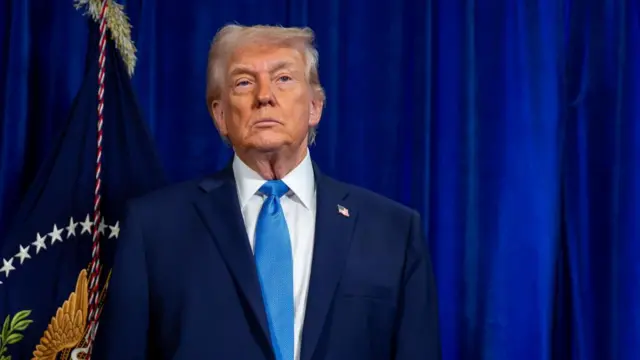
    Speaking to US news outlet The Atlantic, US President Donald Trump has threatened action against interim Venezuelan President Delcy Rodríguez.

    "If she doesn’t do what’s right, she is going to pay a very big price, probably bigger than Maduro," he told the magazine.

    On Venezuela's future, he said "regime change, anything you want to call it, is better than what you have right now. Can’t get any worse".

  16. Analysis

    Military recognition of Rodríguez confirms Maduro's allies remain in chargepublished at 17:46 GMT 4 January

    Ione Wells
    South America correspondent

    Venezuela's Vice-President and Oil Minister Delcy RodriguezImage source, Reuters

    Venezuela's opposition has for years appealed to the country's powerful military to break its loyalty to Nicolás Maduro.

    It knew that without the support of the armed forces, a transition of power would be difficult - and potentially very dangerous.

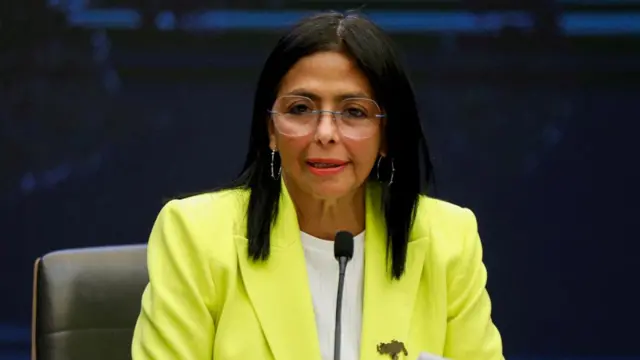
    The military recognition of Delcy Rodríguez as interim president is important because it is further confirmation that - despite Donald Trump saying the US will now run the country - Maduro's allies are still in charge.

    Delcy Rodríguez was not just Maduro's vice president but also his oil minister. Key military men who are allies of his, like the Interior Minister Diosdado Cabello and Defence Minister Vladimir Padrino, are still in government.

    Earlier, Padrino said a large part of Maduro's security team was killed during the US raid on Caracas.

    He did not give an exact casualty figure, but in this televised address he demanded the immediate release of Maduro and his wife, saying they had been kidnapped.

    He confirmed the armed forces had been deployed to maintain order and confront any further "aggression".

    Despite not having boots on the ground, the US may have some control that takes a different, more psychological form. All these allies that remain will have seen the images of Maduro being sent to detention, blindfolded, in the US.

    It is a stark message that if they do not do what the US wants, could they be next?

    Trump has made it clear one of the things he wants is access to Venezuelan oil.

  17. Trump told Venezuelan interim president to 'lead, or get out the way' - Kristi Noempublished at 17:32 GMT 4 January

    Kristi NoemImage source, EPA

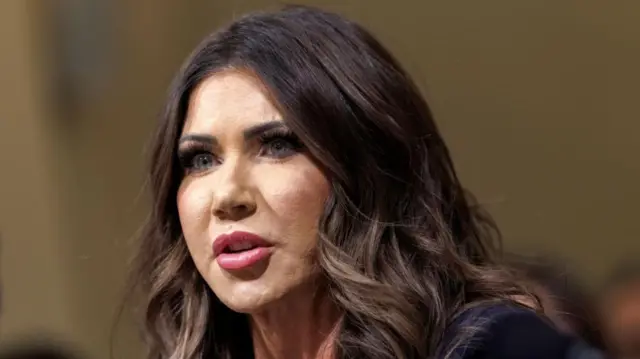
    Donald Trump is having conversations with Venezuelan Interim President Delcy Rodríguez about the running of Venezuela, says Kristi Noem, who heads up the US Department of Homeland Security.

    She tells Fox News the conversations "are very matter-of-fact and very clear".

    "You can lead or you can get out of the way. We're not going to allow you to continue to subvert our American influence."

    Asked if Maduro could be extradited after his trial, Noem says: "I think we need to see them and let the process play out."

  18. Defence minister urges Venezuelans to 'restart their normal activities'published at 17:11 GMT 4 January

    "What happens to Venezuela today could happen to any state or government," says Venezuelan Defence Minister Vladimir Padrino.

    He’s calling on people in Venezuela to "restart their normal activities" in work, trade and education.

    This follows comments we brought you earlier, in which Padrino says Maduro's capture saw a "large part" of Maduro's security team killed, along with "innocent civilians".

    He also says the army is supporting Vice President Delcy Rodríguez as acting leader of the country.

  19. 'Large part' of Maduro's security team and 'innocent civilians' killed in US operation - defence ministerpublished at 16:55 GMT 4 January
    Breaking

    More now from Defence Minister Vladimir Padrino, who's been speaking on television.

    He says Venezuelan armed forces "firmly rejects the cowardly kidnapping" of Maduro and his wife after the "cold-blooded murder of a large part of his security team, soldiers and innocent civilians".

    Earlier, the New York Times reported that an apartment complex was hit and that there have been at least 40 casualties - although it's not clear whether these are civilians or military targets. The BBC has not been able to independently verify these reports.

  20. Venezuelan army says it backs Vice President Rodríguez as interim leaderpublished at 16:46 GMT 4 January
    Breaking

    Defence Minister Vladimir PadrinoImage source, Reuters

    Venezuelan Defence Minister Vladimir Padrino has been speaking on Venezuelan television.

    He says the army has given its backing to Vice President Delcy Rodríguez to act as interim president of Venezuela.

    We'll bring you more on what he has said soon.

    Return to the latest post