Summary

  • The US says there is no time pressure on ending the war with Iran, while the White House says President Donald Trump has not set a new deadline for an extended ceasefire

  • Iran's chief negotiator Mohammad Bagher Ghalibaf says it is "not possible" to reopen the Strait of Hormuz because of "flagrant" breaches of the ceasefire by the US and Israel

  • Iranian President Masoud Pezeshkian says the US blockade and "breach of commitments" are the main obstacles to negotiations

  • With Iran emphatic that it will not reopen the strait, the two sides appear to have reached a stalemate, our North America correspondent writes

  • Iran has attacked three cargo ships as they tried to pass through the Strait of Hormuz and has detained the crews of two of those vessels

  • Israel and Lebanon are due to hold a second round of talks on Thursday, with Lebanon's President Joseph Aoun saying communications are under way "to extend the ceasefire deadline"

  1. Oil prices rise after ships seized in Strait of Hormuzpublished at 07:44 BST

    Oil prices gained on Thursday after reports of three vessels being attacked in the Strait of Hormuz by Iranian forces.

    Brent, the global benchmark for crude, is hovering around $103 (£76.35) a barrel, while US-traded oil climbed above $94.

    Prices have climbed since US President Donald Trump announced a ceasefire extension on Tuesday to give Iran more time to make a deal.

  2. US and Israeli attacks 'the root of insecurity' in Gulf and strait, says Iranian FMpublished at 07:07 BST

    Iran's foreign minister says US and Israeli "aggression" are the "root of insecurity" in the Gulf and Strait of Hormuz.

    A series of posts on X from the Iranian government say Abbas Araghchi met South Korea's special envoy in Tehran, with the Iranian foreign minister urging counties to “take a clear and firm stance in condemning these attacks".

    It reports Araghchi as saying that Iran has taken measures under international law to defend its security and interests, adding that responsibility for consequences "lies with aggressors".

    It comes as Iran said it "seized" two ships in the strait, with a third cargo ship also attacked.

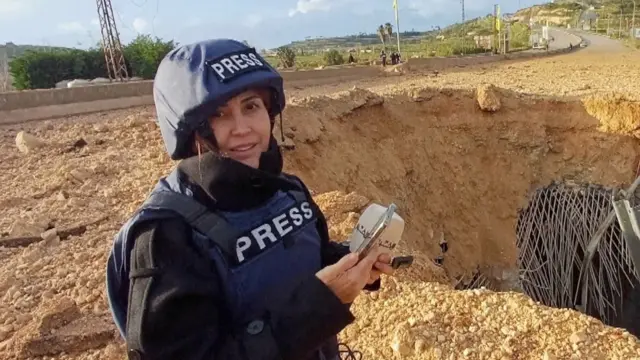
  3. Lebanon accuses Israel of targeting journalist killed in air strikepublished at 06:37 BST

    Amal KhalilImage source, AP
    Image caption,

    Amal Khalil was a journalist with the Lebanese newspaper Al-Akhbar

    Lebanon's prime minister has accused Israel of war crimes after officials said Israeli air strikes killed journalist Amal Khalil and wounded another journalist in southern Lebanon on Wednesday.

    It comes as Israel and Lebanon prepare to hold a second round of talks today in Washington.

    Lebanese officials say Khalil and Zeinab Faraj were deliberately targeted as they sought shelter in a home after an initial air strike hit the vehicle in front of them, killing two men.

    The officials also accused the Israel Defense Forces (IDF) of intentionally targeting a marked ambulance as it tried to reach the journalists in the village of Tayri.

    Khalil, 43, worked for Lebanese newspaper Al-Akhbar. She and Faraj, a freelance photographer, were travelling together. The two men who died have not been named by officials.

    The IDF denied that it was preventing rescue teams from reaching the area and said it did not target journalists.

  4. Turkish president says Iran war beginning to 'weaken Europe'published at 05:45 BST

    Turkish President Recep Tayyip Erdogan said the war in Iran is beginning to "weaken Europe" during a call with German President Frank-Walter Steinmeier.

    A post on social media by Erdogan's office said the two leaders spoke over the phone Wednesday, discussing the relations between the two countries and the ongoing wars in Iran and Ukraine.

    "President Erdoğan noted that the war in our region began to weaken Europe as well, and that if this trend were not addressed with a peace-oriented approach, the damage caused by the period of conflict would be far greater," the post says.

  5. US says it has directed 31 ships to turn around or return to port since blockade startedpublished at 05:38 BST

    US Central Command said late on Wednesday it has "directed 31 vessels to turn around or return to port" since its blockade of Iranian ports began.

    It said most of the ships were oil tankers and had "complied with US directions".

    Iranian President Masoud Pezeshkian has called the blockade one of the "main obstacles" to "genuine negotiations" with the US.

    White House Press Secretary Karoline Leavitt says Donald Trump is "satisfied" with the blockade, which she described as "effective and successful".

  6. Tehran's ship attacks come days after US seized Iranian vesselpublished at 05:09 BST

    Media caption,

    Moment US navy warns Iranian-flagged cargo ship before firing

    Iran has attacked three ships in the Strait of Hormuz and seized two, days after vowing retaliation for the US intercepting an Iranian-flagged cargo ship in the Gulf as part of its naval blockade.

    On Sunday, US President Donald Trump said the ship, Touska, was seized by the US Navy after failing to respond to warnings to stop.

    Iran said this was a violation of the ceasefire and it would retaliate soon for the "act of armed piracy".

    On Wednesday, the Islamic Revolutionary Guard Corps (IRGC) Navy said it was "monitoring" movements through the Strait of Hormuz and has pledged "firm" action against the "violators".

    After seizing the ships, MSC Francesca and Epaminondas, the IRGC Navy said they were "operating without authorisation" and committed "repeated violations", accusing them of trying to leave the Strait of Hormuz "in secret" and tampering with navigation systems.

    The BBC cannot independently verify this claim.

  7. Israel and Lebanon due to hold another round of talkspublished at 05:02 BST

    Israel and Lebanon are set to hold a second round of talks in Washington DC on Thursday, with discussions under way to extend the current 10-day ceasefire.

    Lebanon's President Joseph Aoun says the ambassador-level talks are "based on a complete halt to Israeli aggressions, achieving the Israeli withdrawal from Lebanese territories, the return of prisoners, the deployment of the army to the international borders, and the start of reconstruction of what was destroyed during this war".

    The first round of talks led to a temporary 10-day truce that started at 17:00 EST (21:00 GMT) on 16 April.

  8. Analysis

    White House insists the US is in controlpublished at 05:01 BST

    David Willis
    North America correspondent

    White House Press Secretary Karoline Leavitt has been briefing reporters about President Donald Trump's view of the ceasefire and peace negotiations.

    Trump has said he's extending the ceasefire because Iran's leadership – decimated by the war – is fractured, and needs time to come up with a proposal to end the conflict.

    He has also said a US blockade of ships entering or leaving Iranian ports is to remain in place – a move intended to squeeze Iran economically and which has incensed Tehran, which regards it as tantamount to an act of war.

    Leavitt insisted the plan was working. "We are completely strangling their economy through this blockade. They are losing $500m a day. The Kharg Island is completely full. They can't move oil in and out. They can't even pay their own people as a result of this economic leverage that President Trump has inflicted over them," she said.

    No end date has been given for the extended ceasefire, but with Iran emphatic that it will not reopen the Strait of Hormuz the two sides appear to have reached a stalemate.

    The White House says Trump is satisfied with the situation, and continues to insist the US is in control.

  9. US says no time frame for ending war, as Iran says reopening Strait 'not possible'published at 05:01 BST

    Preparations for peace talks continue in Pakistan but there is yet to be confirmation of delegations from either the US or Iran attending.

    Iranian President Masoud Pezeshkian said Tehran remains open to discussions, but added the US "breach of commitments, blockade and threats are main obstacles to genuine negotiations".

    Vice-President JD Vance, who is expected to lead the US delegation, remains in the US.

    Meanwhile, after US President Donald Trump extended the ceasefire that was due to finish on Wednesday, he says there is "no time frame" for ending the war with Iran.

    White House Press Secretary Karoline Leavitt said the extension was open-ended, and there was no new deadline.

    Tensions continue around the Strait of Hormuz, with Iran's chief negotiator saying it is "not possible" for it to be opened due to "the blatant violations of the ceasefire" by the US and Israel.

    Stay with us as we bring you the latest here.

    Return to the latest post