|
|
 |
Amwell
John
Scott (‘Scott of Amwell’ 1731-1783)
Scott generally wrote conservative pastoral verse but this Quaker
poet is now best remembered for two things - the shell grotto he
created at Amwell in Hertfordshire (described by English Heritage
as "one of the finest grottoes in England") and the pacifist poem
"I hate that drum's discordant sound ...".
Nevertheless
he was also a social reformer (championed Poor Law Reform), literary
critic, road builder and critic of the views of his good friend
Samuel Johnson.
As
well as the grotto, there are other legacies of Scott in Great Amwell.
The name Amwell is derived from 'Emma's Well', now a dried up hollow
alongside the New River which broadens around two small islands
there. The well has a stone enscribed with part of John Scott's
poem "Emma" at the entrance.
Ayot
St Lawrence
Shaw's
Corner (G.B. Shaw)
George
Bernard Shaw (1856-1950)
The playwright and essayist George Bernard Shaw lived at Ayot St
Lawrence in Hertfordshire for 44 years, from 1906 until his death
in 1950. His house is open to the public.
With the onset of middle age, Shaw began looking for a country house
that also had reasonable access to London. This Edwardian house,
just few miles outside of Welwyn Garden City, provided the solution.
 |
|
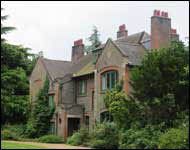
Shaw's
Corner - G.B.S.'s country home
|
Built
as the 'New Rectory', the house was isolated enough to give Shaw
the peaceful environment that he needed in order to write, but it
wasn’t so remote that he couldn’t get back to London easily.
He rented the house from the Church for nearly 14 years, before
buying it in 1920, and he spent much of his later years in the seclusion
of his garden. Here he could write uninterrupted from his revolving
hut and entertain invited guests when it suited him.
After his wife Charlotte’s death in 1943 Shaw remained permanently
at Shaw's Corner and was known as a bit of an eccentric recluse.
In November 1950 he died at Shaw's Corner, and the house became
a shrine to him and his great literary works. His ashes were scattered
around the garden and all his personal effects from his London home
were transferred to Hertfordshire.
The rooms remain much as he left them, with many literary and personal
effects still there together with quotes and verses that display
his humour. Shaw’s writing hut is hidden at the bottom of the garden,
which has richly-planted borders and views over the Hertfordshire
countryside.
During his life, Shaw wrote many books, plays, and film scores,
and received a number of accolades in recognition of his great works,
including, the Nobel Prize for Literature in 1926, and an Oscar
for 'Pygmalion' in 1938.
Through
the Keyhole - Shaw's Corner >>
| House
opening hours |
|
27
March to 3 Nov Wed-Sun and Bank Holiday Mons: 1.00pm–5.00pm
Adult:
£3.60
Child £1.80
Family £9.00
House has ramped access and the garden is accessible via grass
slope.
|
Berkhamsted
Berkhamsted
Collegiate School
(Graham Green)
Graham Greene, (1904-1991)
Graham Greene was born on 2 October 1904 at St. Johns, Chesham
Road and lived there until November 1910. There is a plaque recording
it as his birthplace.
 |
|
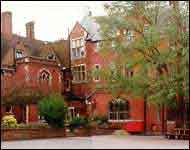
A
view of Berkhamstead Collegiate School
Photo by Dr Ramon Porto, courtesy of the Graham Greene Birthplace
Trust.
|
From
November 1910 to September 1922 he lived at the School House, Berkhamsted
Collegiate School, Castle Street where his father was headmaster.
Going to school here was not easy as he was bullied.
From September 1918 to July 1922 he was a weekly boarder at St Johns.
One
of the most widely read novelists of the 20th-century, Greene was
also a short-story writer, playwright and journalist.
He
was a great storyteller whose novels were always full of adventure
while tackling moral issues and religious themes in the context
of political settings.
As
a result, many of his books have been made into successful films,
such as The End of the Affair starring Ralph Fiennes.
He
also wrote over five hundred reviews of books, films, and plays,
mainly for The Spectator.
Greene was a candidate for the Nobel Prize for Literature several
times, but he never received the award.
Some of his novels:
1925 Babbling April
1929 The Man Within
1932 Stamboul Train
1938 Brighton Rock
1940 The Power And The Glory
1948 The Heart Of The Matter
1951 The End Of The Affair
The
Graham Greene Birthplace Trust has an annual festival. The 5th event
will take place from 26-29 September 2002. You can get further details
from their Web site - www.grahamgreenebt.org
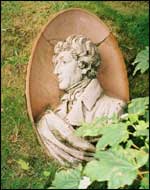 |
| Charles
Lamb set into the verge at Cherry Green, near Buntingford -
photograph submitted by Peter Javes. |
Buntingford
Famous
essayist Charles Lamb (1775 -1834) is said 1775–1834, English essayist,
is said to have stayed with relatives at Button Snap Cottage in
Buntingford. In 1796, his sister Mary Ann Lamb in a fit of temporary
insanity attacked and wounded their father and stabbed and killed
their mother.
Hatfield
Camfield
Place
(Beatrix Potter/Barbara Cartland)
Eight Bells Pub
(Oliver Twist by Charles Dickens)
Camfield
Place
(Beatrix Potter/Barbara Cartland)
Camfield
Place, near Hatfield, was not only the country estate of the late
romantic novelist Barbara Cartland, it was also the summer residence
of Beatrix Potter.
It
is 19th century Italianate with a water tower, a small 18th-century
stable block and early 19th-century lodges.
Dame
Barbara is buried in the grounds by a 400-year-old oak tree which
was planted by Queen Elizabeth I.
As
well as writing, Beatrix Potter was a talented watercolourist, particularly
of the natural world.
Beatrix
drew landscapes, bats and insects as well as fungi at Camfield Place
and her paintings and drawings are now in collections all over the
world.
Eight
Bells Pub, Fore Street, Old Hatfield
In
the days of horse drawn coaches, Hatfield was a staging post on
the Great North Road linking London to the North of Britain. In
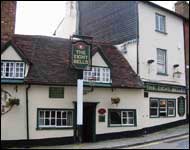
1839 a coach called the Sovereign left 'The Eight Bells' (c.1630)
public house for London at 7.00am every day.
 |
|
The
Eight Bells Inn in Old Hatfield
|
Although
it is not actually named in the novel, this 17th-century coaching
inn was chosen by Charles Dickens as the setting for Bill Sykes’
retreat with his dog after the murder of Nancy in ‘Oliver Twist’.
"It was nine o'clock at night, when the man, quite tired out, and
the dog, limping and lame from the unaccustomed exercise, turned
down the hill by the church of the quiet village, and plodding along
the little street, crept into a small public-house, whose scanty
light had guided them to the spot. There was a fire in the tap-room,
and some country-labourers were drinking before it."
Dick Turpin is also said to have leapt from one of the upper windows
onto his horse Black Bess, and galloped away as the Bow Street Runners
entered the place.
Hertford
Frederick
Forsyth
Bestselling author Frederick Forsyth lives in a 26-room Queen Anne
manor house set in 175 acres of rolling Hertfordshire farmland at
East End Green.
Following
an intense career in journalism, he decided to write a book using
journalistic research methods. This result was The Day of the Jackal,
which spawned a career of many more successful books including The
Odessa File, Dogs of War and The Fourth Protocol.
Knebworth
Knebworth
House
(Sir Edward Bulwer- Lytton)
Victorian
Statesman and romantic novelist Sir Edward Bulwer-Lytton (1st Lord
Lytton) who wrote The Last Days of Pompeii, succeeded to this property
in 1843.
He
lived here until his death in 1873 and was visited by Disreali,
Charles Dickens and other literary friends.
He
redecorated the exterior in Gothic style in 1843. The house now
contains 17th and 18th century furniture, portraits and relics and
manuscripts of Bulwer-Lytton.
St
Albans
Gorhambury House (Francis Bacon)
St
Michael's Church (Francis Bacon
Victoria Street (Charles Williams)
Gorhambury House
The present Gorhambury House, the seat of the Earl of Verulam was
built in the late 18th century by the architect Robert Taylor and
replaced the old 16th-century Gorhambury House that was home to
Francis Bacon.
The
ruins of Bacon’s house still stand nearby and the new house has
an extensive picture collection of 17th-century portraits of the
Grimston and Bacon families and their contemporaries.
Francis Bacon (1561-1626) - 1st Baron Verulam, Viscount St Albans
The English philosopher, lawyer, and politician inherited the Gorhambury
estate in St Albans when his brother died in May 1601.
In January 1621 he was created Viscount St Albans, but just five
days after this he was accused of accepting bribes. The House of
Lords fined him £40,000 and banished him from court.
His political career in tatters, he retired to Gorhambury on 23
June 1621 to concentrate on his writing, after briefly being imprisoned
in the Tower of London.
Some have suggested that during this time he wrote plays that have
been attributed to Shakespeare.
What
we do know is that after retiring to Hertfordshire he published
works including the History of the Reign of Henry VII, 'Apophthegms,
New and Old', 'Translation of Certain Psalms' and the 3rd edition
of 'Essays'.
| New
house opening hours |
May
to September:14.00 - 17.00 hrs (Thursday only)
Adult: £6.00
Child: £3.00
Senior Citizens: £4.00 |
| Old
house opening hours |
Open
daily all year round at any reasonable time
Adult: Free
Child: Free |
St
Michaels Church
Founded by Abbot Ulsinus in 948, it is where Bacon is buried and
it also houses the Sir Francis Bacon Monument.
Victoria
Street (Charles Williams)
Charles
Williams (1886-1945)
Charles Williams' family moved to St. Albans in 1894 where they
ran an art-materials shop. Charles was brought up at 15 Victoria
Street and went to St Albans School.
 |
|
The
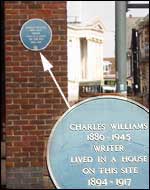
blue plaque commemorating Charles Williams in Victoria Street,
Street St. Albans
|
The
house is no longer there as it was knocked down to make way for
The Maltings Shopping Centre, but there is a blue plaque on the
spot to commemorate his former home.
He was a prolific writer and produced over 30 volumes of poetry,
plays, literary criticism, fiction, biography and theological argument.
He was renowned for his ghostly and weird fiction, although Tolkien
was said to find Williams’ fascination with black magic and diabolism
repellant. Often branded ‘spiritual shockers’, his aim was not just
to make the flesh creep as Williams used them as vehicles for his
brand of religious mysticism.
Some of his publications:
1925 Windows of Night
1930 Heroes and Kings
1937 Descent into Hell
1937 He came down from Heaven
1939 Judgement at Chelmsford
1941 Witchcraft
1942 The Forgiveness of Sins
1944 The Region of the Summer Stars
1944 All Hallows' Eve
MORE
>>
We
want to make these literary maps as comprehensive as possible.
If
you know of any other literary associations, please let us know.
We will add them in and of course tell everybody who told us!

| Tony
Reeve, Potters Bar |
Friday,
06-May-2005 23:52:41 BST |
|
| Indeed
Orwell lived and worked in Wallington, just east of Baldock
- and H G Wells lived in Hay Street. My grandmother, Lisa Sheridan,
informal Royal photographer, lived in Welwyn Garden City and
photographed both HG Wells and George Bernard Shaw - who completely
outclassed her when my grandmother said she'd received a letter
addressed "Lisa, England", Shaw retorted that he'd received
one addressed "GBS, England" |
| Julie
Wright, Hertford |
Sunday,
13-Mar-2005 20:31:32 GMT |
|
| I'm
sure W E Johns who wrote the Biggles books used to live in Hertford
near Cowbridge/Port Hill. There is a Blue Plaque on his cottage
there. |
| Lesley
Dunlop, Nascot Wood, Watford, Herts |
Tuesday,
19-Oct-2004 15:52:59 BST |
|
| And
what about Mrs Humphry Ward, the phenomenally popular Victorian-Edwardian
novelist who lived in Aldbury, near Tring. Her 30+ books, including
Robert Elsmere, Marcella and Helbeck of Bannisdale, earned her
the critical respect of Henry James. Several of her books were
made into films in the early 20th century and the BFI have them
on record. She helped found Somerville College, Oxford, inaugurated
some of the earliest play-centres for children in London and
founded a welfare-based settlement. The Mary Ward Centre in
London exists today as an adult specialist education college.
Although BBC radio dramatised one of her books some years ago,
amazingly BBC television has yet to discover her literary treasure
trove. |
| Douglas
Michael Massing, Oakland, California |
Sunday,
19-Sep-2004 04:10:23 BST |
|
| Pride
and Prejudice is of course largely set in Hertfordshire: the
town of Meryton, the Bennets' home at Longbourn, and the Bingley
house at Netherfield are all imagined as being there. |
| Pat
Sleat, Letchworth Garden City |
Sunday,
27-Apr-2003 14:16:32 GMT |
|
| I
was surprised to see no mention of E.M. Forster or George Orwell,
both with local connections. . |
|