|
Bedford
Bedford
(John Bunyan)
John Bunyan is one of the most celebrated 17th century writers
and one of the world's most well-known Christian writers.
His powerful allegory, 'Pilgrim's Progress', has been translated
into 2,000 languages.
 |
|
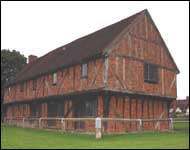
Moot
Hall in Elstow, near John Bunyan's birthplace
|
John
Bunyan was born in 1628 in Elstow, just to the south of Bedford.
He
was the son of a tinker and as a child he travelled the district
helping his father. His family was poor but owned a cottage nearby,
in Harrowden.
After
a short spell in the Parliamentary army he returned to Elstow in
1647, married and had four children.
By
1655 Bunyan and his family were living in St Cuthbert's Street in
Bedford and by 1659 he was recognised beyond the county border as
a gifted preacher.
John
Bunyan Meeting House and Museum
In 1652 Bunyan bought an orchard in Mill Street, Bedford and converted
its barn into a meeting place. In the 19th century the present church
was erected.
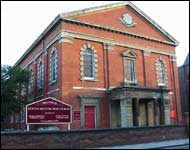 |
| Bunyan
Meeting House |
This
church now has bronze doors, depicting various scenes from the 'Pilgrim's
Progress', which were presented to the Bunyan Meeting House by the
Duke of Bedford in 1876.
There
is now a Bunyan Museum adjoining this Meeting House, which presents
a unique record of his life and works and contains many relics of
Bunyan, including a large collection of translations of his most
famous book.
| Museum
opening hours |
|
April
to end of October
Tues-Sat
10.00am-4.00pm
|
Bunyan
was famously imprisoned for his beliefs and during his 12 years
in Bedford County Gaol he wrote 'Pilgrim's Progress'. This is now
a world classic and has been translated into over 2,000 languages.
There
appear to be two sites of the County Gaol. One is on the Bedford
Bridge and the other is on the corner of the High Street and Silver
Street. There is a plaque marking this spot.
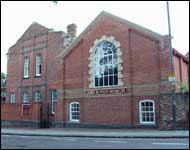 |
| John
Bunyan Museum |
When
the monarchy was restored in 1660, the government thought that forcing
religious conformity on the nation would unify it. As such it forbade
preaching to try and stop the growth of independent churches.
Bunyan
refused to obey, was arrested, and sentenced to remain in prison
until he agreed to conform.
During
this time he also wrote his autobiography, Grace Abounding to the
Chief of Sinners.
Bunyan
was set free in 1672 after Charles II issued a Declaration of Religious
Indulgence but was jailed again the following year for four years
when the Declaration was withdrawn.
Pilgrim's
Progress was finally published in 1677.
Bunyan
lived for another ten years, during which time he wrote another
40 books!
Dunstable
The
Adventures of Tom Jones by Henry Fielding
Tom Jones, a Foundling was published in 1749 and is Henry Fielding’s
most renowned work.
It
is a very long and complex novel but one which is carefully organised
and logical. On his many travels, Tom visits Inns in Dunstable and
St Albans.
Luton
Luton
(John Hegley)
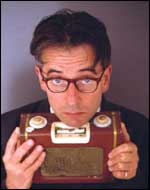
John
Hegley was born in 1953 in Newington Green, and moved to Luton at
an early age.
 |
|
Luton's
John Hegley
|
After
leaving school he worked as a bus conductor in Bristol and social
security clerk, until he went to University where he studied Literature
and Sociology.
He
chose to study at Bradford University after going to watch Luton
Town play in the city.
John originally started out as a musician, before turning to poetry
and performance. His first mainstream book, Glad To Wear Glasses
was published in 1990.
This
was followed by Beyond Our Kennel, Can I Come Down Now Dad?, Five
Sugars Please, These Were Your Father's, Love Cuts and Dog.
His books are a mixture of verse, poetry and prose, along with his
own illustrations, that cover a multitude of themes with wry observations
on existence.
He recently said during a BBC Web chat that his biggest success
was the poem about witches that was published in the Luton Central
Library Magazine when he was 10.
In 2000, John received an honorary Arts Doctorate from Luton University
and is also the patron of their Creative Writing degree.
We
want to make these literary maps as comprehensive as possible.
If
you know of any other literary associations, please let us know.
We will add them in and of course tell everybody who told us!

| Deirdre
Power, Nebraska USA |
Thursday,
03-Feb-2005 17:04:40 GMT |
 |
| Brian
Clemens - screenwriter lives in Ampthill, Beds. He's most famous
for his prolific writing for The Avengers, but has written many
countless screenplays and is a recipient of the Edgar Allen
Poe Award. Please add him to the list. An old friend. |
| Nichole
Brumwell, |
Saturday,
05-Feb-2005 08:41:48 GMT |
|
| Mary
Norton, author of "The Borrowers" series lived in Leighton Buzzard.
The house, situated at the bottom of the High Street, is now
part of Leighton Middle School and was the setting for her series
of books. |
| Jeremy
Clark, Shefford |
Thursday,
08-Jan-2004 16:05:11 GMT |
|
| I'm
surprised that Robert Bloomfield does not appear. He was a resident
of Shefford, Beds for 11 years, his most famous work being "Farmers
Boy". |
|