|
Beaconsfield
G.K.
Chesterton
Chesterton
was a prolific critic and author of verse, essays, novels, and short
stories. Between 1900 and 1936 he published some 100 books.
 |
|
G.K.
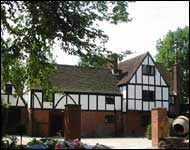
Chesterton's house in Beaconsfield (not open to the public)
|
He
was also one of the big Edwardian men of letters but
is probably best known for his series about the priest-detective
Father Brown who appeared in 50 stories.
In
1909 Chesterton moved with his wife to Overroads in Grove Road,
Beaconsfield from where he continued to write, lecture, and travel.
He wrote much of his best work here including the "Father Brown"
detective stories.
He
died on 14 June 1936 in Beaconsfield. His coffin had to be lowered
from the window to the ground as it was too big to be carried down
the staircase.
He
is buried in the Roman Catholic Cemetery in Beaconsfield, beneath
a stone incorporating a carving by Eric Gill and the text, 'PRAY
FOR THE SOUL OF GILBERT KEITH CHESTERTON...TERMINO NOBIS DONET IN
PATRIA.'
Robert
Frost (1874-1963)
This American poet lived in a bungalow in Reynolds Road, Beaconsfield
after moving to England in 1912. A plaque marks the site where the
bungalow once stood.
Here
he wrote such poems as "Mending Wall" and "Birches."
Alison
Uttley (1884 – 1976)
The creator of "Little Grey Rabbit" and "Sam Pig" lived in Ellwood
Road. She wrote more than 87 children's books.
Chalfont
St Giles
John
Milton
Milton's
Cottage is the only surviving home of John Milton, known
primarily as one of the greatest English poets of all time.
 |
|
John
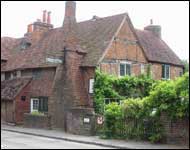
Milton's Cottage
|
It
was in this grade two listed 16th century cottage that Milton completed
Paradise Lost, and the idea of Paradise Regained was put to him.
Milton and his wife came to live in Chalfont
St Giles in the summer of 1665 after leaving London to escape the
plague. They stayed there for less than a year.
This
may seem like a very tenuous link with the village but Milton was
very much part of the community.
It
is also important because it was in this cottage that he completed
his great poetic masterpiece 'Paradise Lost'.
It is laid out today much as it would have appeared over 300 years
ago when Milton first arrived. It is a basic house with few furnishings,
but it now also incorporates a museum to his life and works.
There are also large gardens surrounding the cottage, containing
many varieties of flowers, fruit trees, and herbs referred to in
his poems.
This beautiful cottage offers the visitor a perfect and peaceful
place to contemplate the work of John Milton.
Marlow
T
S Eliot (1888 – 1965)
The poet famous for 'The Wasteland' lived in West Street, Marlow,
for a short time, as well as in High Wycombe.
Thomas
Love Peacock (1795 – 1866)
This novelist and poet lived for many years in West Street, Marlow.
He is chiefly remembered for the novels "Headlong Hall" and "Nightmare
Abbey".
Mary
Shelley (1792 – 1822)
The author of "Frankenstein" lived at Albion House, West Street,
Marlow in 1817. She wrote the classic novel here while awaiting
the birth of her baby. Her husband, Percy Bysshe Shelley, also wrote
"The Revolt of Islam" here.
Stoke
Poges
Thomas
Gray
(1716 – 1771)
The poet often visited his mother at West End Farm, Burnham and
described the area in "Elegy in a Country Churchyard". His tomb
can be seen in the churchyard at the Church
of St. Giles,
off Church Lane, Stoke Poges.
 |
|
The
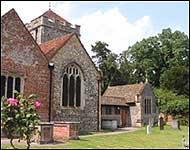
Church of St Giles with Thomas Gray's tomb and the yew trees
he wrote about
|
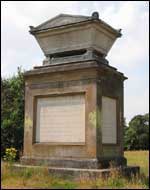
The
church is bordered on one side by the National Trust field with
its sarcophagus to Thomas Gray erected in 1799 by John Penn and
the beautiful Stoke Poges Garden created by Sir Noel Mobbs. These
gardens are open to the public.
The
churchyard was immortalised in Thomas Gray’s Elegy Written in a
Country Churchyard.
The
poet lies in the simple tomb of his mother and sister, close to
the church. His name does not appear on this tomb but his death
was recorded on a tablet on the church wall opposite and, of course,
in the parish register.
 |
|
The
Thomas Gray monument
|
Though
twice enlarged since Gray’s lifetime, the churchyard still remains
much as he must have known it. The yew, under which Gray is said
to have written his Elegy, is still to be seen near the church door,
and the church tower, then clad in ivy, is referred to in the poem.
Taplow
Walter
de la Mare - 1873-1956
Walter de la Mare retired to Taplow, where he lived at Hill House
from 1925 to 1940 with his wife, Constance Elfrida Ingpen, and four
children. .
The
novelist and poet wrote numerous novels, essays, plays, poems and
stories, and also worked as a critic and editor. His best known
novel is "Memoirs of a Midget".
Other
Buckinghamshire places with literary connections
Aylesbury
John
Wilkes (1729 – 1797)
From
1749 onwards, the politician and writer occasionally lived at Prebendal
House.
Bourne
End
Benjamin
Disraeli - 1804-1881
The statesman and novelist spent his childhood in Bourne End, but
lived at Hughenden Manor from 1848. Nearby Bradenham inspired the
Hurstley of his novel "Endymion".
Edgar
Wallace (1875 – 1932)
This writer produced more than 150 novels and 15 plays but died
after accepting a Hollywood offer to work on the film script of
"King Kong". His remains lie in Little Marlow cemetery.
Enid
Blyton
The writer of lived at Old Thatch in Bourne End.
Burnham
R.B.Sheridan
- 1751-1816
The dramatist lived at East Burnham Cottage after his marriage in
1773.
Chalfont
St Peter
Elizabeth
Coxhead (1909 – 1979)
The writer of eight novels - including the controversial "One Green
Bottle", condemned for its explicitness by the Bishop of Chester
in 1951 - lived here.
Chesham
D.H.
Lawrence - 1885-1930
The novelist and poet rented a cottage at Cholesbury near Chesham,
while he was working on "The Rainbow" from 1914-1915.
Denham
John
Dryden -1631-1700
The poet and dramatist was a frequent visitor to relatives at Denham
Court. He was inspired here to write the famous "Ode to St Cecilia"
in 1697.
Gerrard's
Cross
John
Betjeman -1906-1984
Betjeman became a teacher at Thorpe House School, Gerrard's
Cross, before working as a private secretary.
The
former Poet Laureate enthused much about Beechy Bucks, and with
John Piper edited Murray's Buckinghamshire Architectural Guide in
1948.
Great
Missenden
Roald Dahl (1916 – 1990)
The writer of books including 'James and the Giant Peach', 'Charlie
and the Chocolate Factory', and 'Tales of the Unexpected' lived
at Gipsy House.
Grendon
Underwood
William
Shakespeare (1564 – 1616)
Shakespeare
is rumored to have stayed at The Ship Inn - now a farmhouse called
Shakespeare’s Farm - which inspired the rustic humour of "A Midsummer
Night’s Dream".
High
Wycombe
Robert
Louis Stevenson (1850 –1894)
The author and novelist strolled from High Wycombe, through the
Missendens to Tring and described the Chilterns as "The Country
of the Larks".
Holmer
Green
Christina
Rossetti - 1830-1894
The poet Rossetti regularly visited her grandparents here. "If one
thing schooled me in the direction of poetry, it was the delightful
liberty to prowl all alone about my grandfather‘s cottage grounds"
she wrote.
The
Lee
Katherine
Mansfield - 1888-1923
Mansfield lived here with her husband, the poet John Middleton Murray,
from 1914-1915. Her work included collections of short stories such
as "Bliss" and "The Garden Party".
Olney
William
Cowper (1731 – 1800)
The poet lived in Olney for nearly 20 years, moving to Weston Underwood
in 1786. Among many other works, "The Task" was written here.
Princes
Risborough
Winifred
Holtby - 1898-1935
The novelist and essayist convalesced in Whiteleaf near Princes
Risborough in 1932. Her most famous novel "South Riding" was published
posthumously.
Swanbourne
Elizabeth
Fremantle
The diarist settled here in 1798. She and her sisters kept diaries,
published as "The Wynne Diaries".
West
Wycombe
Sir Francis Dashwood (1708 – 1781)
Dashwood
founded the Hell-Fire Club, which met in West Wycombe Park. Other
notable literary members included Charles Churchill, Robert Lloyd,
and John Wilkes.
We
want to make these literary maps as comprehensive as possible.
If
you know of any other literary associations, please let us know.
We will add them in and of course tell everybody who told us!

| Steve
Smith, Olney |
Tuesday,
15-Feb-2005 12:49:49 GMT |
 |
| John
Newton, former slave trader, became Curate of the church of
SS Peter & Paul in Olney in 1764, where he spent almost 16 years
and wrote the hymn Amazing Grace. With his friend, the poet
Willam Cowper, he also co-wrote the 'Olney Hymns'. |
| Pam
Connor, Chalfont St,Giles, Bucks |
Monday,
19-Apr-2004 17:18:47 BST |
|
| Sean
O'Casey lived in a bungalow, just off The Deanway in Chalfont
St Giles. He lived there at the time that his play, The Silver
Tassie, was running in London. |
| Ralph
Stephen, Uxbridge |
Thursday,
31-Jul-2003 13:54:12 BST |
|
| Buckinghamshire
Literary Map. The horror story writer Shaun Hutson lives in
Buckinghamshire, but unfortunately I don't know where. George
Orwell worked as a school teached in Frays College, Uxbridge,
Middlesex, close to the border with Buckinghamshire. One day
he rode his motor bike into the countryside and caught pneumonia
in the rain. I don't have the "Collected Writings" to hand but
I vaguely remember that his unfortunate trip was in Buckinghamshire. |
|