Summary

  • The UK inflation rate rises to 3.3% in the year to March, the Office for National Statistics (ONS) says

  • The rise was largely driven by an increase in fuel prices due to the Iran war, with airfares and food prices also up

  • The price of filling up at the pump when this snapshot was taken in mid-March was enough to derail the drop in inflation that had been anticipated ahead of the war, writes Dharshini David

  • As a reminder, inflation is the increase in the price of goods and services over time

  • Prices in the UK rose by 3% in the year to February, above the Bank of England's 2% target

  1. Trade groups urge government to act to prevent food price spike before it is too latepublished at 08:33 BST

    Jemma Crew
    Business reporter

    Arabica roasted coffee beans are displayed in a coffee roasting shopImage source, Reuters
    Image caption,

    Coffee roasting is an energy-intensive food sector which could be heavily impacted by rising energy costs

    While rising energy prices are on many people’s minds, it’s a particular worry for the food industry.

    The Food and Drink Federation, which represents hundreds of UK manufacturers, is calling for urgent action from the government to stop a spike in food price rises. It has forecast food inflation rate could reach 9-10% by the end of the year.

    Chief executive Karen Betts told a media briefing on Tuesday she’d like to see help with rising energy costs for energy-intensive food sectors, such as coffee roasting and dairy.

    “It’s the sense of urgency that bothers me, because if we go in to act to change what is coming, we need to act now,” she says.

    Andrew Opie from the British Retail Consortium says energy support for the food industry is the biggest intervention the government could make.

    “If the government gives that, I guarantee it will mitigate inflation in stores for customers,” he told a parliamentary committee this week.


  2. Analysis

    Iran war drove inflation - but other factors contributedpublished at 08:22 BST

    Dharshini David
    Deputy economics editor

    Inflation was up in March - but how much of the rise is down to the war in the Middle East?

    Certainly, the source of the biggest upward pressure - petrol and diesel - can be pinned on those higher oil prices.

    There was upward pressure too from airfares - but that was more to do with a relatively early timing of Easter this year (the long haul flights they monitor had a return date of the Tuesday after Easter this time) - and the fares were recorded ahead of the war starting.

    And while food inflation rate rose, the main items behind that - meat, confectionery, soft drinks - may also be linked to the timing of Easter. While elevated commodity prices are expected to add to food prices, they typically take several months to be passed along supply chains.

    In the short term there could actually be a bit of relief: the drop in the energy price cap for domestic customers in April may allow inflation to dip below 3%, economists think - before climbing back towards 4% later in the year.

    But as ever, the exact outlook all depends on the path of oil and gas prices from here.

  3. War in Iran adds £100,000 to lorry firm's fuel costspublished at 08:15 BST

    Dave Harvey
    Business correspondent, BBC West

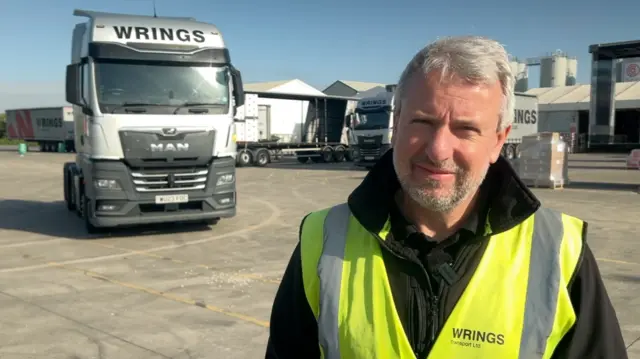
    A man stood in a yard with a large white lorry behind him. He is wearing a reflective yellow jacket. He has short grey hair and a short beard.

    A family haulage firm says the Israel-US war with Iran has pushed up their fuel bill by £100,000.

    Stuart Wring, who runs Wrings Transport at Avonmouth in Bristol with 67 trucks on the road, says the price hikes have been "crazy".

    "March was £45,000 over budget," he says. "And April's already going through the roof - it will be £60,000 over easily."

    The Office for National Statistics chief economist Grant Fitzner says fuel prices in the year to March “saw their largest increase for over three years”.

    In March, the average price of petrol stood at 140.2 pence, according to the ONS - the highest since August 2024. The average price of diesel was 158.7 pence per litre in March, its highest since November 2023.

    Read the full report about the impact of higher fuel prices here.

    This Flourish post cannot be displayed in your browser. Please enable Javascript or try a different browser.

  4. Experts warn today's figures are just 'first wave' of Iran war shockpublished at 08:10 BST

    Rachel Clun
    Business reporter

    The rise in UK inflation is just the start of the impact of the Iran war on prices, experts are saying.

    Adam Deasy, an economist at PwC UK, says fuel prices are the quickest to respond to any oil shock.

    “This is just the first wave of the energy shock, primarily showing up in higher prices at the pump,” he says.

    “We are yet to see the knock-on impact of price pressures in downstream or byproducts to oil and gas, such as fertiliser, helium, plastics or metals.”

    Ruth Gregory, deputy chief economist at Capital Economics, says the next eight months will be “uncomfortable” for the Bank of England’s monetary policy, with inflation expected to remain above its target rate of 2% for some time.

    But with unemployment still high, Gregory expects the Bank to keep interest rates at the current 3.75% level for now.

  5. McDonald's chief says prices may rise in 'small, disciplined way'published at 07:59 BST

    The chief executive of McDonald's UK & Ireland has told the BBC it's likely the company will have to put its prices up in a "very small, disciplined way".

    Lauren Schultz tells BBC Radio 4's Today programme: "We have been operating in a volatile inflationary industry for years now."

    She adds that McDonald's has got long-standing relationships with its suppliers, who have provided a lot of cost certainty this year.

  6. Inflation rate for clothing dropspublished at 07:50 BST

    Rachel Clun
    Business reporter

    A boutique storeImage source, Houston Chronicle via Getty Images

    Let's take a closer look at the inflation rates announced today.

    Transport inflation has jumped from 2.4% in the year to February to 4.7% in the year to March, mainly driven by higher fuel costs.

    But not all categories saw price rises – the rate of clothing price rises actually fell by 0.8% in the year to March.

  7. Analysis

    Still early for rise in food prices from war to be reflectedpublished at 07:42 BST

    Emma Simpson
    Business correspondent

    There've been lots of warnings about rising food prices due to the war in Iran. But it's still early days for this story to play out.

    We saw a surge in food inflation today, from 3.3% to 3.7%.

    It can take about seven to 13 months for cost increases in the food supply chain to be reflected in retail prices on the supermarket shelves.

    Food manufacturers often have lengthy fixed contracts with retailers and lock in some of their costs, like energy and fertiliser, in advance.

    Nobody can say with any certainty how high food inflation will go this year, but today likely marks the start of an upward path.

    Not great for households, when food prices are already about 40% higher than five years ago.

  8. Shadow chancellor: Labour choices have 'made our economy vulnerable'published at 07:34 BST

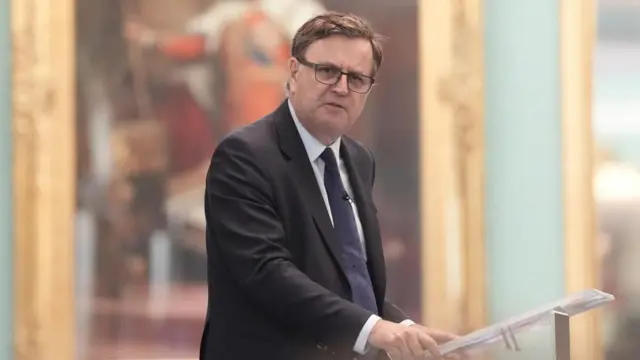
    Shadow Chancellor Sir Mel Stride speaking at the National Growth Debate at the Institute of Directors in LondonImage source, PA Media

    Shadow chancellor Mel Stride says the rate of inflation is rising because of the conflict in the Middle East, but adds that "Labour’s choices have made everything worse and made our economy vulnerable".

    In a social media post, he says: "Tax hikes, reckless spending and disastrous energy policies have left Britain exposed.

    "We already had the highest inflation in the G7 when this crisis began.

    "We need a different approach: cutting the benefits bill, lowering taxes and drilling in the North Sea. Get Britain Working Again."

  9. Rise in energy price can lead to higher food price - ONS chief economistpublished at 07:30 BST

    Customers shop for fresh produce at Ridley Road Market in Dalston, east LondonImage source, EPA

    Office for National Statistics (ONS) chief economist Grant Fitzner tells BBC Radio 4's Today programme that energy prices can feed into other areas.

    "If higher energy prices are sustained for some time, that will be reflected in higher food prices," he explains.

    Fitzner also points out that food prices did rise in the figures, but only by 0.3 of a percentage point.

  10. Analysis

    Future inflation rate rises likely to be modest - here’s whypublished at 07:18 BST

    Dharshini David
    Deputy economics editor

    The price of filling up at the pump when this snapshot was taken in mid-March was enough to derail the drop in inflation that had been anticipated ahead of the war.

    While oil and gas costs have tailed off since, their elevated level risks price pressure in other areas in coming months - from food and airfares to home energy bills.

    But further rises in inflation are likely to be far more modest - economists suggest a peak of perhaps 3.5% to 4% this year - than the double-digit rates seen early on in the war in Ukraine in 2022.

    First, that's because the scale of rises of commodities has been far smaller than four years ago.

    Second, faced with more cautious consumers, retailers will likely have less opportunity to pass on higher costs.

    There is, as a result, a growing expectation among analysts that the chance of a rate rise this year is retreating.

  11. 'This is not our war, but it is pushing up bills,' chancellor sayspublished at 07:12 BST

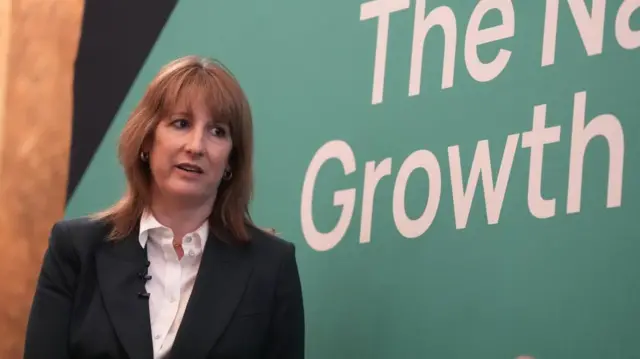
    Chancellor of the Exchequer Rachel ReevesImage source, PA Media

    Rachel Reeves has reacted to the latest inflation figures, blaming the US-Israel war with Iran for pushing up prices.

    "This is not our war, but it is pushing up bills for families and businesses," she says, adding that her "number one priority" is to keep costs down.

    The chancellor says the government’s economic plan has put it in a "stronger position to support families in the face of this new crisis".

    "We’ve taken £117 off energy bills, frozen rail fares and protected motorists with the fuel duty freeze," she says.

    "We’re acting to protect people from unfair price rises if they occur, to bring down food prices at the till, and are boosting long-term energy security - building a stronger, more secure economy."

  12. Fuel prices see biggest rise in more than three years - ONS chief economistpublished at 07:05 BST

    Rachel Clun
    Business reporter

    The rise in the UK inflation rate was driven largely by higher fuel prices, according to Office for National Statistics chief economist Grant Fitzner.

    Fuel prices "saw their largest increase for over three years", he says.

    "Airfares were another upward driver this month, alongside rising food prices."

  13. Inflation rate rises to 3.3%published at 07:01 BST
    Breaking

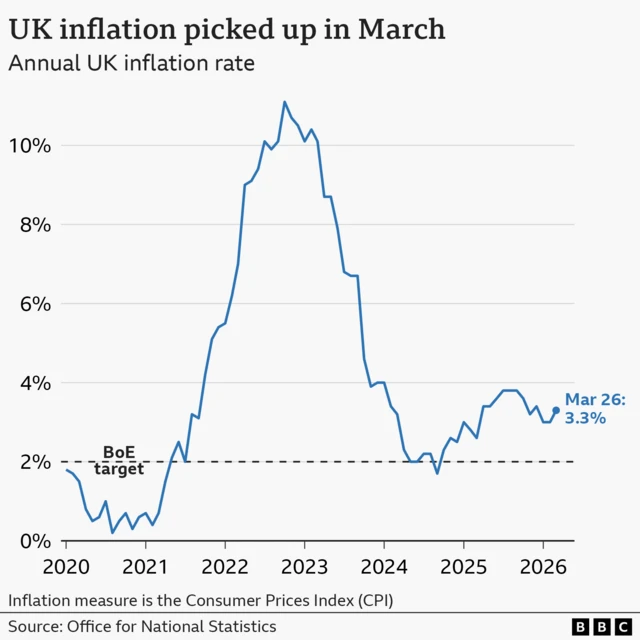
    The UK rate of inflation has risen to 3.3% in the year to March, the Office for National Statistics says.

    That's up from 3% in the 12 months to February.

    A line chart titled 'UK inflation picked up in March', showing the UK Consumer Price Index annual inflation rate, from January 2020 to March 2026. In the year to January 2020, inflation was 1.8%. It then fell close to 0% in late-2020 before rising sharply, hitting a high of 11.1% in October 2022. It then fell to a low of 1.7% in September 2024 before rising again. In the year to March 2026, prices rose 3.3%, up from 3.0% the previous month.
  14. A look at what is happening with inflation in the UKpublished at 06:45 BST

    Jennifer Meierhans
    Business reporter

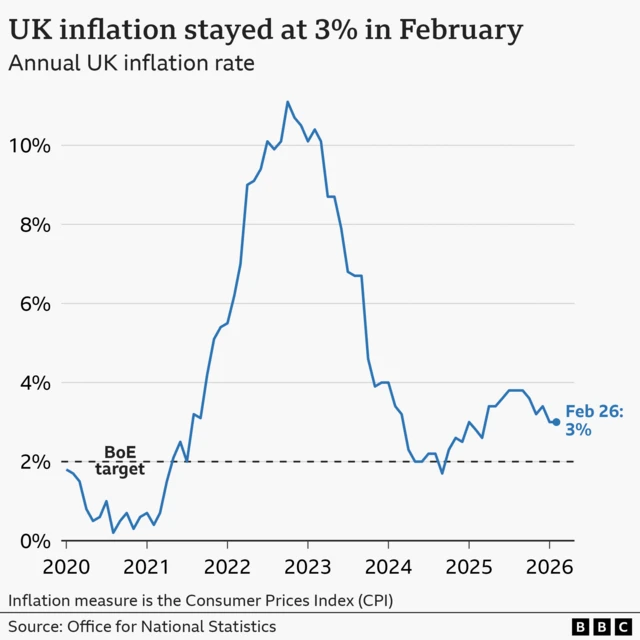
    The UK inflation rate was 3% in February. If it rises to 3.3% as experts are forecasting, that would be its highest level since December.

    Although that's moving further above the Bank of England's 2% target, it's still well below the 11.1% high reached in October 2022 after Russia's full-scale invasion of Ukraine - the highest rate for 40 years.

    A line chart titled 'UK inflation stayed at 3% in February', showing the UK Consumer Prices Index annual inflation rate, from January 2020 to February 2026. In the year to January 2020, inflation was 1.8%. It then fell close to 0% in late-2020 before rising sharply, hitting a high of 11.1% in October 2022. It then fell to a low of 1.7% in September 2024 before rising again. In the year to February 2026, prices rose 3%, in line with 3% the previous month.

    At the start of the year, the Bank of England predicted inflation would dip below its 2% target in April.

    However, the US-Israel war with Iran has led to a sharp rise in oil and gas prices, while disruption to the Strait of Hormuz shipping corridor could also affect other areas.

    Last month, the Bank of England indicated inflation is likely to rise to as high as 3.5% between July and September.

    At a meeting of the International Monetary Fund in Washington last week, the Bank's governor told the BBC the world was facing a "very big energy shock" that will push up prices.

  15. What is inflation?published at 06:36 BST

    Figures that give us an idea of how well the UK economy is doing are closely watched by analysts and households, as the impact of the war in Iran continues to be felt.

    Inflation is one of these measures. It's basically the increase in the price of something over time.

    For example, if a bottle of milk costs £1 but - a year later - costs £1.05, then annual milk inflation rate is 5%.

    The Office for National Statistics collects the costs of 760 products and services across different retailers and tracks price changes over the previous 12 months to calculate inflation.

    The main inflation measure is called the Consumer Prices Index (CPI), and that figure is published monthly.

    Benefits, pensions and interest rate decisions by the Bank of England are all affected by inflation. The Bank has a target of 2% for the CPI.

  16. Analysis

    Fuel price rises expected to push up inflationpublished at 06:28 BST

    Dharshini David
    Deputy economics editor

    The price of filling up at the pump is one of the most visible and immediate impacts of higher global energy costs, not just on our own budgets but the official figures too.

    Petrol and diesel prices climbed steadily during March. And while the inflation data was collected around the middle of that month, the rise by then - it is thought - could have been enough to add about 0.3 of a percentage point to inflation and derail a hoped-for drop.

    There is likely to be more price pressures in the pipeline from the rise in oil and gas prices.

    The impact on transport costs as well as fertiliser and other commodities could take several months to pass through supply chains to affect prices of items like food. Home energy bills could also rise in the months to come.

    But the potential rise in inflation is likely to be far more modest than that seen at the start of the war in Ukraine.

    The easing of oil prices in recent weeks has fuelled hopes that it will peak at between 3.5% and 4% this year - and that may mean the chances of an interest rate rise this year are retreating.

  17. Inflation figures due soon, showing impact of Iran war on UK cost of livingpublished at 06:08 BST

    Jennifer Meierhans
    Business reporter

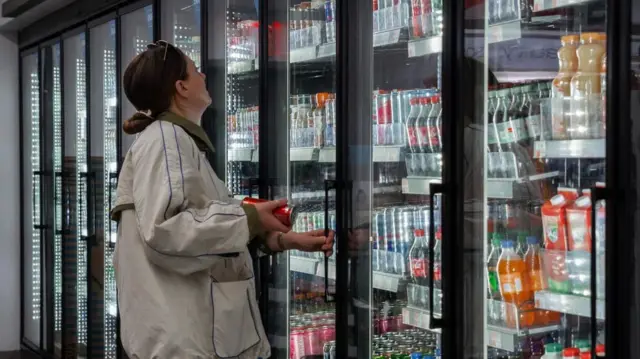
    A woman holds a drink and stares at other cans in a fridge in a super marketImage source, EPA/Shutterstock

    The latest UK inflation figures, showing how quickly prices are rising, are due out later this morning at 07:00 BST.

    The data from the Office for National Statistics is for March - and will give us the first official look at how the US-Israel war with Iran has affected the cost of living in the UK.

    Inflation for February was 3%, and economists expect March's figure to rise to 3.3%, mainly because of higher petrol and diesel prices linked to the conflict.

    We'll bring you the headline figure here at 07:00 BST - along with analysis from our correspondents.