Summary

  1. Pope Leo, President Trump and the Iran warpublished at 14:09 BST 13 April

    Media caption,

    Pope Leo responds to Trump, saying he will continue to 'speak out'

    The first American pontiff and the US president have voiced starkly different views on the war in the Middle East.

    5 April: In his first Easter blessing, Pope Leo urges "those who have the power to unleash wars" to "choose peace"

    7 April: Trump writes on Truth Social that "a whole civilisation will die tonight" if Iran does not open the Strait of Hormuz. Pope Leo later tells journalists: "Today... there was this threat against all the people of Iran, and this is truly unacceptable."

    11 April: As Iranian and American negotiators gathered for talks to end the war, Pope Leo urges the international community to end "the madness of war"

    12 April: Trump criticises the Pope, saying he should "focus on being a Great Pope, not a Politician". He accuses the pontiff of being "weak on crime" and "catering to the Radical Left". In a lengthy social media post, Trump says Pope Leo should be "thankful," adding: "If I wasn't in the White House, Leo wouldn't be in the Vatican"

    13 April: Pope Leo tells reporters he is "not afraid of the Trump administration or of speaking out loudly about the message of the Gospel"

  2. BBC Verify

    How are we tracking vessels in the Strait of Hormuz?published at 13:49 BST 13 April

    By Kayleen Devlin

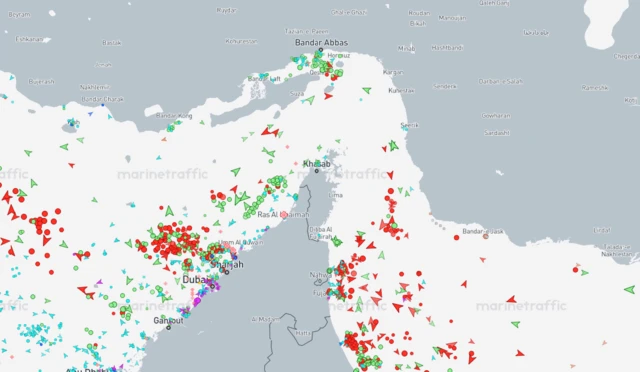
    Since the start of the war on 28 February, BBC Verify has tracked 392 vessels transiting the Strait of Hormuz using data provided by maritime intelligence firm MarineTraffic.

    Large vessels are fitted with an Automatic Identification System (AIS), which uses GPS to determine and broadcast their location in near real time.

    However, there are limitations to what we can say from AIS alone, as ships can switch it off entirely or deliberately obscure their positions to appear like they are elsewhere - a practice known as “spoofing”.

    A screenshot of MarineTraffic showing the locations of ships near the Strait of Hormuz, there are hundreds of points markedImage source, MarineTraffic
    Image caption,

    A screenshot from MarineTraffic showing the locations of ships near the Strait of Hormuz

    Analysis of satellite imagery can identify the location of ships, but gaps in where satellites cover or the presence of cloud obscuring images mean this is not always possible.

    Previous monitoring of the US blockade on Venezuela showed vessels attempting to evade restrictions through spoofing or turning off their AIS. Energy industry experts warn similar tactics are likely already being used in and around the strait.

    According to monitoring firm TankerTrackers.com, Iran-linked tankers have previously used spoofing to disguise movements, including making false port calls in neighbouring countries.

    “That's just modus operandi when it comes to obfuscating the loadings of Iranian crude oil and refined products. It's been the case since the Trump 1.0 era,” they tell BBC Verify.

  3. US blockade to encompass entire Iranian coastline - Reuterspublished at 13:25 BST 13 April

    More now on the note sent to seafarers from US Central Command (Centcom), which was first reported by Reuters news agency.

    In it, Centcom says the blockade encompasses "the entirety of the Iranian coastline", including but "not limited to" Iranian ports and oil terminals.

    It adds that humanitarian shipments such as food and medical supplies would be allowed, subject to inspection.

  4. Vessels breaching US blockade face 'interception, diversion and capture' - Reuterspublished at 13:12 BST 13 April
    Breaking

    The US military is set to enforce a blockade in the Gulf of Oman and the Arabian Sea, east of the Strait of Hormuz, and this will apply to all vessel traffic regardless of flag, according to a note sent from US Central Command (Centcom) to seafarers and reported by Reuters news agency.

    Centcom warns that vessels "entering or departing the blockaded area without authorization is subject to interception, diversion, and capture", the note says.

    The blockade is due to begin at 14:00 GMT (15:00 BST), the note confirms.

    It also reportedly states: "The blockade will not impede neutral transit passage through the Strait of Hormuz to or from non-Iranian destinations."

    We will bring you more on this as soon as we have it.

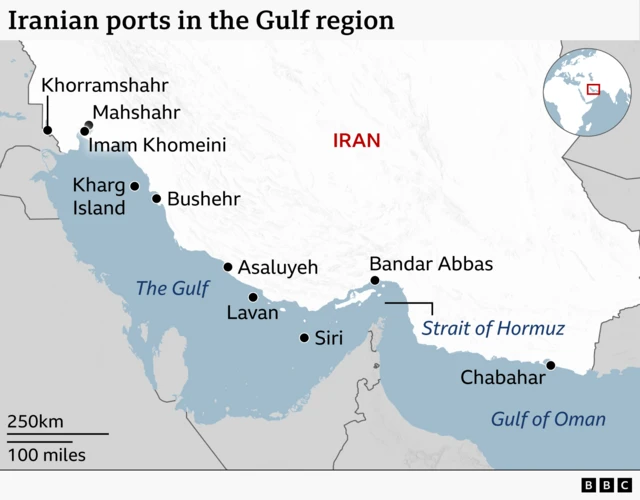
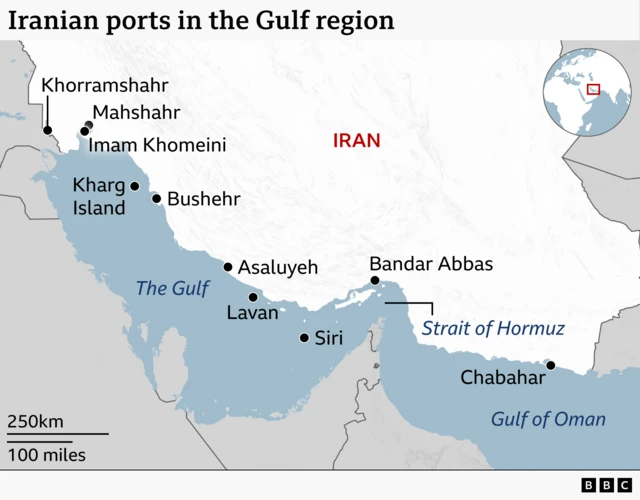
    A map showing Iranian ports in the Gulf region. Starting at the eastern end of the Gulf on Iran’s border with Iraq and heading west they are: Khorramshahr, Imam Khomeini, Mahshahr, Kharg Island, Bushehr, Asaluyeh, and the islands of Lavan and Siri. Then, a little further east, the major port of Bandar Abbas is on the Strait of Hormuz and further east is Chabahar on the Gulf of Oman, near to Pakistan.
  5. Israel supports US naval blockade, says Netanyahupublished at 12:55 BST 13 April

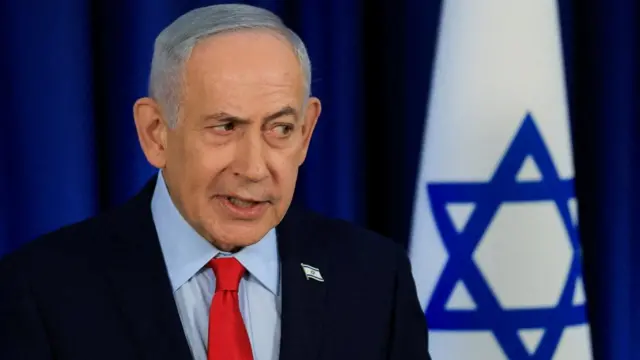
    Israeli Prime Minister Benjamin NetanyahuImage source, Reuters

    Benjamin Netanyahu says Israel supports the US naval blockade of Iranian ports.

    In a video address to his cabinet, the Israeli prime minister says: "President Trump decided to impose a naval blockade on them. We, of course, support this firm stance."

    He also says he spoke with US Vice-President JD Vance on Sunday, after talks with Iran. Vance told Netanyahu "the central issue is the removal of all enriched [nuclear] material and ensuring there is no more enrichment", according to the video address.

    Netanyahu says Vance called him from his plane back from Pakistan, and the vice-president gave a detailed update on the progress of the negotiations with Iran.

    The Israeli prime minister adds that any suggestion of a disconnect between the US and Israel is "the complete opposite".

  6. Less than three hours until US due to start blockade - what is the latest?published at 12:29 BST 13 April

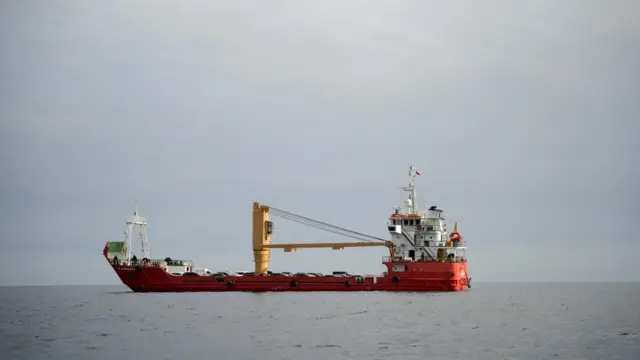
    A vessel at the Strait of Hormuz, off the coast of Oman’s Musandam province, April 12, 2026.Image source, Reuters
    Image caption,

    Around 20% of the world's oil and liquified natural gas pass through the Strait of Hormuz (file photo)

    Looming Iranian ports blockade

    The US has threatened to impose a blockade of Iranian ports, set to begin in the next few hours at 10:00 ET (14:00 GMT / 15:00 BST).

    US Central Command (Centcom) says the blockade will apply to vessels from all nations entering or leaving Iranian ports - both in Iran and those on the Gulf and Gulf of Oman.

    However, the US says it will not stop "freedom of navigation" through the strait "to and from non-Iranian ports".

    Iran's parliament speaker Mohammad Bagher Ghalibaf says Iran will not give in to threats, stating: "If they fight, we will fight." The Islamic Revolutionary Guard Corps says military vessels approaching the Strait of Hormuz will be "dealt with severely".

    Pope and Trump

    Pope Leo says he has "no intention to debate" US President Donald Trump, telling reporters he is "not a politician" and his message remains the same - "to promote peace".

    Over the weekend, Pope Leo urged the international community to end the "madness of war". Trump said the Pope was "terrible for foreign policy".

    Strikes between Lebanon and Israel

    In Lebanon, the Israeli military continues its offensive against Iran-backed Hezbollah. The Israel Defense Forces says its troops have surrounded the key town of Bint Jbeil in southern Lebanon.

    Hezbollah says it has attacked troops in Israel.

  7. Freedom of navigation in Hormuz strait of 'paramount importance,' says von der Leyenpublished at 12:18 BST 13 April

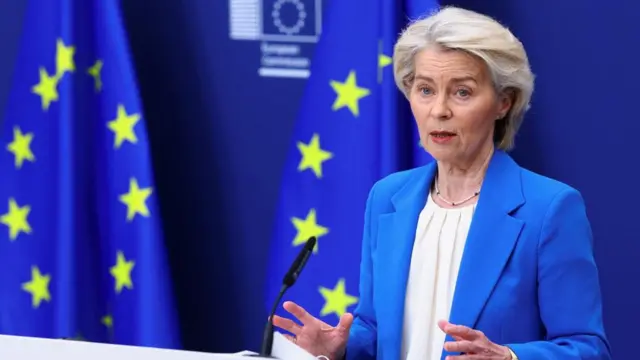
    European Commission President Ursula von der Leyen speaks at a press conference in BrusselsImage source, Reuters

    European Commission President Ursula von der Leyen has spoken about the financial impact of the US-Israeli war in Iran.

    She says the EU's bill for fossil fuel imports has risen by more than €22bn (£19.1bn) since the war began 44 days ago, without receiving a "single molecule" more.

    "We are paying a very high price for our over-dependence on fossil fuels," she says.

    Von der Leyen adds that freedom of navigation in the Strait of Hormuz is of "paramount importance" and that "robust coordination" between EU states is needed.

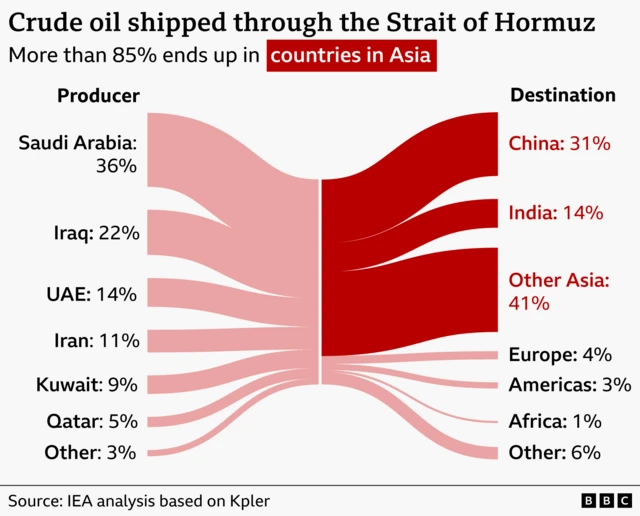
  8. Who is receiving crude oil passing through the Strait of Hormuz?published at 11:52 BST 13 April

    A Sankey-diagram showing crude oil producers on the left and destinations on the right for oil shipped through the Strait of Hormuz. Producers and their shares are: Saudi Arabia 36%, Iraq 22%, UAE 14%, Iran 11%, Kuwait 9%, Qatar 5%, and Other 3%. Destinations are: China 31%, India 14%, Other Asia 41%, Europe 4%, Americas 3%, Africa 1%, and Other 6%. Source: IEA analysis based on Kpler. Sent from Outlook for Mac

    The Strait of Hormuz is a vital shipping route, with around 20% of the world’s oil and liquefied natural gas passing through it.

    China is the largest single recipient of crude oil from the strait, taking 31% of the oil transported. India is next, receiving 14%.

    In total, 86% of all oil passing through the strait is delivered to countries in Asia.

    But any disruption to this route can affect prices around the world.

  9. Analysis

    Blockade puts US in even more dangerous territorypublished at 11:37 BST 13 April

    Frank Gardner
    Security correspondent

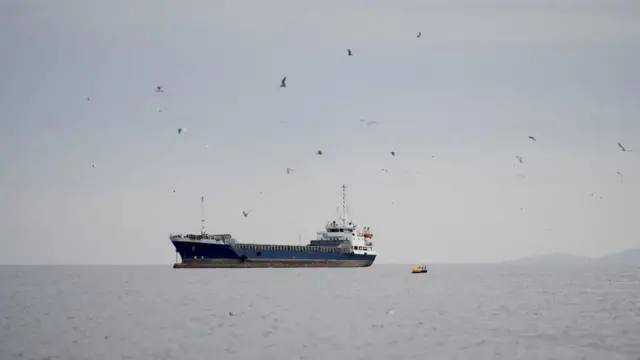
    A vessel at the Strait of HormuzImage source, Reuters
    Image caption,

    A vessel in the Strait of Hormuz, pictured on 12 April

    Blockading Iran’s ports means entering even more dangerous territory than the US was in before – legally, militarily and economically. It can be done, but at some risk.

    The US Navy’s warships will not be loitering around just outside the harbour walls of say, Bandar Abbas or Jask. That would be to invite immediate attack by drone, missile or "kamikaze" speedboat.

    Instead, Centcom, the part of the US military that covers the Middle East, will likely use satellite and other intelligence to ascertain which ships have left Iranian ports and who they belong to. Even with these vessels’ AIS (automatic identification system) transponders switched off, US warships sailing at a relatively safe distance offshore, will have no difficulty in finding them once they emerge into the Gulf of Oman, and interdicting them.

    But Iran has called this threat an act of maritime piracy, a charge levelled at itself for constricting the Strait of Hormuz. The Islamic Republic has threatened in turn to act against neighbouring Gulf Arab ports.

    Then there is the question of Iran’s allies: China and Russia. Will the US be prepared, say, to board and impound a Chinese-owned vessel or cargo? And what happens if China, which has a military base not far away in Djibouti, decides it will offer its ships an armed naval escort?

    A map showing Iranian ports in the Gulf region. Starting at the eastern end of the Gulf on Iran’s border with Iraq and heading west they are: Khorramshahr, Imam Khomeini, Mahshahr, Kharg Island, Bushehr, Asaluyeh, and the islands of Lavan and Siri. Then, a little further east, the major port of Bandar Abbas is on the Strait of Hormuz and further east is Chabahar on the Gulf of Oman, near to Pakistan.
  10. International community reacts to current Middle East situationpublished at 11:27 BST 13 April

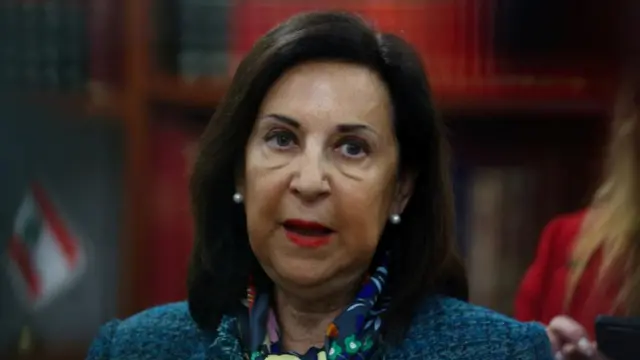
    A head and shoulders picture of Margarita Robles speaking at a press conference, wearing a blue jacket and a blue scarf with a flower pattern.Image source, Reuters
    Image caption,

    Spain's Defence Minister Margarita Robles says the US proposal to blockade Iranian ports "makes no sense"

    Several countries are responding to US President Donald Trump's threat to blockade Iranian ports.

    Spain's Defence Minister Margarita Robles has used some of the strongest language so far, saying the proposal "makes no sense".

    China is urging calm and restraint, adding that keeping the Strait of Hormuz open is in the common interest of the international community.

    Asean - a group of 11 Southeast Asian nations, many of which rely on the Middle East for energy - has called for "full and effective implementation of the ceasefire... ensuring maritime security and freedom of navigation and overflight".

    Meanwhile, France's Macron says France and the UK will organise a conference "aimed at restoring freedom of navigation in the strait" in the "coming days".

    As we've reported, UK Prime Minister Keir Starmer says the UK is "not supporting a blockade".

  11. Analysis

    Path to negotiations still open as shaky ceasefire holdspublished at 11:09 BST 13 April

    Lyse Doucet
    Chief international correspondent

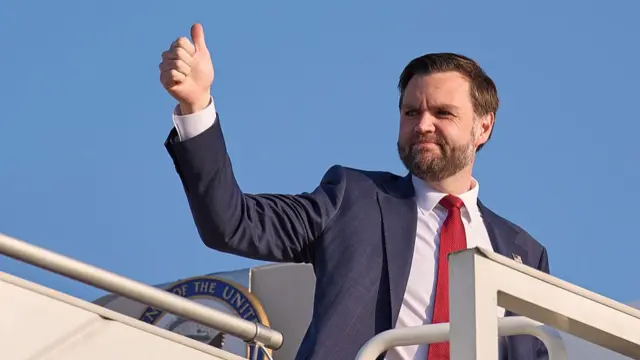
    US Vice President JD VanceImage source, Getty Images

    The door to diplomacy has not been shut, even though the US Vice-President JD Vance boarded a plane saying he had made the US's "final and best" offer.

    Since then, President Trump has said the meetings “went well”, even that some points were agreed. And although the atmosphere is not the defining issue, it makes a difference in diplomacy.

    We're hearing now from people who were in the room that discussions which began with maximalist demands became productive, even, as Trump put it, "friendly".

    Now that Tehran's political taboo of meeting face-to-face at this high level has been broken, it opens a path to a more serious negotiating track.

    But there are big bright red lines on both sides, especially on Iran’s nuclear programme.

    On that issue and others, including the Strait of Hormuz, neither side will move easily, quickly, or at all – that’s the task of talks.

    For now, the shaky ceasefire is holding, just. Even though both sides may want to avoid a military escalation, we have seen all too often the real risk of an accidental tumbling into confrontation.

  12. Pope has 'no intention to debate' Trump about warpublished at 10:59 BST 13 April

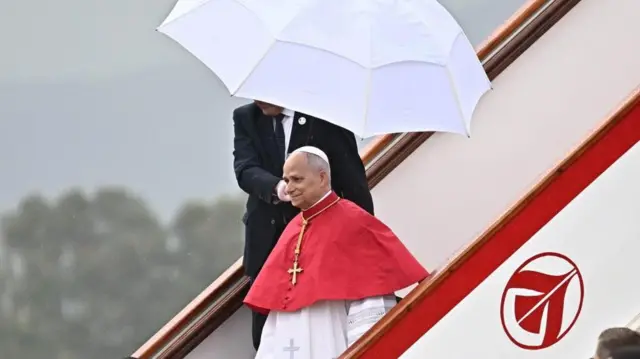
    Pope Leo XIV disembarks from his plane upon his arrival at Algiers International Airport, near Algiers, Algeria, 13 April 2026.Image source, EPA

    Pope Leo says he has "no intention to debate" US President Donald Trump, after the US leader criticised the pontiff's comments about the war in the Middle East.

    "I am not a politician," Pope Leo tells reporters, while defending his earlier remarks. "The message is the same: to promote peace."

    On Saturday - as Iranian and American negotiators met in Pakistan for talks to end the war - Pope Leo urged the international community to end "the madness of war". He also denounced the use of Christian language to justify war.

    In response, Trump said Pope Leo was "terrible", calling him "WEAK on Crime, and terrible for Foreign Policy".

    Return to the latest post
  13. Analysis

    Diplomatic consequences of US blockade of Iranian ports could be hugepublished at 10:52 BST 13 April

    Joe Inwood
    World news correspondent

    There’s a lot to unpack in the original threats of Donald Trump - and the clarification from his military commanders.

    His initial proposal of "BLOCKADING any and all Ships trying to enter, or leave, the Strait of Hormuz" now seems to refer only to ships travelling to or from Iranian ports. But even this is fraught with complications and risk.

    Stopping Iranian flagged vessels is one thing, but what about an Indian or Pakistani flagged tanker? Chinese vessels have made up a significant proportion of the ships able to make it through.

    Boarding a ship is technically an act of war, and certainly a deeply hostile act. The diplomatic ramifications could be huge.

    It would set a precedent that would not go unnoticed in the South China Sea, where China’s ambitions over Taiwan are never far from the surface.

    Trump also said "no one who pays an illegal toll will have safe passage on the high seas". It’s been widely reported that a fee in the region of $2m (£1.5m) is being charged for safe passage - an important source of revenue to Iran.

    But this could be paid in untraceable cryptocurrency. How do you separate those who have bought safe passage from those whose governments have negotiated it?

    Ultimately, this appears to be an attempt to escalate rather than to deescalate. "'ALL BEING ALLOWED TO GO IN, ALL BEING ALLOWED TO GO OUT'", the president said. But the risk with that strategy is that sometimes escalation just leads to more escalation.

  14. France and UK to hold conference on Strait of Hormuz, Macron sayspublished at 10:41 BST 13 April

    French President Emmanuel Macron says France and the UK will organise a conference "aimed at restoring freedom of navigation in the strait" in the "coming days".

    In a post on social media, he says the conference will be organised with countries ready to contribute to a "peaceful multinational mission aimed at restoring freedom of navigation in the strait".

    "This strictly defensive mission, separate from the warring parties to the conflict, is intended to be deployed as soon as circumstances permit," he adds.

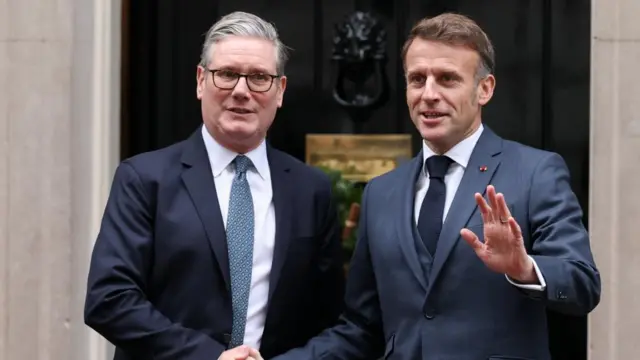
    Starmer and Macron shaking hands outside Downing StreetImage source, Reuters
    Image caption,

    Starmer and Macron at No 10 back in December 2025

  15. Analysis

    Why could the US naval blockade affect China?published at 10:34 BST 13 April

    Laura Bicker
    China correspondent

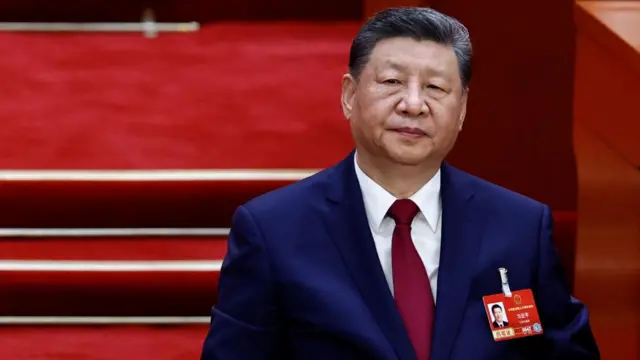
    Chinese President Xi JinpingImage source, Reuters

    The Chinese government has called for calm and restraint from all sides as Donald Trump threatens to launch a naval blockade of Iranian ports.

    China has not confirmed it had any part in persuading Tehran to attend peace talks in Pakistan over the weekend, but there’s no doubt that Beijing will want an end to this war.

    And not because it needs Iranian oil.

    Iran only provides about 13% of China's crude oil. If needed, Beijing could go elsewhere for these supplies.

    But the Strait of Hormuz is key to energy supplies from other Gulf States including Saudi Arabia, Iran and UAE.

    The Middle East has become more important to China in recent years as Beijing fought a trade war with Washington. China’s exports to the Middle East grew nearly twice as fast as its exports to the rest of the world in 2025.

    This is where China’s real interests lie. Its economy is heavily reliant on the sale of goods to countries across the world, and global instability will be a serious concern to Beijing.

    President Xi will also not want the US having any role in policing such a strategic waterway.

    This may pressure Beijing to consider taking further action. But China has a long policy of non interference and so far, it does not appear interested in providing guarantees for Iran’s long term security.

  16. Hezbollah launches drones at Israel as IDF carries out attacks in Lebanonpublished at 10:18 BST 13 April

    As the US threatens a blockade of Iranian ports, fighting continues in the Middle East.

    Today, Hezbollah said it has attacked Israeli soldiers in Shlomi, Israel, using drones. Israel issued an air raid alert for the area.

    Meanwhile, the Israel Defense Forces has given an update, saying its forces are expanding operations in the south of Lebanon.

    It says an attack on Bint Jbeil killed 100 Hezbollah fighters and that hundreds of weapons were found in the area.

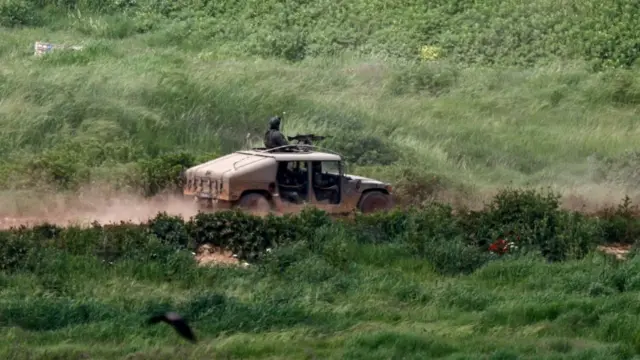
    An Israeli military vehicle kicking up dust, with a soldier manning a machine gun on the roofImage source, Reuters
    Image caption,

    An Israeli military vehicle in southern Lebanon on Sunday, seen from the Israeli side of the border

  17. 'Not a question of whether it can be done, but to what impact' - ex-US envoy on US blockade threatpublished at 09:53 BST 13 April

    It's not the first time the US Navy has enforced a blockade - most recently, it did so towards Cuba and Venezuela, says former US special envoy David Satterfield.

    "It's not a question of how it is done, or whether it can be done, but to what impact," Satterfield tells BBC Radio 4's Today programme.

    "The Gulf is a critical global supply point, far beyond hydrocarbons - and the impact if this goes on for several more weeks is going to become quite profound, beyond just the cost of petrol and diesel at the pump."

    • As a reminder, Donald Trump has announced a US blockade of Iranian ports will begin on Monday at 10:00 ET (14:00 GMT / 15:00 BST)
  18. BBC Verify

    Four ships identified crossing Strait of Hormuz since last nightpublished at 09:34 BST 13 April

    By Shruti Menon

    BBC Verify is tracking shipping passing through the Strait of Hormuz following the announcement by US Central Command (Centcom) that a blockade is to be enforced against “all maritime traffic entering and exiting Iranian ports” from 10:00 ET (14:00 GMT / 15:00 BST) today.

    Since Centcom issued its statement last night at 21:52 BST, four vessels have been identified crossing the strait, according to tracking data provided by MarineTraffic.

    All are identified as tankers - carrying either oil, gas or chemicals. We have not found Iranian links for any of these vessels, and none can be identified as going to or from Iranian ports.

    We are, however, relying on data transmitted by the vessels themselves, and none of these four have provided their origin as an Iranian port.

    Centcom has previously announced that two destroyers - the USS Frank E Petersen Jr and USS Michael Murphy - are in the area as part of a mission to clear "sea mines previously laid by Iran’s Islamic Revolutionary Guards Corps".

    We will continue to monitor shipping in the area through the day as the deadline approaches for the implementation of the US blockade.

    Correction 15:30: We have subsequently learned that one of the ships crossing the strait today, the Auroura, is on the US sanctions list for transporting Iranian petroleum products.

    A second vessel, the NV Sunshine, has been flagged by UANI (United Against Nuclear Iran) as being suspected of helping move Iranian petroleum products.

  19. European markets open lower as US threatens blockade of Iranian portspublished at 09:23 BST 13 April

    Dearbail Jordan
    Live reporter

    European stock markets opened lower on Monday after US-Iran peace talks failed at the weekend and Donald Trump announced the US will blockade Iranian ports.

    In the UK, the FTSE 100 index fell by 0.38%. France’s Cac 40 dropped 0.95%, while Germany’s Dax index was down 1%.

    Oil prices stayed high, with Brent crude rising more than 7% to $102 a barrel.

    Susannah Streeter, chief investment strategist at investment firm Wealth Club, said: "Trump is turning Iran’s chokepoint into a US stranglehold."

    She added: "Trump does have a track record of pulling back from the brink, especially when markets react negatively, and so there will be hopes that he’ll remain true to form and an agreement can be salvaged sooner rather than later.

    "But in the meantime, investors should be prepared for more turbulence."

  20. Analysis

    Blocking Iranian ports may prompt China to put more pressure on Iran to reach a dealpublished at 09:14 BST 13 April

    Simon Jack
    Business editor

    The collapse of talks over the weekend and Donald Trump's threat to blockade ships coming from and heading to Iranian ports has had the expected impact on markets.

    Oil prices have surged back above $100 a barrel, Asian stock markets have fallen and European market futures point to a lower opening.

    But the wider canvas here is what seems an attempt to bring more pressure to bear on China.

    Although China has large oil reserves and gets a lot of oil from Russia, Iran provided 16% of China's crude oil imports. Most of the Iranian oil that was making it through the strait was bound for China. Stopping that may force China to bring more pressure on Iran to reach a deal.

    The other commodity that takes a battering from the extended blockage is confidence and this morning's chief financial officers confidence survey by Deloitte - which included most of March - has shown any signs of returning business confidence earlier this year extinguished.