Summary

  1. White House briefing room buzzing as Iran questions lingerpublished at 16:49 GMT 25 March

    Bernd Debusmann Jr
    Reporting from the White House
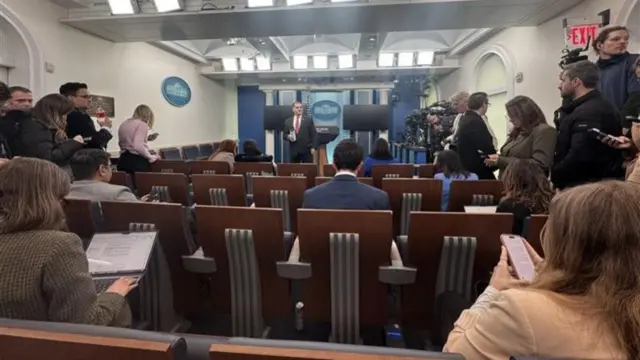
    The media preparing for a press briefing in the White House briefing room

    I'm currently in the White House briefing room, which is already buzzing with activity ahead of Press Secretary Karoline Leavitt's briefing in a few minutes.

    It's more crowded than usual, and much of the interest, it's fair to say, has to do with the war in Iran.

    Questions about the war are likely to dominate the session, particularly the many lingering questions regarding a potential negotiated end to the conflict.

    The White House, for its part, has not publicly commented on the 15-point plan being reported by the world's media.

    Iran's counterproposal, however, has been broadcast through official channels.

    Several of its points - most notably war reparations and "natural" sovereignty over the Strait of Hormuz - would be extremely difficult for the Trump administration to accept and are likely already considered a non-starter as far as the president is concerned.

    There's also likely to be many questions on the deployment of ground troops to the region, and how they might be used if the war continues.

  2. Netanyahu says Israel 'expanding' southern Lebanon security zonepublished at 16:44 GMT 25 March
    Breaking

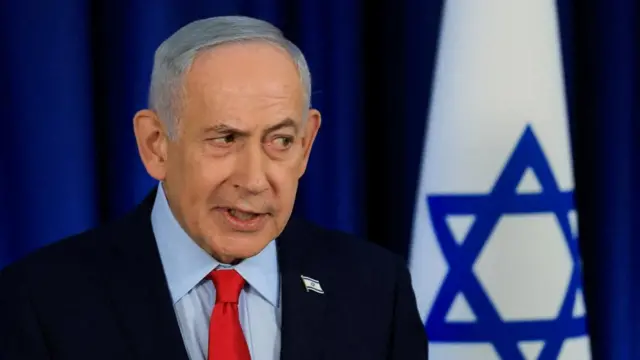
    Israeli Prime Minister Benjamin Netanyahu in front of a national flag.Image source, Reuters

    Israel has announced it is "expanding" its security zone in southern Lebanon to remove the threat of anti-tank missiles.

    Israeli Prime Minister Benjamin Netanyahu posted on X the expansion would create a "larger buffer zone" and help prevent a ground invasion of Israel by the Iranian-backed Hezbollah.

    In recent days, Israeli troops have blown up various bridges on the Litani River, about 30km (19 miles) from the Lebanon-Israel border, which the country's defence minister Israel Katz said were being "used by Hezbollah for the passage of terrorists and weapons".

    Katz said on Tuesday that the many thousands of Lebanese people in the south who have been displaced "will not return south of the Litani River until security is guaranteed for the residents of the north" of Israel.

  3. Iran seizes exiled figures' assets as daily arrests continuepublished at 16:22 GMT 25 March

    Ghoncheh Habibiazad
    Senior reporter, BBC Persian

    Iranian authorities have targeted diaspora figures accused of supporting Israel and the US during the conflict with asset seizures.

    Iranian media outlets say the properties of exiled actor Borzou Arjmand and several of his relatives in Iran have been confiscated following a judicial order.

    In a separate case, a court in central Yazd province confirmed the seizure of assets belonging to Ali Sharifi Zarchi, an exiled academic, and a woman identified only by her initials MMA (in Persian), both living abroad.

    Ali Sharifi Zarchi reacted on his X account, saying his “insignificant assets”, which have been seized, are worth less than "even a single strand of the Iranian people’s hair".

    The BBC has seen text messages sent to Iranians by Iran’s judiciary yesterday, informing them of a domestic online platform for seizing assets of “elements co-operating” with Israel and “hostile” countries.

    Meanwhile, arrests of those accused of “collaborating with the enemy” are still happening daily.

  4. Analysis

    Iran claims sovereignty over the Strait of Hormuz - but no country has sole authoritypublished at 16:11 GMT 25 March

    Paul Adams
    Diplomatic correspondent

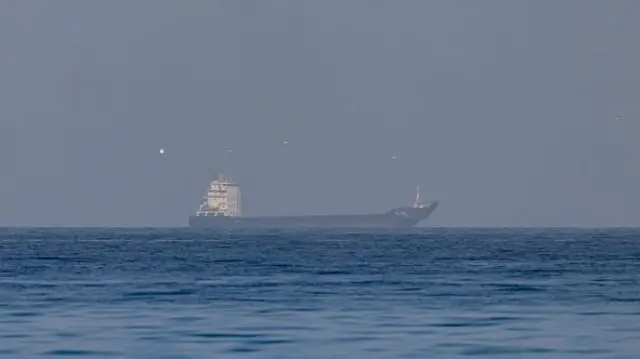
    A shipping vessel on the horizon in the Strait of HormuzImage source, Getty Images

    In a defiant reply to Washington’s reported proposals to end the war, Iran claims sovereignty over the Strait of Hormuz “is its natural and legal right".

    The claim is made in a statement to Iran’s Press TV by an unnamed “senior political-security official".

    But no country has sole legal authority over the Strait of Hormuz.

    Under international law, the Strait is a shared waterway, in which both Iran and Oman claim territorial waters of 12 nautical miles from their respective coastlines.

    According to the UN Convention on the Law of the Sea (UNCLOS), ships enjoy the right of “transit passage", and cannot be interfered with by coastal states.

    The two main shipping corridors generally used by vessels transiting the Strait of Hormuz mostly pass through Omani territorial waters, where depths are more favourable.

    However, either side of the Strait’s narrowest point (21 nautical miles) both lanes briefly cross into Iranian territorial waters.

  5. BBC Verify

    Footage shows smoke plume after reported Iranian missile strike on Israeli power plantpublished at 15:57 GMT 25 March

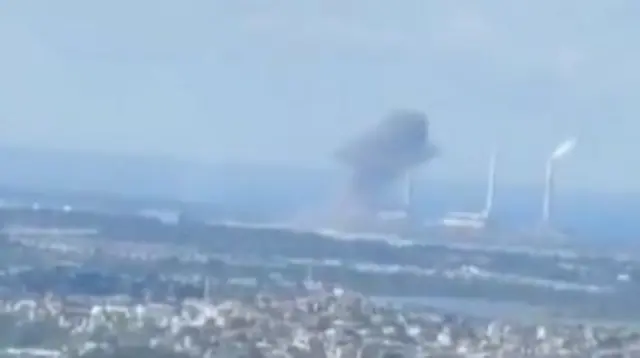
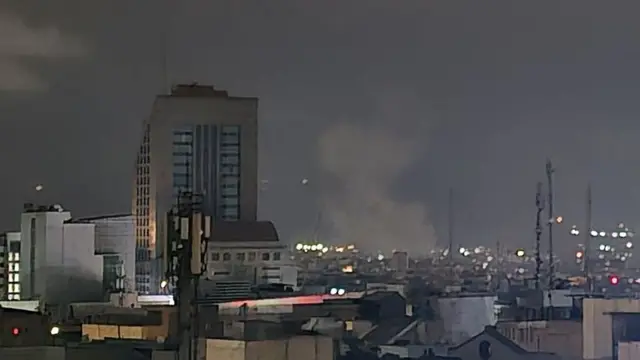
    A smoke cloud seen at the power station which has three chimney stacksImage source, X

    By Sarah Jalali

    We’ve verified footage from today showing a cloud of smoke near a power station in Israel following a reported Iranian missile attack.

    The power station, at Hadera on the Mediterranean coast, is one of the largest in Israel and was converted from coal to gas-fired in 2022.

    The footage shows grey smoke rising from near one of the plant’s cooling towers.

    We were able to identify the location using satellite imagery, and a reverse-image search indicated the clip was first uploaded today.

    The Times of Israel, citing the Israel Electric Corporation, reported that no damage was caused to the power station’s infrastructure following a ballistic missile attack.

  6. Iranian air defence systems heard in Tehranpublished at 15:43 GMT 25 March

    Ghoncheh Habibiazad
    Senior reporter, BBC Persian

    Three sources tell me they have heard the sound of air defence systems in Iran's capital, Tehran.

    It comes after the Israeli military said earlier today it had completed several waves of strikes targeting infrastructure in the capital.

  7. Analysis

    Mixed messages surround prospect of talks to end warpublished at 15:26 GMT 25 March

    Sebastian Usher
    Middle East analyst

    Mixed messages and lack of clarity continue to surround the prospect of talks between the US and Iran.

    The rumours have calmed energy markets for the moment, but the first comments from Iranian officials are not hopeful.

    A senior but unnamed official quoted by the Iranian media has said that Tehran has responded negatively.

    The official said that Iran would end the war only when it decided to do so and when it's conditions were met.

    And he repeatedly rejected the offer of a ceasefire rather than a complete end to the war.

    Certainly, the so-called fifteen-point plan demands major concessions from Iran - amounting to closing down its nuclear programme, ending its backing of armed proxies in the region, limiting its missiles and allowing the Strait of Hormuz to function as a free maritime zone.

  8. US is 'wrapping up' Operation Epic Fury, House speaker sayspublished at 15:15 GMT 25 March

    US Speaker of the House of Representatives Mike Johnson.Image source, EPA

    US House of Representatives Speaker Mike Johnson says the United States is "wrapping up" its war with Iran.

    "I think we're wrapping up Operation Epic Fury. That's what I think. And I think it'll be done in short order and that'll be right on schedule," Johnson tells US media in Washington DC.

    His comments come after US President Donald Trump said his administration was talking to the "right people" in Iran who wanted to "make a deal".

    Iran has since rejected a peace plan sent by the US, labelling it as "excessive".

  9. US confirms paratroops on way to Middle Eastpublished at 14:48 GMT 25 March
    Breaking

    Bernd Debusmann Jr
    Reporting from the White House

    After days of questions, the Pentagon has now officially confirmed the deployment of some ground troops to the region.

    In a statement to the BBC, a spokesperson said some elements of the 82nd Airborne Division headquarters, some "division enablers" and the 1st Brigade Combat Team will be deploying to the Middle East.

    For security reasons, the spokesperson declined to give further details.

    The make-up of these units tells us a lot about what capabilities are being brought in for possible use in the conflict.

    Based in North Carolina, the 82nd Airborne is seen as one of the military's top conventional combat units, with some elements always ready to deploy anywhere in the world within 18 hours.

    These troops are trained to parachute or helicopter into a target area and seize it. In the case of Iran, they could give the US an option to seize Kharg Island or other key territory.

    The unit, however, is meant for mobility and lacks heavy equipment for sustained combat.

    The 1st Brigade Combat Team, or 1st BCT, is a New York-based part of the 10th Mountain Division and is fully equipped for sustained combat, or "full spectrum" operations in military terms.

    Return to the latest post
  10. Iran responds 'negatively' to US proposal to end war - state mediapublished at 14:42 GMT 25 March
    Breaking

    Ghoncheh Habibiazad
    Senior reporter, BBC Persian

    Iran’s state broadcaster Press TV says, quoting a “senior political-security official”, that Iran has rejected a US proposal aimed at ending the current war.

    Press TV hasn’t named the official, nor their rank or title, but reports the official says: "Iran will end the war when it decides to do so and when its own conditions are met."

    Iranian officials have repeatedly said they want a complete end to the war, not just a ceasefire.

    According to Press TV, the official outlined five conditions, including:

    • A complete halt to "aggression and assassinations" by the enemy
    • The establishment of concrete mechanisms to ensure that the war is not reimposed on the Islamic Republic
    • Guaranteed and clearly defined payment of war damages and reparations
    • The conclusion of the war across all fronts and for all resistance groups involved throughout the region
    • International recognition and guarantees regarding Iran's sovereign right to exercise authority over the Strait of Hormuz

    Press TV says Washington has been pursuing talks through various diplomatic channels, but Tehran sees the proposals as “excessive”.

  11. White House adds previously unannounced briefing to schedulepublished at 14:25 GMT 25 March

    Bernd Debusmann Jr
    Reporting from the White House

    The North Portico of the White House is seen under a cloudy sky on March 9, 2025 in Washington, DCImage source, Getty Images

    White House Press Secretary Karoline Leavitt says there will be a briefing for reporters at the White House today, with questions about Iran expected to dominate.

    The briefing was not on the previously announced schedule, and it’s unclear why it was added.

    Donald Trump has a busy schedule today, though we may only catch glimpses of him.

    Most of the president’s events are closed to the press, including his intelligence briefing and a series of policy meetings this afternoon.

    In the evening, Trump will make a short trip to nearby Union Station, Washington’s main train terminal, for a National Republican Congressional Committee fundraiser.

    He’s likely to make remarks there, and it would be surprising if he didn’t at least mention Iran.

  12. How many people have been killed in the war?published at 14:10 GMT 25 March

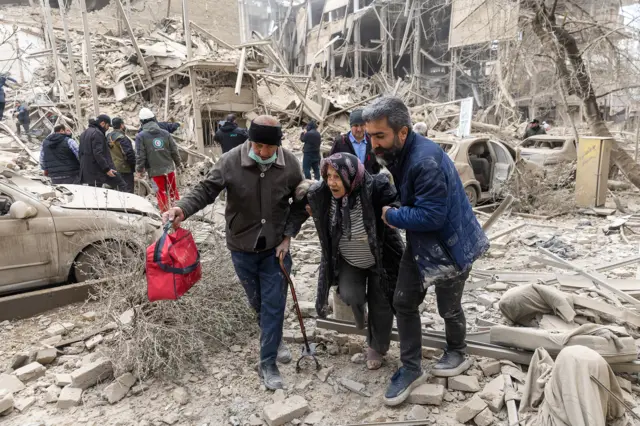
    A woman is pulled by two men away from rubble and debris following US-Israeli attacks on Tehran on 16 MarchImage source, Getty Images
    Image caption,

    Iran has seen the most killed since 28 February from US-Israeli attacks - this photo shows an elderly woman being pulled from the scene of a strike on a residential building in Tehran on 16 March

    While it's difficult to independently verify all figures, the death toll from the war in the Middle East appears to have surpassed 4,500.

    Here's a snapshot:

    Iran has suffered the heaviest losses, with US-based rights group HRANA estimating 3,291 deaths - including 1,455 civilians.

    In Lebanon, where Israel is carrying out strikes against Hezbollah, 1,072 people have been killed, according to the Lebanese health ministry.

    According to Iraqi authorities, at least 81 people have died in Iraq, mostly members of the Hashed al-Shaabi (Popular Mobilisation Forces, PMF), which has links to Iran.

    Israel has reported 18 deaths, mostly from missile attacks. The Israeli military said two soldiers were killed in southern Lebanon.

    The US has lost 13 service members, including six in a refuelling aircraft crash over Iraq.

    A separate incident killed seven people in Qatar when a helicopter malfunctioned during "routine duty", according to Qatar's defence ministry.

    The UAE's defence ministry confirmed nine deaths, including three armed forces members and six civilians.

    Kuwait has reported six deaths, including two interior ministry officers and two army soldiers.

    Strikes are also reported to have killed four people in Syria, four in the West Bank, two in Bahrain, two in Oman and two in Saudi Arabia.

  13. How some Iranians are coping with the warpublished at 13:49 GMT 25 March

    Ghoncheh Habibiazad
    Senior reporter, BBC Persian

    There’s nothing “normal” about a war.

    Some people are paying hefty prices to connect to the internet, as the government has imposed an internet outage.

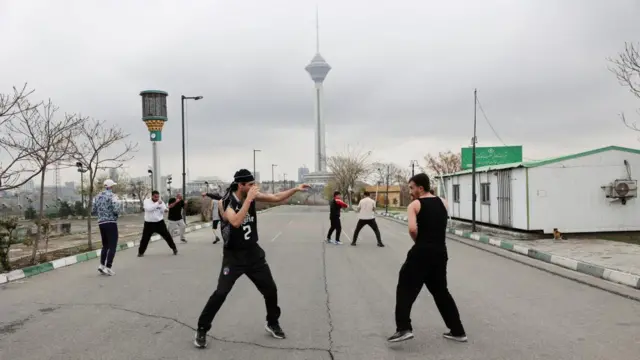
    From what I’m hearing from young people inside the country, they’re trying to get back to their routines before the war and go out more whenever they can.

    “I’m feeling a bit better. I went to a coffee shop for the first time since the war started! But the streets were emptier than usual,” said a woman in her 20s in Tehran.

    “I went out for a run in the morning. Had a nice start to my day,” said another woman in her 20s who moved from Tehran to a northern province she sees as “safer”.

    Tehran has seen the heaviest strikes since the war began.

    Some are trying to visit relatives and friends during the current holiday period for Persian New Year.

    Another woman in her 20s who has moved out of Tehran said, “I went to see them for a day or two. Well, it was good for a change at least. But I miss Tehran so much.”

    Iranian people exercise at Pardisan Park, amid the U.S.-Israeli conflict with Iran, in Tehran, IranImage source, Reuters
    Image caption,

    People exercise at Pardisan Park in Tehran during the US-Israeli war with Iran

  14. Latest developments as war continues in the Middle Eastpublished at 13:31 GMT 25 March

    Imogen James
    Live reporter

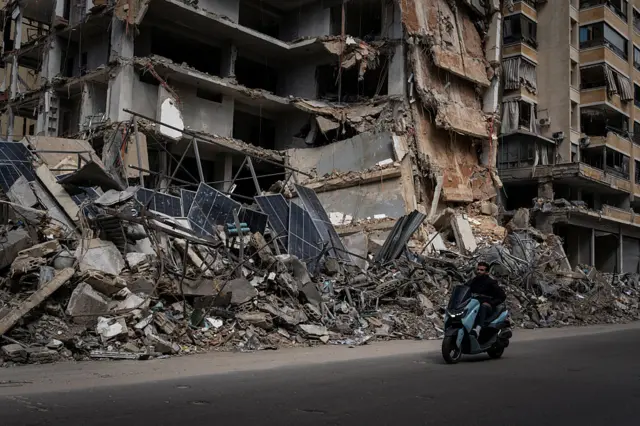
    man rides on a motorbike in front of the aftermath of an IDF strike in the area of DahiyeImage source, Getty Images
    Image caption,

    The aftermath of an IDF strike in Beirut on 25 March

    US-Iran talks still unclear

    It's still not confirmed whether talks between the US and Iran are happening.

    A spokesperson for Iran's Khatam al-Anbiya Central Headquarters - the country's main military command - spoke about a "self-proclaimed global superpower", saying "someone like us will never come to terms with someone like you".

    That contradicts a statement from US President Donald Trump, who said on Tuesday that his administration was "talking to the right people" and Iran wants "to make a deal".

    We haven't seen the 15-point plan which the US says it has sent to Iran, but reports suggest it includes destruction of Iranian nuclear facilities and removal of sanctions.

    Strikes continue

    Lebanon's state-run National News Agency says Israeli strikes killed at least six people in the south on Wednesday.

    The Israel Defence Forces says Iran has launched multiple rounds of missiles at the country. It also says it carried out an "extensive" wave of strikes across Iran's research facility in the city of Isfahan on Tuesday.

    Elsewhere, Iranian drones have been targeting Saudi Arabia and Kuwait.

    Seven fighters have been killed in Iraq, according to its defence ministry.

    Blocking of Strait of Hormuz

    In a message posted on X, external by its mission to the UN on Tuesday, Iran said "non-hostile vessels" would be allowed to pass through the Strait of Hormuz, provided they co-ordinate with "the competent Iranian authorities".

    But so far today, only one tanker has passed through, BBC Verify has found.

  15. Iraq to submit complaint to the UN after attackspublished at 13:10 GMT 25 March

    Iraq will submit a formal complaint to the United Nations Security Council after attacks on its military units, a spokesman says in a statement from the prime minister's media office.

    The prime minister has also told the foreign ministry to summon the chargé d’affaires of the US Embassy following the attacks.

    Iraq's defence ministry says seven fighters were killed and 13 injured at a base in western Iraq on Wednesday.

    The strike comes after the deadliest attack on Iraq since the war began in the Middle East, which killed 15 Iraqi fighters on Tuesday. The Shia-dominated Hashed al-Shaabi (Popular Mobilisation Forces, PMF) said they were killed in a US attack. The US has not commented.

    For context: The PMF is an umbrella organisation of paramilitary groups, some of which are aligned with Iran.

  16. Pentagon puts defence production 'on a wartime footing'published at 12:48 GMT 25 March

    Defence Secretary Pete HegsethImage source, EPA

    The Pentagon says it will boost production of several defence systems and munitions.

    It will "accelerate the production of the precision strike missile," as well as the seekers for the Terminal High Altitude Area Defense (Thaad), which is designed to intercept high-altitude missiles, the department says in a statement on its website.

    Defence Secretary Pete Hegseth wants to "put the defence industrial base on a wartime footing," the department says, adding that it will also increase production of navigation systems and electronic warfare solutions.

  17. BBC Verify

    Only one tanker identified passing Strait of Hormuz so far todaypublished at 12:32 GMT 25 March

    By Daniele Palumbo

    In a message posted, external on X, external , externalby its mission to the UN on Tuesday, Iran said that "non-hostile vessels" would be allowed to pass through the Strait of Hormuz, provided they co-ordinate with "the competent Iranian authorities".

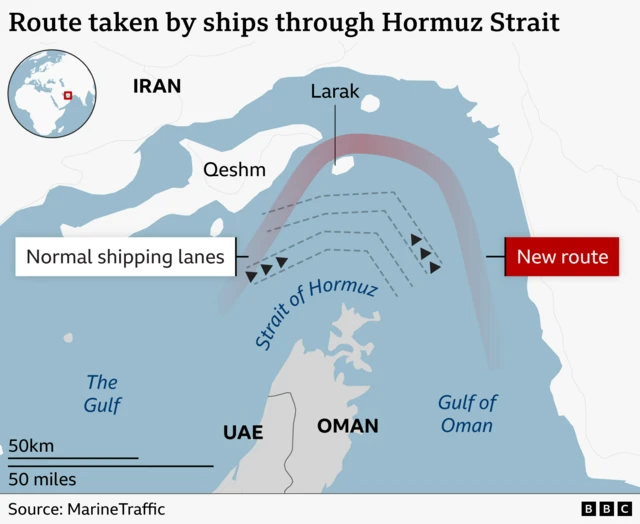
    We’ve been analysing data from MarineTraffic - which tracks movements of vessels via their location transmitters - and identified just one tanker passing through so far today.

    The Chinese-owned tanker, Egret, travelled westwards into the Gulf early this morning on a track closer to the Iranian coast than the usual shipping routes, according to MarineTraffic.

    Yesterday, six tankers passed through the strait broadcasting their positions. Three were Chinese-owned, two by Indian companies and one registered to a Panamanian owner.

    The Iranian UN mission said vessels would be allowed passage "provided that they neither participate in nor support acts of aggression against Iran and fully comply with the declared safety and security regulations".

    Route taken by Chinese-owned ship through the Strait of Hormuz, showing it sailing closer to the Iranian coast than the usual shipping lanes
  18. New list of targets approved for attack on Iran - Israel defence ministerpublished at 12:19 GMT 25 March

    Explosions lighting up the skylineImage source, Anadolu via Getty Images
    Image caption,

    Explosions light up the skyline in Tehran on 25 March

    Israeli Defence Minister Israel Katz says a new list of targets has been approved for an attack on Iran.

    The Israeli Air Force has dropped more than 15,000 bombs on targets in Iran since the start of the war - using four times the amount of munitions used in the 12-day war between Iran and Israel last year, Katz says.

  19. Israel says it has struck Iranian research facility in Isfahanpublished at 12:02 GMT 25 March

    The Israel Defense Forces says it has carried out an "extensive" wave of strikes across Iran's Underwater Research Center in the city of Isfahan on Tuesday.

    The military says the centre is the only facility in the country responsible for producing submarines and other support for the Iranian navy. Iran has not commented on this.

    Earlier, we brought you a post from BBC Verify saying that a high-rise building and nearby shops in Isfahan appear to have been damaged after air strikes yesterday. It's not clear whether these are the same strikes.

  20. Iran 'closely monitoring' movement of US troops - parliament speakerpublished at 11:41 GMT 25 March

    Mohammad Bagher Ghalibaf sits in a television studio next to two microphones in 2024Image source, Reuters

    The speaker of the Iranian parliament, Mohammad Bagher Ghalibaf, says Iran is "closely monitoring all US movements in the region, especially troop deployments".

    "Do not test our resolve to defend our land," he adds in a social media post.

    The Pentagon is expected to send troops from the 82nd Airborne Division - including ground forces and a command element - according to CBS News, the BBC's US partner.

    Unconfirmed reports suggested, external the Trump administration was considering Ghalibaf as a potential partner, and possibly even a future leader.