Summary

  1. Iran and the US continue to send conflicting messages about negotiationspublished at 01:33 GMT 26 March

    Our live coverage of the Iran war continues at this link amid conflicting reports about negotiations between Washington and Tehran. Here are the latest developments:

    • Speaking on Wednesday, White House Press Secretary Karoline Leavitt said President Trump has been engaged over the last three days in "productive conversations" with Iran
    • She also said the operation was "ahead of schedule" and the Iranian regime was looking for an "exit ramp"
    • That message is in stark contrast to the tone of Iranian Foreign Minister Abbas Araghchi, who said later that Iran has “no intention of negotiating for now
    • He said messages had been “conveyed via friendly countries”, but these exchanges is “neither dialogue nor negotiation, nor anything of the sort”
    • Undeterred, Trump insists that Iran "are negotiating", saying "they're afraid to say it because they figure they'll be killed by their own people". He added: "They're also afraid they'll be killed by us"
    • There has also been conflicting reports about proposals to end the war. On Wednesday, there were reports that Iran had received a 15-point plan from the US for reaching a ceasefire
    • For its part, an Iranian “senior political-security official” was quoted by state broadcaster Press TV as saying they had five conditions to end the war, including payment of "war damages and reparations" and the end of the war across all fronts
    • Meanwhile, the fighting continues - smoke was seen billowing from an Israeli power station after a reported Iranian missile attack, while Iranian air defence systems have been heard in Tehran

    Stay with us here for the latest updates and analysis.

  2. Manila transport strike as drivers protest rising fuel costspublished at 01:02 GMT 26 March

    Suranjana Tewari
    Asia Business Correspondent in Manila

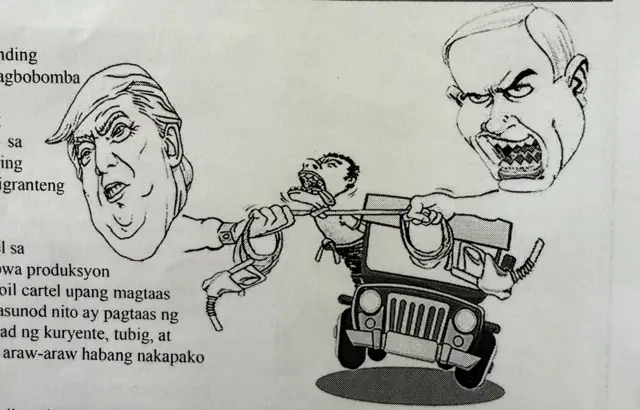
    cartoon on leaflet being handed out at protest

    Demonstrators have been on the streets in central Manila since 7am this morning, part of a wider “welga” or strike action, calling for urgent government intervention as fuel prices continue to rise.

    I’m at one protest in Cubao, a commercial district in Quezon City, where members of PISTON are holding a loud rally. The group represents jeepney drivers and operators and says many are no longer earning enough to sustain daily operations, with diesel prices now more than double what they were before the war broke out.

    There is also anger among some protesters at global leaders and the impact of geopolitical tensions on oil supply; some are handing out leaflets featuring a political cartoon depicting Ferdinand Marcos Jr. being strangled by Donald Trump and Benjamin Netanyahu.

    Protests are taking place in other parts of the capital, with demonstrators holding leaflets and placards outlining their grievances. They point to rising food and utility costs, saying broader cost-of-living pressures are compounding the strain on transport workers.

    Demonstrators are critical of the government’s response, saying subsidies and financial aid are insufficient and often delayed. Their demands include the removal of fuel taxes, stricter regulation of oil prices, and higher fares.

    While the government has put in place a legal framework that would allow fuel tax cuts, no reductions have been implemented so far.

    Organisers warn transport disruptions could escalate if their concerns are not addressed.

  3. US Postal Service to apply temporary fuel surcharge on packagespublished at 00:33 GMT 26 March

    A United States Postal Service (USPS) collection box is pictured in Washington on 18 December 2024 while two people walk behind it out of focusImage source, Reuters

    The US Postal Service will implement ian 8% surcharge on packages - its first such surcharge - to keep up with rising costs of fuel due to the war.

    The "time-limited adjustment" comes in response to market conditions to allow the mail carrier to support its "universal service obligation in a more financially sustainable manner going forward", USPS says in a news release.

    The planned price change was approved on 24 March by the independent federal agency's bipartisan board of governors. It will be applied to packages, not mail, and affects base postage prices on products including priority mail and ground services.

    The surcharge is scheduled to take effect on 26 April and will remain in place until 17 January 2027, when the Postal Service - which serves more than 170 million addresses six to seven days a week - will decide if a different long-term approach is needed.

    "Transportation costs have been increasing, and our competitors have reacted with a number of surcharges," USPS says, adding that it has steadfastly avoided surcharges and this charge is less than one-third of what its competitors charge for fuel alone.

  4. What negotiations - if any - might be happening between the US and Iran?published at 00:12 GMT 26 March

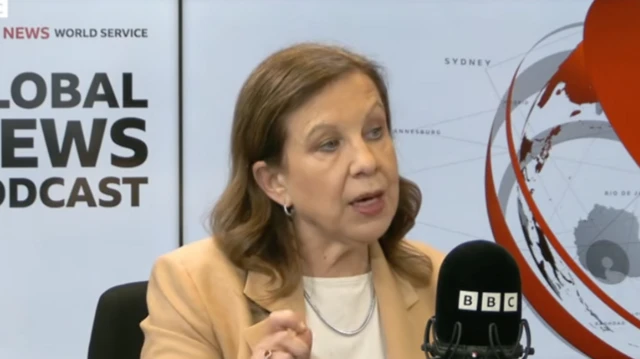
    The BBC Global News podcast has spoken to BBC's chief international correspondent Lyse Doucet about what negotiations - if any - might be happening between the US and Iran.

    Donald Trump - who prides himself on his deal-making - says he has sent Iran a 15-point plan to end the war, and that the two sides are having "good and productive" talks. But Iran has responded saying the US is "negotiating with itself".

    Many of Iran's senior figures are now dead, and the new supreme leader Mojtaba Khamenei has not been seen in public since taking power.

    What deal, if any, would each side be willing to accept? Could there be any common ground?

    Listen to the BBC Global News podcast, external to hear more.

    A woman in a white top and beige jacket is seen talking into a black microphone labeled "BBC".
  5. President Trump says Iranian leaders 'afraid' to admit they are negotiating with the USpublished at 23:54 GMT 25 March

    We're hearing from President Donald Trump, who is speaking now at an unrelated fundraising dinner.

    He's pushing back on what we've heard from Iranian leaders today - that they have rejected a US deal and don't want to negotiate. Trump contradicts that, saying "they are negotiating".

    "They want to make a deal so badly, but they're afraid to say it because they figure they'll be killed by their own people," Trump says. "They're also afraid they'll be killed by us."

    He adds: "There's never been a head of a country that wanted that job less than being the head of Iran."

    Return to the latest post
  6. Iran's rejection of US talks reflects deep mistrustpublished at 23:30 GMT 25 March

    Amir Azimi
    Editor, BBC Persian

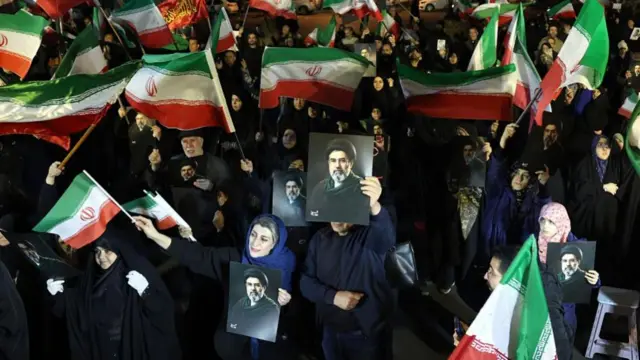
    Iranian people chant, wave flags and hold posters of the new Iranian supreme leader Mojtaba Khamenei during a rally in support for the military, in Tehran, Iran on 25 March 2026.Image source, EPA/Shutterstock

    While Washington talks about progress with Tehran, Iran rejects it outright.

    That disagreement reflects a deep mistrust that stems from previous talks between the two sides.

    They have twice raised hopes of easing tensions.

    Both times, they were followed by Israeli and US military strikes on Iran.

    From Iran's point of view, talks have not reduced the possibility of war; they have come just before it. That is why Trump's claims are being treated with suspicion.

    But Iran's denial does not necessarily mean it is against talks. There is more going on.

    Even officials who support diplomacy are under pressure. Trying negotiations again, would be risky. There is no clear sign that this time would be different, which helps explain the tough tone from Foreign Minister Abbas Araghchi and other officials.

    More: Iran's rejection of US talks reflects deep mistrust

  7. Analysis

    Who wants what, and why, from US-Iran peace talks?published at 22:45 GMT 25 March

    Frank Gardner
    Security correspondent in Doha

    When one side, the US, says there are ongoing, productive negotiations to end the war and the other side, Iran, says "no, there are not", then who to believe?

    Messages are certainly being passed from the US to Iran, but indirectly, via intermediaries like Pakistan that enjoy good relations with both governments. That, of course, is not the same as "negotiations", which might explain why an Iranian military spokesman has flatly denied they are taking place.

    The signs are that we are now entering into a situation not dissimilar to the logjam over ending the Russia-Ukraine war.

    When this war started, there were high hopes in Washington and Jerusalem that the overwhelming military superiority enjoyed by both these two nations over Iran would result in the inevitable collapse of the Islamic Republic.

    That has not happened. So what the US and Israel want, they may not necessarily get, as every day the Iranian regime survives it feels more emboldened.

    Meanwhile, the Gulf Arabs are dismayed by what has happened. They have watched in horror as the US has given this war its best shot and failed to bring down the Iranian regime, instead leaving it wounded and angry, lashing out at its neighbours.

    Iran believes it has both time and geography on its side and the more the White House tells the world that Iran is desperate for a deal, the less inclined Iran is to make one.

  8. Trump to speak later at Republican fundraiserpublished at 22:04 GMT 25 March

    Bernd Debusmann Jr
    Reporting from the White House

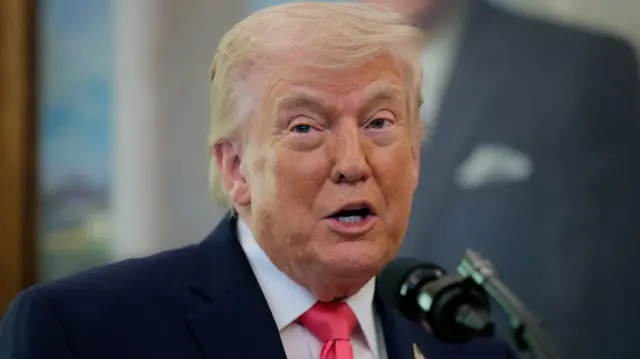
    Trump speaking on TuesdayImage source, Reuters

    It's pretty quiet right now at the White House, where only a handful of reporters remain hours after White House briefing from Press Secretary Karoline Leavitt.

    We're yet to hear on-camera remarks from President Donald Trump, though he's been busy posting on Truth Social throughout Wednesday.

    None of those posts, however, dealt with the conflict in Iran - they were focused on domestic concerns.

    In a short while, Trump is going to leave the White House for nearby Union Station - Washington's primary train terminal - for a fundraiser organised by the Nation Republican Congressional Committee.

    The president is expected to deliver remarks at the event, which will likely focus on the issues that Republicans in Congress are primarily focused on domestically, such as funding for the Department of Homeland Security.

    Over the last few weeks, though, Trump has often begun public speeches with a brief update on the military operation in Iran. It's possible he'll do the same later.

  9. 'If a position needs to be taken, it will certainly be determined': Iran's FM on US's 15-point planpublished at 21:21 GMT 25 March

    Ghoncheh Habibiazad
    Senior reporter, BBC Persian

    We've a bit more to bring you now from an interview Iran's Foreign Minister Abbas Araghchi has given to Iranian state media.

    During the televised interview, Araghchi doesn't go as far as rejecting the US's reported 15-point plan to end the conflict. Though his position on the document is not immediately clear.

    Acknowledging that "some ideas" have been put forward, and that in "one or two instances" he's seen this be referred to as a "15-point plan", Araghchi says: "These [ideas] were being presented in various formats as different ideas, all of which have been passed on to the country's senior authorities.

    "If a position needs to be taken [regarding these ideas] it will certainly be determined".

    In our earlier post, covering the same interview, we reported how Araghchi said Iran had "no intention of negotiating for now" - but confirmed that "the American side has begun sending various messages through different intermediaries".

  10. UN chief calls on Israel, US and Iran to put an end to warpublished at 21:10 GMT 25 March

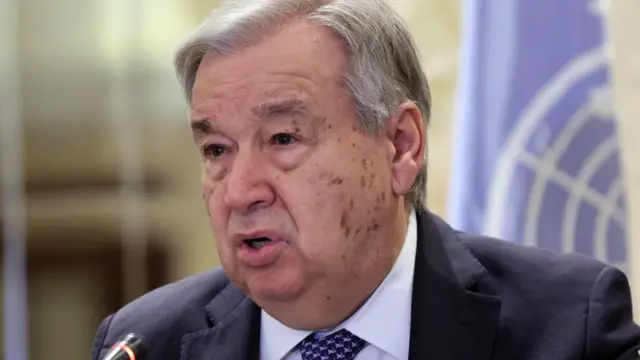
    Antonio Guterres speaks into a microphone in front of a UN flagImage source, EPA/Shutterstock

    UN Secretary General Antonio Guterres tells the US and Israel it is time to end the war, and calls on Iran to stop attacking nearby countries.

    Speaking to reporters earlier, Guterres describes how people are living under "profound insecurity" - something he says he saw first hand during a recent visit to Lebanon.

    "There too the war must stop," he says, calling on Hezbollah to stop launching attacks on Israel and for Israel to stop its military operations and strikes.

    "The Gaza model must not be replicated in Lebanon," he adds.

  11. Little clarity over progress of peace talks as Iran and US issue rebuttalspublished at 20:38 GMT 25 March

    Adam Goldsmith
    Live reporter

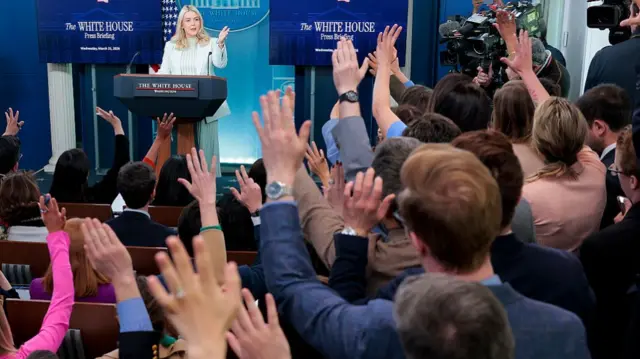
    Leavitt faces reporters with hands raised for questions in White House briefing roomImage source, Getty Images
    Image caption,

    Plenty of questions remain around the progress of peace talks between the US and Iran

    As the US and Iran engage in a series of rebuttals over progress on peace talks, here's a rundown of what's been happening.

    White House Press Secretary Karoline Leavitt insists that Donald Trump is having "productive discussions" with Iran - we've a full round-up of her press conference remarks.

    Iranian Foreign Minister Abbas Araghchi accepts that the two countries have exchanged messages, but says Iran has "no intention of negotiating for now".

    Meanwhile Leavitt has also dismissed a 15-point peace plan reportedly issued by the US as "speculative".

    The impasse, our security correspondent writes, is that both sides want to end the war on their own terms - read Frank Gardner's full analysis.

    Away from the US-Iranian grappling over negotiations, the wider war in the Middle East continues, as Israel's Benjamin Netanyahu announces his country will create a "larger buffer zone" in Lebanon to push back the threat of Hezbollah.

    And, our correspondent in Dubai says Gulf countries remain on the front line of Iran's fury, as Kuwait international airport battles a fire following a drone attack.

  12. Analysis

    Relationship with US might not offer protection Gulf nations hoped forpublished at 20:19 GMT 25 March

    Azadeh Moshiri
    South Asia correspondent, reporting from Dubai

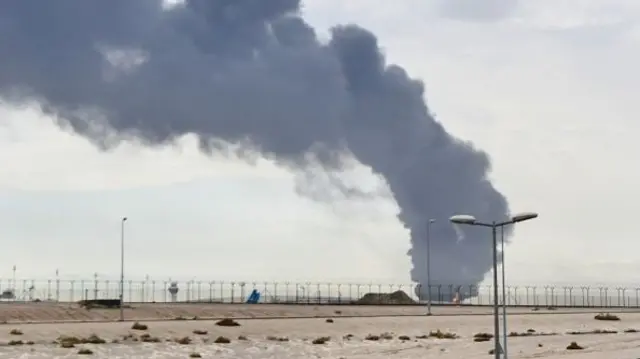
    Smoke rises over Kuwait International Airport after an Iranian-sourced drone attack on a fuel depot on the site. Photo: 25 March 2026.Image source, Anadolu via Getty Images
    Image caption,

    Smoke rises over Kuwait International Airport after an Iranian-sourced drone attack on a fuel depot on the site

    The reality for countries in the Gulf is clear: they are still on the front line of Iran’s fury, and the Strait of Hormuz, which their economies depend on, is still not safe.

    At Kuwait International Airport, emergency crews battled a fire after a drone attack hit a fuel tank. No casualties were reported. But the incident was a reminder that major infrastructure is still at risk.

    Kuwait’s ambassador to the United Nations, Nasser Abdullah Al Hayen, shared his anger, telling the UN Human Rights Council that "the manifestations of this aggressive approach have reached the pinnacle of contempt for international sovereignty and humanitarian law."

    The United Arab Emirates (UAE) has borne the brunt of Iran’s attacks. It said it refused to be “blackmailed by terrorists”. Should Iran’s regime survive, officials here have said the relationship won’t recover.

    Leaders will want guarantees their region won’t be weaponised against Iran’s enemies again. There is also a growing sense their relationship with the United States is not the protection it appeared to be.

  13. No intention of negotiating for now, says Iran's foreign ministerpublished at 19:59 GMT 25 March

    Ghoncheh Habibiazad
    Senior reporter, BBC Persian

    Iranian Foreign Minister Abbas Araghchi has said in a televised interview on Iran’s state TV news channel that for “several days” the US has "begun sending various messages through different intermediaries”.

    But he says that the fact these messages were “conveyed via friendly countries”, and that Iran was responding by stating their “positions and issuing warnings”, is “neither dialogue nor negotiation, nor anything of the sort”.

    Araghchi also says that Iran’s policy for now is to continue “defending”, and they have “no intention of negotiating for now”.

    He adds that “this is Israel’s war and people of the region and people of the US are paying the price for it”.

  14. Analysis

    Trump administration confident war will end - but how remains unclearpublished at 19:40 GMT 25 March

    Paul Adams
    Diplomatic correspondent

    If the White House is clear about one thing it’s this: the war will soon be over.

    Whether or not this turns out to be wishful thinking remains to be seen, but once again Karoline Leavitt was at pains to emphasise that Operation Epic Fury is “ahead of schedule.”

    She continues to remind reporters of Donald Trump’s initial assertion that the war might last 4-6 weeks, and she threw in a new detail this afternoon: the president’s delayed trip to China will now go ahead on May 14-15.

    That’s still more than seven weeks away, but clearly the White House believes – or wants us to believe – that the crisis will have passed and the Mr Trump and the Chinese leader can get down to their agenda without a war in the Middle East hanging over them.

    But if the administration managed to sound confident about when the war will end, it’s still shedding very little light on how it will end.

    Ms Leavitt says there are still “productive conversations” taking place, but that if Iran fails to accept that it’s losing, the president is prepared to “unleash hell.”

    As things stand, there’s little sign that Tehran is giving up.

  15. The lingering question of 'regime change'published at 19:30 GMT 25 March

    Bernd Debusmann Jr
    Reporting from the White House

    The White House briefing earlier today left us with very few answers on the negotiations, or - vitally - who exactly they are taking place with.

    Trump has now repeatedly claimed that the US is communicating with the "right people" in the Iranian government, after previous tiers of the country's leadership were killed in waves of US and Israeli strikes.

    It is unclear, however, whether those "right people" include the country's new Supreme Leader, Mojtaba Khamanei, or top figures who remain at the IRGC.

    The US president, for his part, this week insisted that the fact that senior figures in Iran are talking at all already represents "regime change".

    "This is a change in the regime," he told reporters on Tuesday. "Because the leaders are all very different than the ones that we started off with."

    Early on in the conflict, Trump also said that he believes the US should have a role in choosing Iran's leadership.

    Earlier, I asked Karoline Leavitt whether Trump still believes that it an objective of the operation.

    "I think the president obviously believes that the United States want to have someone in leadership in the Iranian regime that will be much more favourable to work with the United States, that will no longer chant 'death to America'," she responded.

    "These would be good, common sense things for the United States and our allies."

  16. BBC Verify

    Footage of strike at Israeli industrial site in Negevpublished at 19:18 GMT 25 March

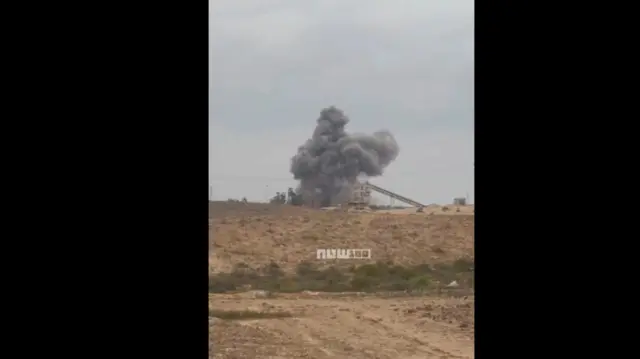
    A dark smoke plume erupts from a mine site at the top of a hill.Image source, Teelgram

    By Shayan Sardarizadeh

    BBC Verify has confirmed a video and an image that appear to show a strike targeting an industrial plant in Israel’s Negev desert.

    One video, filmed from a vehicle, shows a thick plume of black smoke rising in the air near the Rotem Amfert industrial facility.

    According to its website, the facility mines phosphate for use in fertilisers.

    An image captured inside the facility, also verified by the BBC, shows damage to at least one structure in the plant.

    The Rotem plant is located around 7km from Israel’s Dimona nuclear complex.

    A missile strike on Saturday caused damage in the city of Dimona.

  17. Centcom says almost 300 US soldiers wounded in war with Iran - CBS Newspublished at 19:08 GMT 25 March

    The BBC's US partner CBS News is reporting that nearly 300 American soldiers have been injured since the US-Israeli war with Iran began, citing the US Central Command (Centcom).

    290 US service members have been wounded since the first day of the war according to a Centcom spokesperson, reports CBS.

    The spokesperson says that 255 of these wounded soldiers have returned to duty and ten remain seriously wounded.

    The status of the other 25 was not disclosed.

  18. Middle Eastern countries issue joint statement condemning 'blatant Iranian aggressions'published at 19:03 GMT 25 March

    A group of Middle Eastern countries has published a joint statement on Iran's military action during its war with the US and Israel.

    Kuwait, the UAE, Bahrain, Saudi Arabia, Qatar and Jordan have expressed "their strongest condemnation of the blatant Iranian aggressions" - which they call "a flagrant violation" of sovereignty.

    During the war, Iran has carried out strikes targeting US assets in countries across the Middle East, including some of those issuing this joint statement.

    The statement also condemns "the aggressions launched by Iran-aligned armed factions from the Republic of Iraq against a number of regional states".

    The countries have called on the Iraqi government to take the necessary measures to "halt the attacks" launched from its territory.

  19. Speaker of Iran's parliament threatens to target regional country ‘vital infrastructure’ if island is seizedpublished at 18:54 GMT 25 March

    Ghoncheh Habibiazad
    Senior reporter, BBC Persian

    The account affiliated with Mohammad Bagher Ghalibaf, Iranian parliament speaker, has said on X that "based on some information, Iran’s enemies, with the backing of a regional country, are preparing to seize one of the Iranian islands".

    The post by Ghalibaf's account has said that "all enemy movements are under the close surveillance of our armed forces. Should they step out of line, all vital infrastructure in that regional country will, without restriction, become the target of sustained attacks."

    The post hasn't specified which country or which island.

    Some unconfirmed reports suggested that the Trump administration was considering Ghalibaf as a potential partner, and possibly even a future leader.

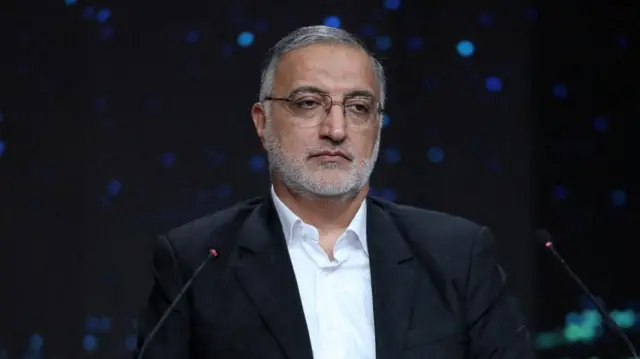
  20. 2,000 families left homeless due to US-Israeli strikes - Tehran mayorpublished at 18:48 GMT 25 March

    Zakani sat at a television studio in TehranImage source, Reuters

    2,000 families in Tehran, Iran's capital, have been made homeless since the US and Israel began bombing the city, says its mayor.

    "They struck down our ordinary Tehran fellow citizens," says Alireza Zakani in a statement originally in Persian.

    He also says that that women, children and the elderly have had their homes destroyed.