Summary

  • This page contains very strong, uncensored language that some may find offensive

  • US President Donald Trump has issued an expletive-laden threat against Iran's infrastructure if the Strait of Hormuz is not opened

  • Trump says "Tuesday will be Power Plant Day, and Bridge Day, all wrapped up in one" in Iran if the key shipping lane is not reopened

  • He reiterates his earlier threat to unleash "hell" if the country does not meet his 6 April deadline - previous deadlines given by the president have shifted and Trump tells US media there's a "good chance" of a deal being reached

  • The key battleground between the two countries may now be at sea, Orla Guerin writes, as she reports seeing ships at anchor close to the mouth of the strait

  • One Iranian tells the BBC: "It feels like we're sinking deeper into a swamp...what can we do as ordinary people? We can't do anything. We can't stop [Trump]"

  • Meanwhile, the US president says an American crew member rescued after a fighter jet was shot down over Iran is "SAFE and SOUND" - here's what we know

  1. Strait of Hormuz will ‘reopen’ when toll revenues cover war damage - Iranian officialpublished at 16:13 BST 5 April

    Ghoncheh Habibiazad
    Senior reporter, BBC Persian

    Mahdi Tabatabaei, an aide at Iran’s President’s Office, says the Strait of Hormuz “will be reopened” when “a portion of transit tolls is used to compensate for all the damage caused” by the war.

    Iranian officials and lawmakers have previously raised the possibility of imposing transit fees or tolls on vessels using the strait.

    Responding to Donald Trump's latest comments, Tabatabaei says the US president "has instigated a full-scale war in the region and is still issuing threats”.

    He says Trump’s “insults and nonsense” are born of “sheer desperation and anger”.

  2. Ships remain at anchor near entrance to Strait of Hormuzpublished at 15:56 BST 5 April

    Orla Guerin
    Senior international correspondent, reporting from the Strait of Hormuz

    The key battleground between Iran and the US may now be at sea, not on dry land.

    President Trump has repeated that the Strait of Hormuz must be re-opened or - come Tuesday - Iranians will be “living in hell”.

    The narrow waterway, which connects the Gulf and the Arabian Sea, used to be the route for one fifth of global oil supplies. Not anymore.

    With the US countdown under way, we headed for the strait - or as close as we could get - setting sail from the port of Khasab, on the coast of Oman.

    The view from our dhow, a traditional wooden sailing boat, was of ships at anchor close to the mouth of the strait.

    We counted eight vessels just one nautical mile ahead of us. Maritime organisations say as many as 2,000 are stranded in the area.

    Under clear blue skies, with the sun glinting on the waves, the strait looked calm and peaceful - but is now perhaps the most powerful weapon in the hands of Iran.

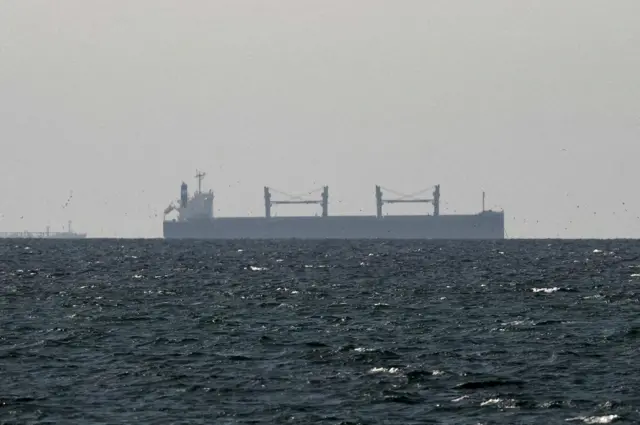
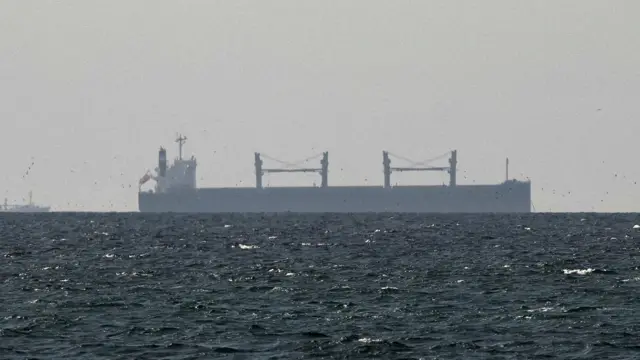
    A cargo ship in the Gulf, near the Strait of Hormuz, in a photo taken last monthImage source, Reuters
    Image caption,

    A cargo ship in the Gulf, near the Strait of Hormuz, in a photo taken last month

  3. Multiple splashes from projectiles near container ship reported - UKMTOpublished at 15:39 BST 5 April

    A container ship in the UAE has reported "multiple splashes from unknown projectiles" nearby, according to UK Maritime Trade Operations (UKMTO).

    The incident happened at Khor Fakkan Port while the container was being loaded, UKMTO says.

    UKMTO is a Royal Navy-led organisation that liaises between merchant shipping and military forces for maritime security.

    Iran has said "non-hostile vessels" can use the Strait of Hormuz, but the war - in which several ships have been attacked - has halted normal transport activity.

    Last week commercial ships anchored off the UAE and Qatar were struck by projectiles.

  4. Why the Strait of Hormuz is so importantpublished at 15:19 BST 5 April

    The Strait of Hormuz is a key trade artery through which around 20% of the world's oil passes.

    Since the beginning of the US-Israeli war with Iran, numerous ships have come under attack in the area.

    About 3,000 ships usually sail through the strait each month but this has dramatically decreased recently, with Iran threatening to attack tankers and other ships.

    About one-third of the world's fertiliser trade also passes through the strait, and it is a vital channel for imports to the Middle East, including food, medicines and technological supplies.

    The effective blockade of the the strait has caused energy prices to spike. There are fears it could fuel higher inflation.

    This Flourish post cannot be displayed in your browser. Please enable Javascript or try a different browser.

  5. CBS corrects report of fire fight during airman's rescuepublished at 15:11 BST 5 April

    In our post at 08:39 BST, we relayed reporting from the BBC's US-partner CBS News that "hundreds" of troops were involved in the rescue mission of the second US airman from the F-15E aircraft shot down over Iran, and that a "firefight erupted" during the operation.

    The BBC has since received a clarification from CBS that these details are incorrect.

    It says sources have since confirmed that there was no firefight during the rescue and that the true number of troops involved was fewer than 100.

    An Iranian commander has also since denied there were clashes with US and Iranian forces.

  6. Trump's shifting deadlines over the Strait of Hormuzpublished at 15:00 BST 5 April

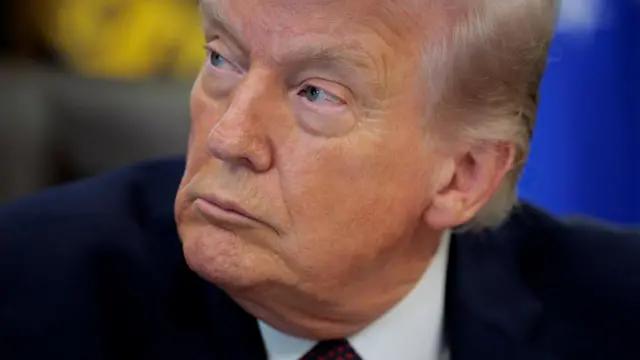
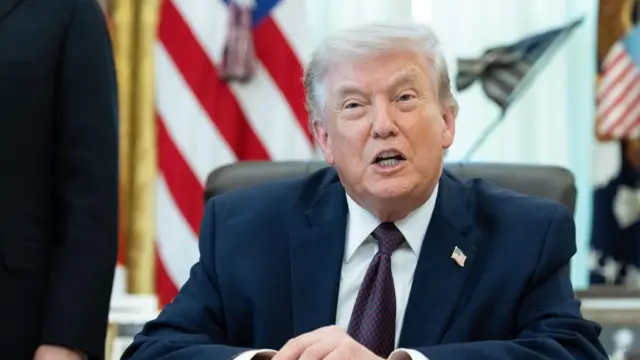
    US President Donald Trump looking to his right.Image source, Reuters

    Donald Trump has just repeated his threats to Iran unless it opens the Strait of Hormuz by 6 April. He has shifted his deadlines during the war - here's a recap.

    • Deadline 1: On 21 March, Trump said he would "hit and obliterate" power plants, "starting with the biggest ones first", if Iran didn't reopen the waterway within 48 hours
    • Deadline 2: Two days later, he said there had been "very good and productive conversations" between the countries and postponed strikes against energy infrastructure for five days
    • Deadline 3: On 27 March, Trump said he would postpone attacking energy plants for 10 days, "as per [an] Iranian government request", bringing the deadline to 6 April
    • 48-hour warning: Yesterday, with the 6 April deadline looming, he warned that Iran had "48 hours" before he unleashed "all hell"
    • Latest threat: In a post laden with offensive language, Trump reiterated this threat today
  7. Trump issues expletive-laden social media postpublished at 14:39 BST 5 April
    Breaking

    Warning: The below post contains very strong, uncensored language that some may find offensive.

    US President Donald Trump has published an expletive-laden post on his Truth Social platform, in which he threatens Iran to reopen the Strait of Hormuz.

    He references targeting civilian infrastructure and tells Iran they will be "living in Hell" if the vital shipping lane is not opened.

    The post comes ahead of Trump's self-imposed deadline to Tehran to reopen the strait by Monday, which has been effectively closed since war broke out at the end of February.

    The paragraph below contains very strong language.

    Trump says: "Tuesday will be Power Plant Day, and Bridge Day, all wrapped up in one, in Iran. There will be nothing like it!!! Open the Fuckin’ Strait, you crazy bastards, or you’ll be living in Hell - JUST WATCH! Praise be to Allah. President DONALD J. TRUMP"

  8. Four killed and dozens injured in Israeli strike on Beirut, Lebanese state media reportspublished at 13:50 BST 5 April

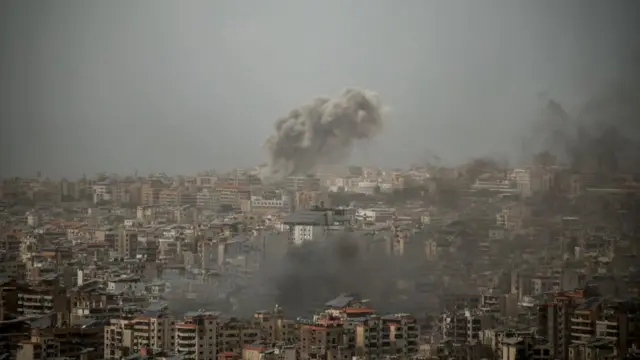
    Smoke rises from Beirut's southern suburbs following an Israeli strikeImage source, Reuters

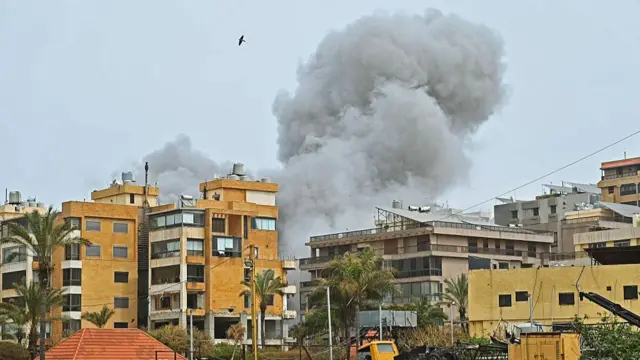
    Four people have been killed in an Israeli strike on the Jnah area of southern Beirut, according to Lebanon's state-run National News Agency.

    Citing the health ministry, it says a further 39 people were injured in the strike.

    Israel's military said on Sunday morning that it was targeting Hezbollah infrastructure in the Lebanese capital.

    Images have captured smoke rising from areas of southern Beirut following a number of strikes today.

    Earlier, we reported the country's health ministry said seven people had been killed in strikes on Kfar Hatta in southern Lebanon.

    Smoke rises from the site of an Israeli airstrike that targeted a building in Beirut's southern suburbsImage source, AFP via Getty Images
  9. Oman says it's in talks with Iran for 'smooth passage' through Strait of Hormuzpublished at 13:24 BST 5 April

    A large cargo ship pictured against a grey sky above a choppy body of water.Image source, Reuters
    Image caption,

    A cargo ship pictured near the Strait of Hormuz, which has been effectively closed by Iran since the war began

    Iran's blockade of the Strait of Hormuz, a key international shipping lane, has caused energy prices to soar and placed growing pressure on the global economy.

    The Omani foreign ministry says in a post on X the deputy foreign ministers of Iran and Oman have met to discuss "possible options for ensuring smooth passage" through the channel.

    Saturday's meeting also included experts from both sides, with a "number of visions and proposals" put forward, the ministry said.

    Donald Trump has warned that that Tehran must reopen the crucial shipping channel on Monday or face "all hell".

  10. Trump says Iran was 'getting close' to finding the F-15 crew memberpublished at 13:02 BST 5 April
    Breaking

    US President Donald J TrumpImage source, EPA

    US President Donald Trump has posted a new message on his Truth Social platform about the rescue of the second US airman. It reads:

    "We have rescued the seriously wounded, and really brave, F-15 Crew Member/Officer, from deep inside the mountains of Iran. The Iranian Military was looking hard, in big numbers, and getting close. He is a highly respected Colonel.

    "This type of raid is seldom attempted because of the danger to 'man and equipment.' It just doesn’t happen! The second raid came after the first one, where we rescued the pilot in broad daylight, also unusual, spending seven hours over Iran.

    "An AMAZING show of bravery and talent by all! I will be having a News Conference, with the Military, at the Oval Office, on Monday, at 1:00 P.M. God Bless our great MILITARY WARRIORS! President DONALD J. TRUMP"

  11. Child among seven killed in Israeli strike on southern Lebanon - ministry of healthpublished at 12:36 BST 5 April

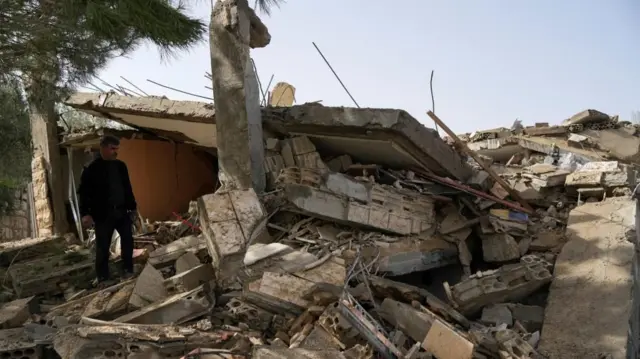
    A pile of rubble and debris in Lebanon's Kfar Hatta.Image source, Reuters
    Image caption,

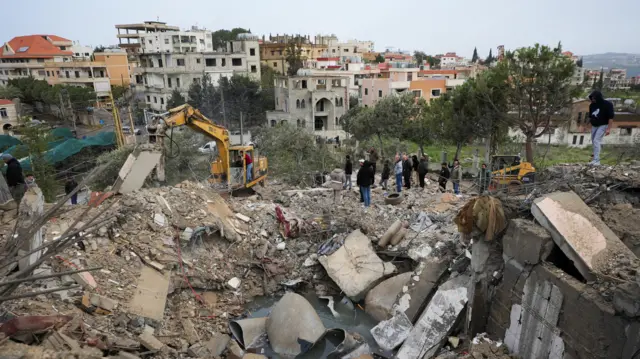
    Destruction was pictured in Kfar Hatta early on Sunday after the overnight strike

    Seven people, including a four-year-old girl, have been killed in an Israeli strike on Lebanon's Kfar Hatta, the country's ministry of public health says.

    The statement, reported by state-run news agency NNA, comes after local media said a strike there had taken place overnight.

  12. Iran internet blackout nation's 'longest' on record - monitoring grouppublished at 12:22 BST 5 April

    Ghoncheh Habibiazad
    Senior reporter, BBC Persian

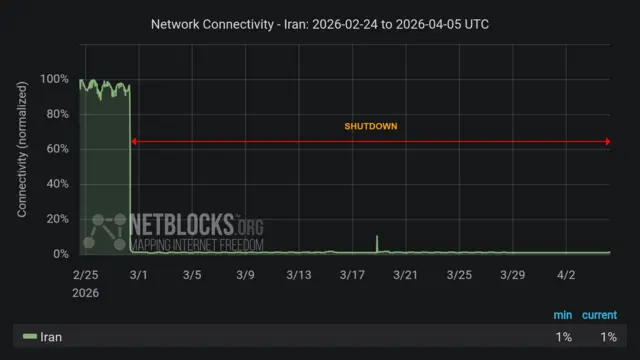
    Line chart shows Iran’s internet connectivity plunging from near 100% in late February to about 1% after March 1, remaining near-zero through early April.Image source, NetBlocks

    Iran's internet blackout has now entered day 37, with most users cut off from the outside world for over 864 hours, according to internet monitoring group NetBlocks.

    Connectivity to the outside world remains at 1% of normal levels.

    Netblocks has said that Iran’s internet blackout is now the "longest nation-scale internet shutdown on record in any country, exceeding all other comparable incidents in severity".

    Meanwhile, the BBC understands that some officials, pro-establishment users, and journalists still have unrestricted access, while others are paying large sums to get online.

    A few people have managed to connect using satellite internet such as Starlink and other methods, but it comes at a high cost.

    In Iran, using or possessing Starlink can lead to up to two years in prison, and authorities are trying to crack down on it. Iranian outlets have reported that “hundreds” of Starlink devices have been confiscated since the war started.

    Return to the latest post
  13. Drone strikes cause 'significant losses' at Kuwait energy facilitiespublished at 12:03 BST 5 April

    The Kuwait Petroleum Corporation says a number of its facilities have been targeted by Iranian drone attacks, resulting in fires and "significant material losses", according to the government.

    Teams are working to contain the fires and prevent their spread, it adds in a statement on X, which did not disclose the location.

    No casualties have been reported in the attack, which follows strikes in other parts of the Gulf region, including petrochemical and energy sites in Bahrain.

  14. Verified images show charred wreckage south of Isfahanpublished at 11:46 BST 5 April

    Emma Pengelly
    BBC Verify journalist

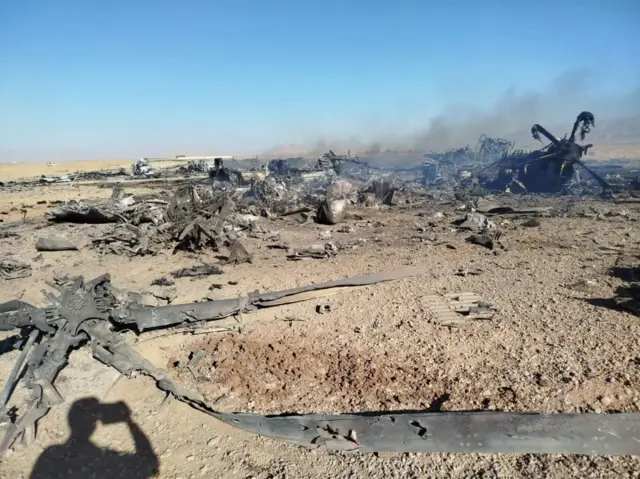
    A burnt wreck pictured in a bare expanse of land. The strewn debris is charred and smoke is rising from the ground. It is daytime beneath a clear blue sky. The shadow of the photographer can be seen in the bottom left of the image.

    Verified footage and a series of photos first shared online today appear to show smouldering aircraft wreckage in a mountainous area of central Iran.

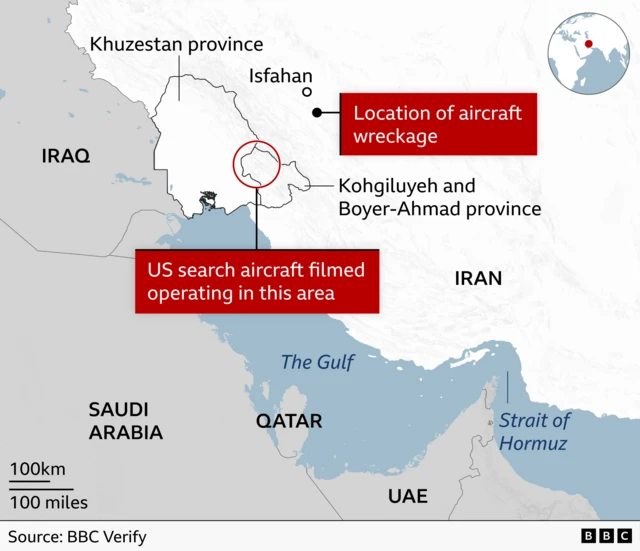
    By matching the peaks and ridges of mountains in the background in some of the photos to those visible on 3D Google Earth imagery, we can confirm the wreckage is located around 50km southeast of the city of Isfahan.

    Iran’s military has claimed that two US C-130 military transport planes and two Black Hawk helicopters were destroyed during the US rescue operation that followed the downed US F-15E - and that “a deception and escape mission at an abandoned airport in southern Isfahan…was completely foiled”.

    In the US, CBS News reports officials as saying two transport planes used in the mission were unable to take off from a remote base in Iran and were destroyed to stop them from being captured.

    We’ve not been able to confirm either statement or report ourselves.

    We’ve sent the verified wreckage visuals to military analysts to ask if they are able to identify the debris and parts shown.

    A map showing western and southern Iran, the Gulf, and neighbouring countries. A red label near the city of Isfahan marks the “Location of wreckage of US aircraft”. Another red label further south marks the area where “US search aircraft filmed operating” pointing to a location around the Kohgiluyeh and Boyer‑Ahmad province and Khuzestan province. Surrounding countries labelled include Iraq to the west, Saudi Arabia to the southwest, and Qatar, the UAE and Oman to the south of Iran.
  15. What is the role of a weapon systems officer, the second airman rescued in Iran?published at 11:26 BST 5 April

    Chris Partridge
    BBC News weapons analyst

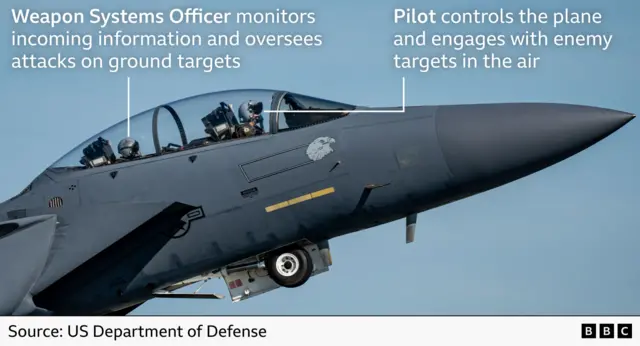
    The F-15E Strike Eagle is a two-crewed jet, with the pilot in the front flying the aircraft and the weapon systems officer (WSO) in the second seat behind. Having two crew members allows roles to be divided up, which is important in combat.

    The WSO has four screens in front of them, giving access to air-to-air radar, air-to-ground radar, weapons systems and configurations pages, and terrain-following radar navigation for ultra low-level flight.

    They will operate the targeting pod to locate targets or select pre-briefed targets that have already been set by command.

    The main job of the WSO is to put bombs on target, liaising with Joint Terminal Attack Controllers (JTAC) on the ground. They also ensure that each weapon is properly configured for deployment.

    It is a tough role. The WSO’s head is usually buried deep in the screens as the pilot may be performing violent manoeuvres to get the aircraft to the right place to drop bombs.

    A side‑on photograph of an F-15E fighter jet, showing both crew members inside the cockpit. A label above the rear seat identifies the “Weapon Systems Officer,” with text explaining that they monitor incoming information and oversee attacks on ground targets. Another label above the front seat identifies the “Pilot” with text noting that they control the aircraft and engage enemy targets in the air.
  16. IDF bombs Beirut suburbs as Israel and Hezbollah trade strikespublished at 11:02 BST 5 April

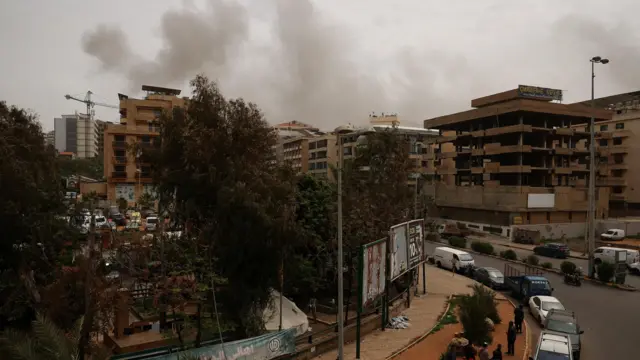
    Smoke rising above a row of buildings, some blown-out, in Beirut. On the street people look up at the smoke behind a row of trees.Image source, Reuters
    Image caption,

    Smoke could be seen rising in Ghobeiry, where the IDF had warned residents to evacuate a "facility affiliated with Hezbollah"

    The Israeli military says it has launched fresh strikes at Hezbollah infrastructure in Beirut after warning residents of the Lebanese capital's southern suburbs to evacuate immediately earlier this morning.

    Meanwhile, the Iranian-backed group says it has launched missiles towards northern Israel - which the IDF says it has intercepted, according to Israeli media.

    The exchange of fire comes hours after Hezbollah said it had struck an Israeli warship off Lebanon’s coast overnight with a missile. According to Israeli media, the IDF said it wasn't aware of the incident.

  17. Iran is framing the US rescue mission as a 'failure'published at 10:31 BST 5 April

    Ghoncheh Habibiazad
    Senior reporter, BBC Persian

    I’ve been monitoring statements by Iranian officials and state TV to see how they are framing the US rescue mission.

    This morning Donald Trump posted on Truth Social that the US had pulled off "one of the most daring search and rescue operations in US history".

    But the spokesman for the Khatam al-Anbiya Central Headquarters has described the mission as a failure.

    "The enemy's desperate efforts to rescue its downed fighter pilot failed thanks to Almighty God's blessings and divine assistance, as well as the timely actions and joint operations” of Iranian forces," he said.

    It has been reported in the US a fire fight broke out between US and Iranian troops during the operation.

    Meanwhile, the IRGC claims Trump had "claimed a special operation to rescue the pilot of a crashed plane in Iran in a post to cover up his heavy defeat".

    Throughout its coverage, Iranian state TV today followed the same narrative and also repeatedly likened the incident to Operation Eagle Claw, the failed 1980 US hostage rescue mission in Tabas, central Iran.

  18. Several killed in attacks on Iranian province - officialpublished at 10:09 BST 5 April

    Ghoncheh Habibiazad
    Senior reporter, BBC Persian

    An Iranian governor in the southern Kohgiluyeh and Boyerahmad province has said that several civilians have been killed in attacks.

    According to Iranian outlets, Boyer-Ahmad county governor Abbas Beheshti said five people were killed and eight injured following attacks on Kuh Siah region in the province.

    Beheshti separately told state IRNA news agency that the two areas of Kakan and Vezg in the same province came under “enemy attack” with “drones” last night.

    Two people were killed in the attack on the Kakan area, and three died in the attack on Vezg, according to Beheshti.

  19. As US forces rescued the airman overnight, strikes continued across the Middle Eastpublished at 09:44 BST 5 April

    A man stands at the site of Israeli strike in Kfar Hatta in southern Lebanon, 5 April 2026Image source, Reuters
    Image caption,

    The site of Israeli strike in Kfar Hatta in southern Lebanon

    In the UAE: Abu Dhabi authorities are responding to "multiple fires" in the Borouge petrochemicals plant caused by falling debris, according to the region's media office on X this morning.

    It follows an Israeli strike on a petrochemical complex in Mahshahr, southwestern Iran, on Saturday.

    In Bahrain: The Gulf Petrochemical Industries Company says a facility was hit by a drone attack but fires are now extinguished, according to the state news agency. It also reports a tank fire at Bapco Energies.

    In Lebanon: New images show destruction in Kfar Hatta, a municipality in southern Lebanon. IDF spokesperson Avichay Adraee issued an evacuation warning in the area last night.

    In Iran: The Israel Defense Forces (IDF) says this morning it has struck more than 120 targets, including missile sites, in central and western Iran over the past 24 hours.

    In Israel: The IDF has also reported further waves of Iranian missile strikes overnight and this morning, and said at the time defensive systems were operating to intercept the threat.

  20. 'You have to be prepared to be the person that's hit,' retired US admiral sayspublished at 09:17 BST 5 April

    A former top US military official has spoken to the BBC about how the Americans might have found the second rescued airman.

    William Fallon, a retired US Navy admiral, tells the World Service's Weekend programme that "in typical circumstances in a two-seater plane, the two are not that far apart when they get on the ground".

    He says this means the US likely had a "pretty good idea" of where the airman might have been, adding "time of day" probably worked in the rescue mission's favour: "Darkness is better for our people because they’re used to operating at night."

    Fallon says that when flying over hostile territory, "you have to be prepared to be the person that's hit".