Summary

  1. Another message attributed to Iran's Supreme Leader - but leader still not seen in publicpublished at 17:21 BST 29 March

    Ghoncheh Habibiazad
    Senior reporter, BBC Persian
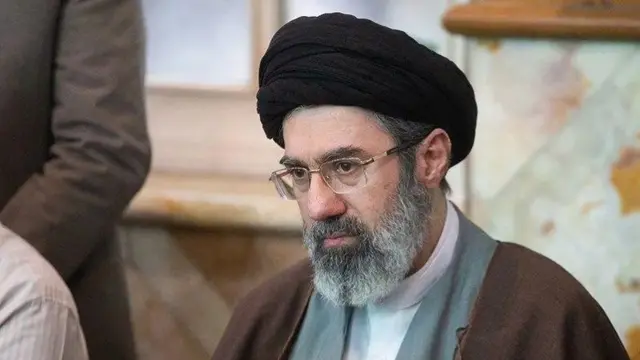
    Mojtaba pictured looking into distanceImage source, Tasnim News Agency

    In the latest message attributed to Iran’s third Supreme Leader, Mojtaba Khamenei, he is said to have thanked the Iraqi clergy and people for their “clear position on aggression against Iran”.

    According to Iranian outlets, the message, attributed to Khamenei, was delivered to an Iraqi official following a meeting between the Speaker of the Supreme Islamic Assembly of Iraq and the Iranian ambassador to Baghdad.

    Since his succession to the position in early March, several written messages attributed to Mojtaba Khamenei have been published.

    However, he has yet to be seen in public or on state television since his succession.

    Iran’s late Supreme Leader, Ali Khamenei, was killed on the first day of strikes on 28 February, but he has yet to be buried.

    US President Donald Trump has claimed that Mojtaba Khamenei is “either dead or in very bad shape, because no one has heard from him”.

    Meanwhile, Iran’s ambassador to the United Nations in Geneva insists that Khamenei’s absence from public view is due to “security considerations”.

    Israel had vowed to target Mojtaba Khamenei both before and after his succession.

    The US State Department has also placed a $10m bounty on 10 Iranian leaders, one of them being the new supreme leader.

  2. Industrial fire in Israel declared 'hazardous materials incident' as people urged to shelterpublished at 16:40 BST 29 March

    More on this incident in southern Israel now, as the national fire and rescue service instructs workers in and around the blaze to shelter in a safe space.

    The service says the fire in Neot Hovav industrial zone has been declared "a hazardous materials incident", urging workers to evacuate "exposed" areas and instead shelter in "protected structures".

    According to Reuters news agency, ADAMA, a global crop protection company, has released a statement confirming its Makhteshim plant was the site that was hit - either by an Iranian missile or debris from an intercepted missile.

    ADAMA - part of Chinese-owned Syngenta Group - says the extent of any damage to the plant is not immediately known, reports Reuters.

  3. BBC Verify

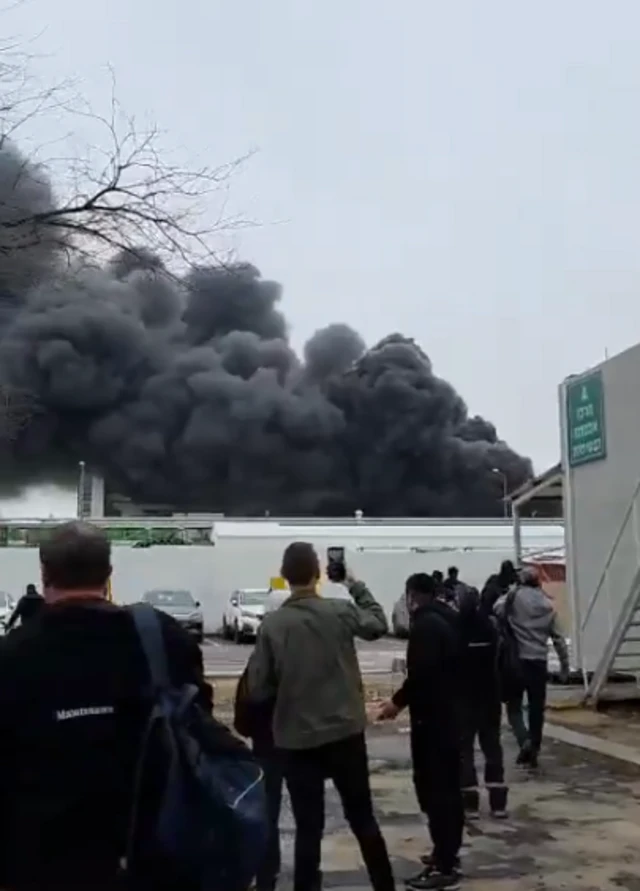
    Thick smoke rising above industrial site in Israelpublished at 16:21 BST 29 March

    By Jake Horton

    As we told you earlier, Israeli media has been reporting that a fire has broken out at an industrial site in the Negev desert of southern Israel.

    We’ve verified footage which shows thick black smoke rising into the sky near the Neot Hovav complex, located south of the city of Beersheba.

    A crowd of people can also be seen watching the smoke billowing across the site.

    Large plumes of smoke billow upwards as a group of people watch on from a distance. One person is filming the smoke with their phone.Image source, X
    Image caption,

    A screenshot from the video, posted on social media

    The Israel Defense Forces' (IDF) said earlier it was working to intercept missiles fired from Iran. The fire at Neot Hovav may have been caused by missile shrapnel, the IDF has said.

    No injuries have been reported.

  4. BBC Verify

    Photos show heavily damaged US military jet at Saudi basepublished at 16:09 BST 29 March

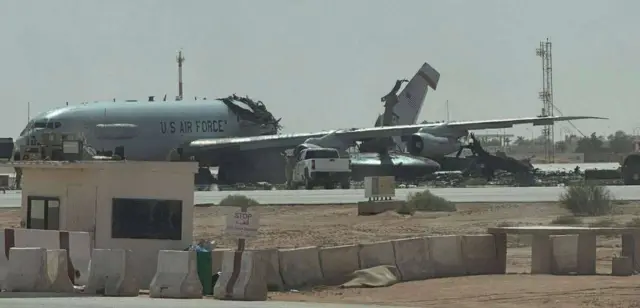
    US Air Force E-3 aircraft destroyed at an air base in Saudi Arabia.Image source, Facebook

    By Emma Pengelly and Shayan Sardarizadeh

    Verified pictures show a US command and control aircraft has been destroyed at an air base in Saudi Arabia.

    The pictures appear to have been first shared by a Facebook page carrying US military news. They show the E-3 Sentry aircraft appears to have been split in two.

    We’ve confirmed the photos were taken at the Prince Sultan air base about 100km (62 miles) south-east of the Saudi capital Riyadh. Features seen in the pictures, including pylons, storage units and markings on paved areas, matched with satellite imagery.

    BBC Verify has also seen an E-3 in this location in a satellite image captured on 11 March. We cannot say if they are the same aircraft.

    In one of the verified pictures the aircraft’s tail number is visible. Using this we checked flight-tracking site Flightradar24 which showed it was airborne near the base on 18 March.

    A satellite image taken on Friday appears to show a fire on the air base apron, about 1,600m (5,200ft) east of the E-3. It’s not clear whether this was part of the same attack in which the E-3 was damaged.

    On Friday a US official told Reuters that 12 US personnel had been wounded, two of them seriously, in an Iranian military attack on the air base.

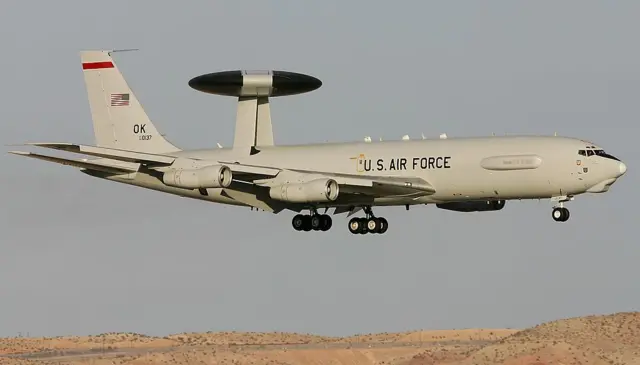
    US Air Force aircraftImage source, Getty Images
    Image caption,

    The destroyed aircraft was similar to the one seen in this file photo

  5. Zelensky in Jordan for 'security talks' as Middle East tour continuespublished at 15:52 BST 29 March

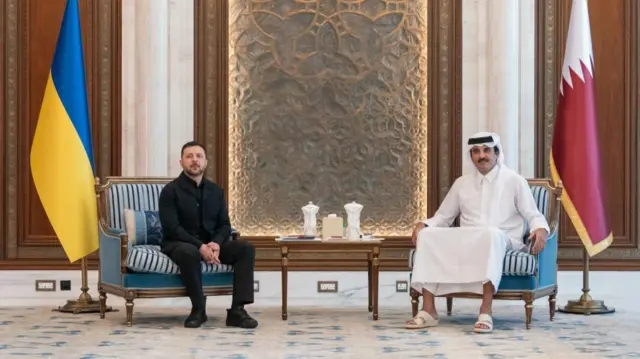
    Zelensky sitting on a chair with the Emir of Qatar, Sheikh Tamim bin Hamad Al ThaniImage source, Reuters
    Image caption,

    Zelensky - pictured in Qatar on Saturday - is on a tour of the region

    A short while ago, Ukrainian President Volodymyr Zelensky touched down in Jordan, the latest stop in his whistlestop tour of the Middle East.

    Zelensky says "security is the top priority" today, sharing a video of himself being greeted by Jordanian officials on the tarmac.

    "Important meetings ahead", he says.

    The Ukrainian leader is on a relationship-building tour around the region, having already made stops in Qatar, Saudi Arabia and the United Arab Emirates.

    He has signed deals with Saudi Arabia and Qatar on sharing drone defence expertise and technology.

  6. Houthi missiles pull Yemen into war: How did we get here?published at 15:35 BST 29 March

    Freya Scott-Turner
    Live reporter

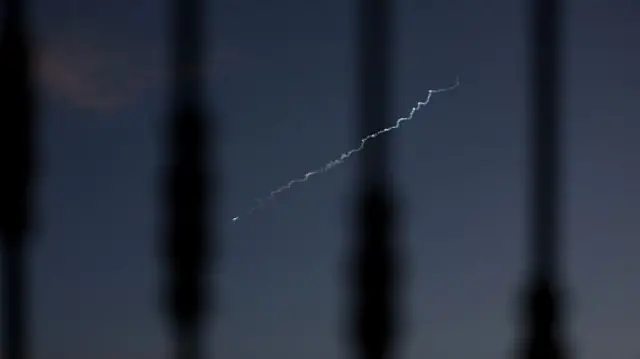
    missile traces launched from Yemen at Israel sighted in the sky over Hebron, West Bank. Photo: March 28, 2026.Image source, Getty Images
    Image caption,

    Traces from a missile, launched from Yemen, visible over the sky in Hebron, the West Bank, on Saturday

    The war in the Middle East is now in its second month, and more countries have been pulled into the conflict. The launch of missiles from Yemen's Houthi rebels towards Israel this weekend mark the latest in a series of developments that have brought us to this point:

    Saturday 28 February

    US and Israel strike Iran: The US and Israel launch wide-ranging strikes on Iran, killing the country's Supreme Leader Ali Khamenei.

    Iran responds: Tehran fires missiles and drones towards Israel and four Gulf Arab countries which host US military bases - Bahrain, Kuwait, Qatar and the United Arab Emirates. Dubai International Airport and Fairmont The Palm Hotel in the UAE are among the sites struck.

    Sunday 1 March

    Hezbollah threatens retaliation: The leader of Hezbollah, an Iran-backed political and military group in Lebanon, denounces Khamenei's killing as "the height of crime", pledging to "undertake our duty of confronting the aggression" by Israel and the US.

    Monday 2 March

    Rockets fired from Lebanon: At around 01:00 local time, alarms sound in northern Israel as Hezbollah fires "a barrage of rockets and a swarm of drones".

    Israeli forces respond: The IDF sends a powerful wave of air and naval strikes on Beirut's southern suburbs, and order residents of more than 50 southern and eastern villages to evacuate ahead of strikes.

    Saturday 7 March

    Iran apologises: Iran's president Masoud Pezeshkian surprises many, apologising to his country's neighbours for recent strikes against them in a video broadcast. But strikes across the region linked to Iran or its forces continue.

    Saturday 28 March

    Houthis enter conflict: The Iran-backed rebel group in Yemen launch two attacks against Israel - their first since the current conflict began. They add that there will be further attacks in the coming days "until the criminal enemy ceases its attacks and aggression".

  7. Beirut-based American university moves to online learning following Iran threatspublished at 15:19 BST 29 March

    The American University of Beirut has announced it is moving to online learning, following threats from Iran.

    Yesterday, Iran's Islamic Revolutionary Guard Corps (IRGC) threatened to target Israeli and American universities in the Middle East, in response to strikes hitting universities in Tehran and Isfahan.

    "Like many of you, we learned early this morning of threats issued against American universities in the region," reads a statement from the university's president.

    The statement says there is "no evidence of direct threats" against the university, but it will operate fully online on Monday and Tuesday "out of an abundance of caution".

  8. Industrial site on fire in southern Israel after Iranian missile attack - Israeli media reportspublished at 14:54 BST 29 March

    Israeli media is reporting that an industrial site in the Negev desert in the south of the country is on fire.

    The Israeli public broadcaster Kan, Channel 12 and the Times of Israel have all shared footage that appears to show thick black smoke blowing from what they say is the Ne'ot Hovav industrial complex, south of the city of Beersheba. Outlets say that no injuries have been reported.

    The Israeli military says that the impact may have been caused by missile shrapnel, in comments reported by the AFP news agency.

    It follows the Israel Defense Forces' (IDF) announcement that it was working to intercept missiles fired from Iran.

  9. Qatari television network condemns strike on its Tehran officepublished at 14:35 BST 29 March

    Media caption,

    Footage shows inside of Qatari TV network's Tehran office damaged by strike

    Earlier today, Qatari news channel Al Araby confirmed that its office in Tehran had been struck by a missile.

    The channel has now released a statement, saying it “condemns this attack on a civilian commercial building and affirms that endangering journalists or considering them targets runs counter to international law”.

    The statement says that 10 people have been injured as a result, citing the Iranian Red Crescent.

    It is still not clear who launched the missile. BBC Verify has asked the Israel Defense Forces and the US military's Central Command to comment on what happened.

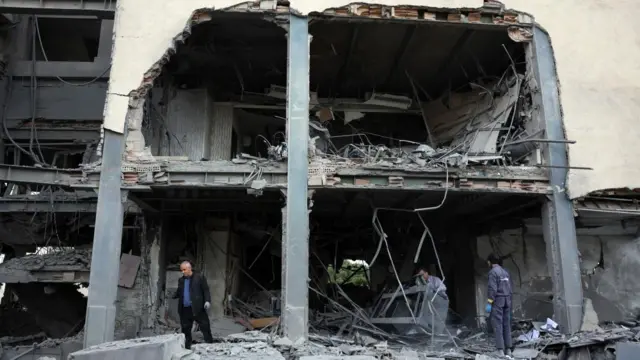
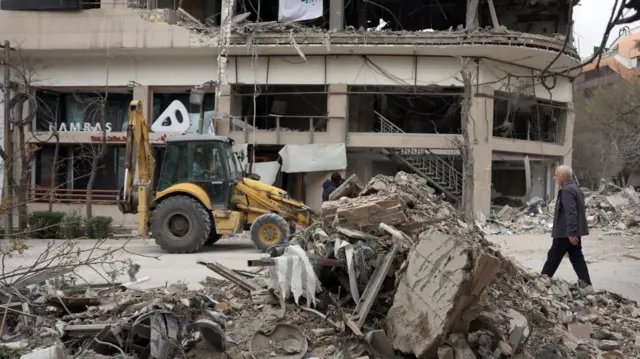
    Here are some pictures of the offices following the strike.

    The destroyed Qatari Al Araby TV office after an airstrike in northern TehranImage source, EPA
    Image caption,

    Search and rescue teams have been operating after the building was hit

    Truck woks to remove rubble at destroyed buildings near the Qatari Al Araby TV officeImage source, ABEDIN TAHERKENAREH/EPA/Shutterstock
    Image caption,

    Industrial vehicles are being used to remove rubble from the area of the strike

  10. Bahrain institutes maritime curfew on civilian shipspublished at 14:17 BST 29 March

    Bahrain is implementing an indefinite ban on private boats, including fishing boats and leisure vessels, from its waters between the hours of 18:00 and 04:00 local time.

    The country's Ministry of Interior says the ban is "for the protection of seafarers amid the blatant Iranian aggression against the Kingdom of Bahrain and the serious risks it poses to the safety of citizens and residents".

  11. Hundreds in Beirut mourn journalists killed in Israeli strikepublished at 13:55 BST 29 March

    Hugo Bachega
    Middle East correspondent

    Media caption,

    Hundreds in Beirut mourn journalists killed in Israeli strike

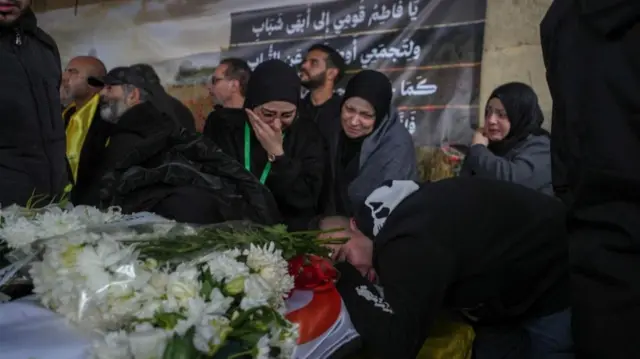
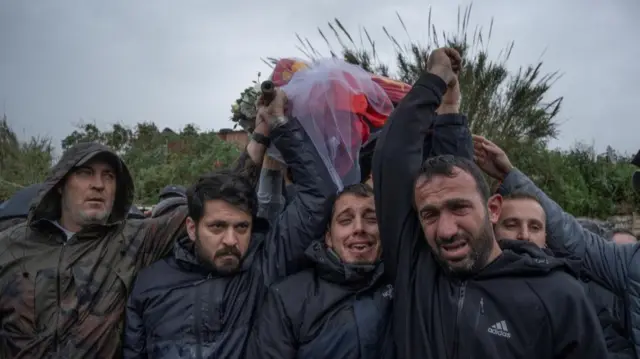
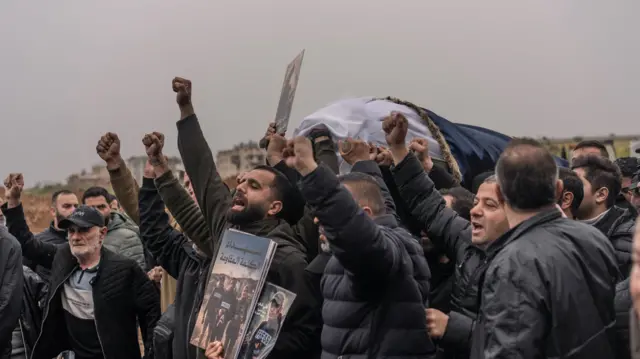
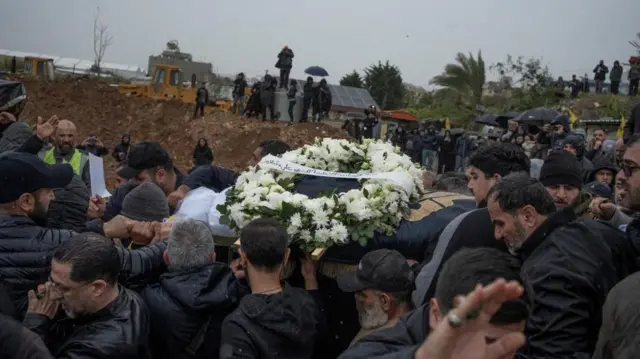
    Despite the heavy rain, hundreds of people gathered this morning in a cemetery in the southern suburbs of Beirut for the funeral of three Lebanese journalists killed in a targeted Israeli air strike in southern Lebanon yesterday, an attack that has sparked commotion and anger in this country.

    The mourners included relatives and other journalists who carried pictures of Ali Shoeib, Fatima Fetoni and Mohamed Fetoni. The emotional ceremony happened in the area known as Dahieh, where the Iranian-backed group Hezbollah holds sway. Other graves were marked with the bright yellow flag of the group.

    Shoeib was a well-known reporter for Al-Manar, a Lebanese TV station affiliated with Hezbollah. The Israeli military described him as a “terrorist” in the intelligence unit of Hezbollah’s elite Radwan Force, but it provided no evidence to support the claim that he played a military role in the organisation.

    The Committee to Protect Journalists said last year that “Israel, in particular, has repeatedly killed journalists whom it subsequently – and in some cases preemptively – alleged were militants, without providing credible evidence to support its claims”. It also says that impunity is virtually the norm in Israel in cases where journalists are killed by the country’s military.

    The Israeli military has not offered any comment on the killings of the Fetonis – Fatima was a correspondent with the Al-Mayadeen channel and her brother worked as a cameraman.

    Lebanon’s President Joseph Aoun condemned the killing of the journalists as a “blatant crime” that “violated the most basic rules of international law”.

    Human rights groups fear Israel is carrying out in Lebanon similar tactics that it employed in Gaza, with deliberate attacks on journalists, healthcare professionals and others, often providing unfounded claims that those killed had military involvement with Hezbollah. The cases are almost never investigated by the Israeli military.

    Relatives and friends mourn next to the coffin of Fatima Ftouni, during the funeral of Lebanese journalists, Al Manar reporter Ali Shaib, Al Mayadeen reporter Fatima Ftouni and cameraman Mohammed Ftouni who were killed by a targeted Israeli strike, amid escalating hostilities between Israel and Hezbollah, as the U.S.-Israeli conflict with Iran continues, in Choueifat, Lebanon, March 29, 2026Image source, Reuters
  12. BBC Verify

    Videos show destruction at building in Tehran where a Qatari TV office is locatedpublished at 13:39 BST 29 March

    By Shayan Sardarizadeh and Ghoncheh Habibiazad

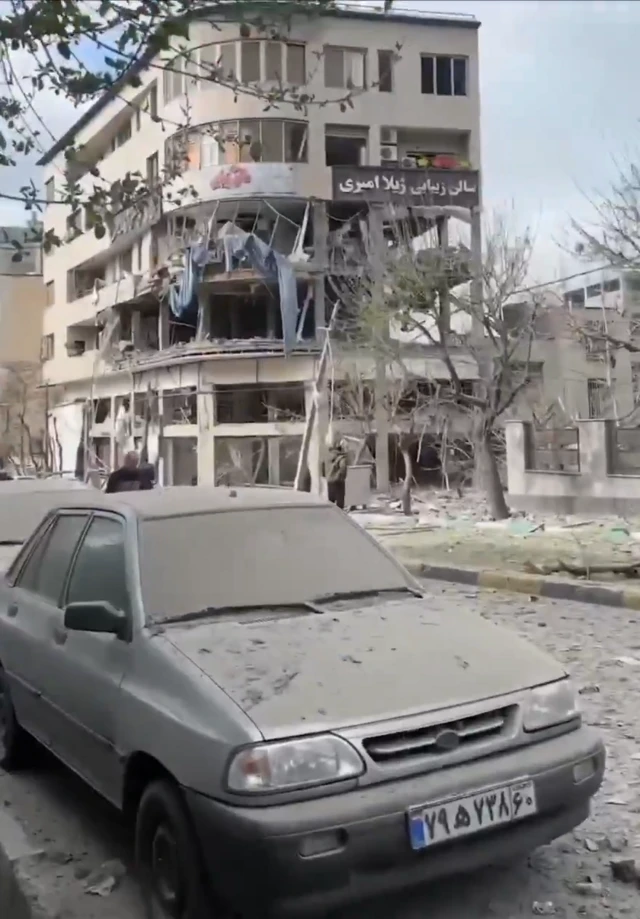
    Verified video shows damage to a building where the Qatari TV network al-Araby has an office in north-east Tehran.

    One clip, filmed from Vafamanesh Street near Heravi Square, shows the building’s windows blown out, with debris and dust scattered across the area. Signs on the building indicate a beauty salon, a cafe and another office are also located there.

    Another video, filmed by al-Araby correspondent Hazem Kallas, shows damage inside the building. Kallas also films outside, where Iranians are gathered near damaged cars, and says adjacent buildings were badly damaged.

    Al-Araby shared the footage, saying its office in Tehran had been damaged by a missile. It said its staff were unharmed but there was "significant material damage". It’s not immediately clear from the videos what the target of the reported strike was.

    BBC Verify has asked the Israel Defense Forces and the US military’s Central Command to comment on what happened.

    Building hit by strike seen in the background of the picture. Interior of the building appears largely destroyed, while the overall structure is still standing.Image source, X
  13. 'I think I can hold up the business for one month maximum'published at 13:22 BST 29 March

    Ghoncheh Habibiazad
    Senior reporter, BBC Persian

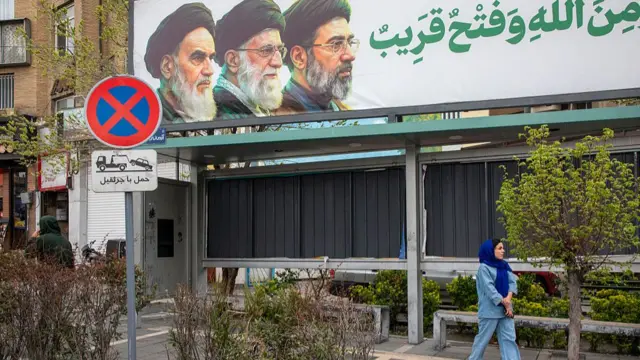
    A woman stands walks by a poster featuring the current and former Supreme Leaders on March 28, 2026 in Tehran, Iran.Image source, Getty Images

    As the war enters its second month, more issues are starting to come to the surface.

    Normally, during the roughly two-week Persian New Year holidays, which began on 21 March, businesses like tourism and hospitality would flourish. But I’ve heard it hasn’t been the same as last year.

    A restaurant owner in Tehran, a man in his 30s, told me: "Many businesses are completely shut down now. My situation is not better than theirs. It’s been very quiet, and I think I can hold up the business for one month maximum."

    Some businesses are struggling because of the government-imposed internet outage. Others need to repair their homes after strikes.

    A woman in her 20s, who had travelled to a northern province to "distract" herself from the war, said: "My mum called me to tell me that all the glasses of our windows had been shattered when a strike happened behind our house in Tehran. Luckily my parents had blankets on them when it happened, and nothing happened to them."

    There are also those in Tehran suffering with their pets, as the city has seen the heaviest strikes.

    A woman in her 20s in Tehran said: “Every time there’s an explosion I feel like I’m going to be sick, and I’ve ended up with a sore throat as well.

    "And on top of that, my cat’s more scared than anything. He’s really not coping. He gets so anxious. He’s never usually a cuddly cat, but now he just runs straight into my arms. He doesn’t play at all anymore, he just stays with me all day, just breathing really fast."

  14. Iranian forces 'waiting' for US ground troops, parliament speaker says - what you need to knowpublished at 13:04 BST 29 March

    Jacob Phillips
    Live reporter

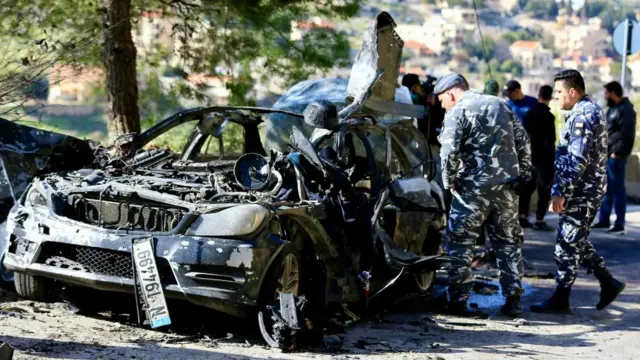
    Policemen inspect a destroyed vehicle that has been completely burnt up after being hit by an Israeli strikeImage source, Shutterstock
    Image caption,

    Police inspect a destroyed vehicle hit by an Israeli strike carrying Al Manar TV correspondent Ali Shoeib, Al Mayadeen TV reporter Fatima Fetoni and video journalist Mohamed Fetoni

  15. Iran says wave of strikes launched against Israelpublished at 12:44 BST 29 March

    Iran's Islamic Revolutionary Guard Corps (IRGC) says it has carried out a wave of strikes against Israel today.

    Quoted by Iranian media, the IRGC says the strikes against US and Israeli targets in the region were in memory of Lebanese journalists killed in an Israeli air strike.

    Throughout the morning, the Israeli military has said its defence systems were working to intercept missiles launched from Iran towards Israel. People in affected areas were told to take shelter and follow the Home Front Command's guidelines.

  16. An unusually muted Palm Sunday in Jerusalempublished at 12:22 BST 29 March

    Sebastian Usher
    Reporting from Jerusalem

    Behind me in this church the sound of hymns, Bethphage, can be heard. There is a small community of around 70-80 local Christians still celebrating Palm Sunday.

    Palms have been handed out, olive branches have been blessed, but there won't be any procession because of security reasons.

    Just a week or so ago, there was a fragment of an Iranian missile that landed on part of the old city, in Jerusalem, just a few hundreds metres away. Close to not only the Church of the Holy Sepulchre, but also the Western Wall and al-Aqsa Mosque - all of those sacred sites are closed.

    Essentially, the authorities are afraid there might be a mass casualty event if something like that were to happen when people are gathered.

    So this is a muted Palm Sunday - unusually so. Through all moments of strife and war, it has generally carried on the same, with the procession walking down the steep slope of the Mount of Olives into the old city through the Lions' Gate.

    It’s not going to happen today but people are still lifting their voices up in prayer, hoping for a better future.

  17. 'Avoid Yemeni waters at all times,' warns EU maritime security bodypublished at 11:52 BST 29 March

    The European Union's maritime security body warns ships to avoid entering Yemeni territorial waters as the Iran-backed Houthis could resume "attacks on merchant ships", particularly in the Red Sea and Gulf of Aden.

    This comes after the Houthi rebel group fired missiles at Israel on Saturday and vowed to carry out more attacks.

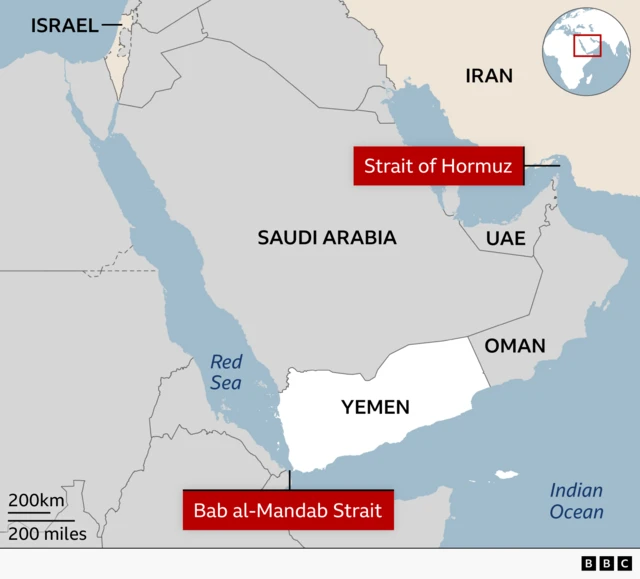
    The Houthis, who hold sway in north west Yemen, have so far not wielded their most potent weapon – their ability to disrupt traffic through Bab al-Mandeb, the maritime chokepoint linking the Red Sea to global trade routes, writes our chief international correspondent Lyse Doucet.

    The European Union Naval Force Aspides mission adds that merchant ships linked to the US or Israel should avoid the Yemeni waters until "the threat becomes less pressing".

    The report, published on Saturday, rates the threat level as "high" for vessels affiliated with Israeli interests. There is a "medium" threat level for vessels "not linked to Israel or the United States".

    For context, the Iran-backed Houthis began attacking shipping in the Red Sea in November 2023, saying they were acting in solidarity with the Palestinians.

    A regional map of the Middle East highlighting two strategic waterways: the Strait of Hormuz, which lies between Iran and the UAE and Oman, and the Bab al‑Mandab Strait, which lies between Yemen and the Horn of Africa. Yemen is highlight in white and its neighbours Saudi Arabia, Oman and the UAE are all shown in grey. Israel, which is to the north west of the Gulf region, is also labelled as is Iran. The Red Sea is labelled along the western coastline of Saudi Arabia, and the Indian Ocean is labelled to the southeast. A small inset globe in the top right shows the region’s location.
    Image caption,

    Coupled with Iran's near-closure of the Strait of Hormuz, two of the main strategic waterways in the world for trade and energy supplies could potentially be cut off

  18. In pictures: Funeral held for three Lebanese journalists killedpublished at 11:24 BST 29 March

    Relatives and friends carry the coffin of Mohammed Ftouni, during the funeral of three Lebanese journalists killed in an Israeli strikeImage source, Reuters

    We’ve received pictures showing the funeral of three Lebanese journalists killed in an Israeli strike yesterday.

    Friends and relatives are seen carrying the coffins of Fatima Fetoni, her brother Mohamed Fetoni, and Ali Shoeib.

    The Fetonis worked for Al Mayadeen, a TV channel based in Beirut. Shoeib was a reporter for the Hezbollah-affiliated Al Manar TV channel.

    In a post confirming the strike yesterday, Israel accused Shoeib of being a Hezbollah operative "under the guise of a journalist".

    Relatives and friends carry the coffin of Ali Shaib, during the funeral of three Lebanese journalists killed in an Israeli strikeImage source, Reuters
    Relatives and friends carry the coffin of Fatima Ftouni, during the funeral of three Lebanese journalists killed in an Israeli strikeImage source, Reuters
  19. What has the US said about ground troops?published at 11:05 BST 29 March

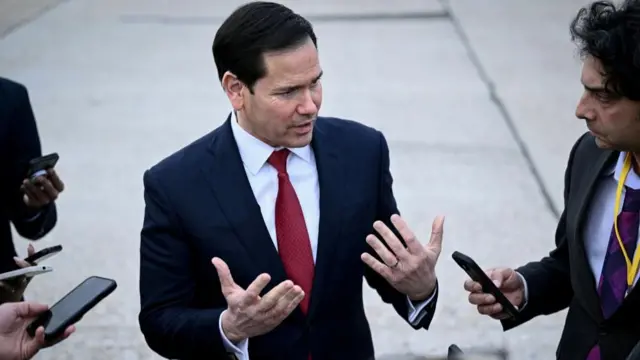
    US Secretary of State Marco Rubio speaks to the press before his departure following a G7 Foreign Ministers' meetingImage source, Reuters
    Image caption,

    US Secretary of State Marco Rubio spoke to the press after a G7 meeting on Friday

    Iran Parliament Speaker Mohammad Bagher Ghalibaf says Iranian forces are "waiting" for US ground troops.

    This follows a Washington Post report that the Pentagon is preparing for weeks of ground operations in Iran, though it's not clear whether Donald Trump will approve them.

    Here's a recap of what the US administration has said about this:

    • Earlier this month, Trump told reporters: "I'm not putting troops anywhere" - but quickly added: "If I was, I certainly wouldn't tell you"
    • On Friday, US Secretary of State Marco Rubio said the US could achieve its goals "without any ground troops"
    • He explained that recent deployments were meant to give Trump options, saying: "We are always going to be prepared to give the president... maximum opportunity to adjust to contingencies"
    • On Saturday, US Central Command said the warship USS Tripoli had arrived in the region - it leads a unit of about 3,500 sailors and marines
  20. Analysis

    Iran has always been signalling deep mistrust amid speculation of talkspublished at 10:50 BST 29 March

    Ghoncheh Habibiazad
    Senior reporter, BBC Persian

    Iran Parliament Speaker Mohammad Bagher Ghalibaf has said the “enemy signals negotiation in public, while in secret it plots a ground attack".

    It’s not the first time Iranian officials have shown deep mistrust amid speculation about talks between the US and Iran.

    While we don’t know much about what’s happening behind the scenes, one thing is clear: since the 1979 revolution, Iran’s policy has largely been shaped by opposition to western political, cultural and ideological influence, often viewing the US and Israel as its main adversaries.

    The war that started on 28 February began two days after a third round of indirect US-Iran nuclear talks in Geneva.

    Last summer, attacks on Iran also began while the US and Iran were engaged in nuclear negotiations, leading to a 12-day war between Iran and Israel, with the US bombing three key Iranian nuclear facilities.

    Iranian officials see any agreement as a test of whether the US can be trusted after Trump withdrew from the 2015 accord.

    They are even more sceptical now.

    Return to the latest post