Summary

  • This page is no longer being updated. You can continue to follow our coverage at our new live page here

  1. The BBC is on the ground across the Middle East - here's what we're seeingpublished at 16:37 GMT 5 March
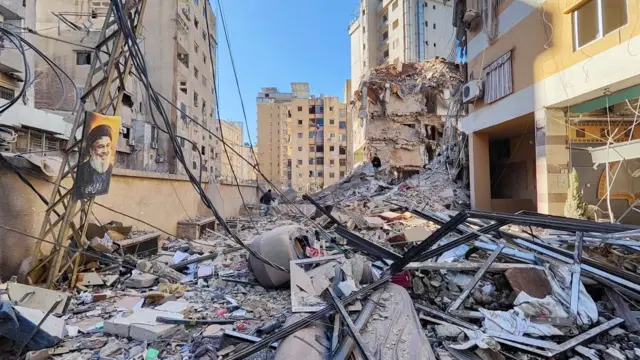
    A view shows the rubble of a damaged building after an Israeli strike on Beirut's southern suburbs, following renewed hostilities between Hezbollah and Israel amid the U.S.-Israeli conflict with Iran, LebanonImage source, Reuters
    Image caption,

    The rubble of a damaged building after an Israeli strike on Beirut's southern suburbs

    We've got correspondents across the Middle East as this war unfolds - here's a quick recap of their latest reporting.

    Lebanon

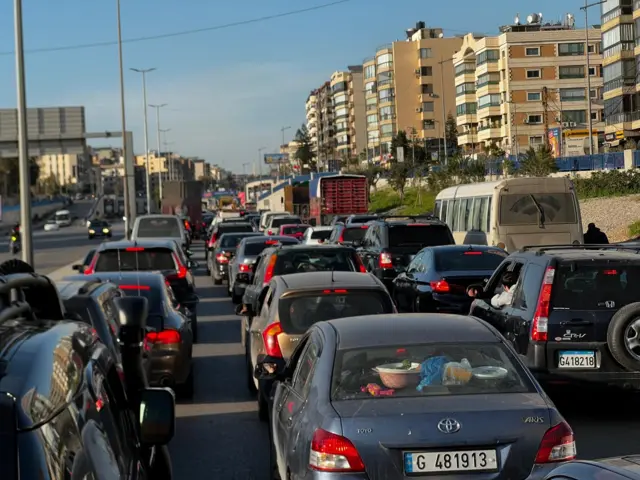
    Alice Cuddy is in Beirut, where huge queues of traffic have been piling up as residents flee after Israel warned people to immediately leave their homes.

    In Lebanon's capital people are scouring through the wreckage of a residential buildings damaged by strikes.

    "We moved away on Monday because of fears that something would happen. Today we were supposed to come for a shower and to pick up our stuff and we found this," one resident told Alice next to the wreckage. "Thank god it was just our things and not us."

    Qatar

    Barbara Plett Usher heard the rumble and bang of anti-aircraft fire above Doha earlier today. Alerts buzzed on phones as the security threat was elevated.

    She said it's clear that Qataris don’t want to take any chances as the threat of strikes in the region persist.
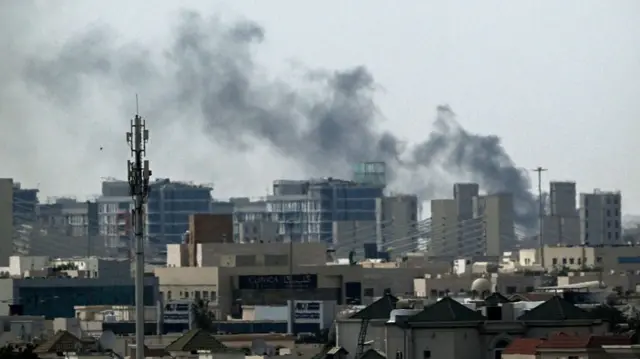
    A plume of smoke rises over buildings in DohaImage source, Getty Images
    Image caption,

    A plume of smoke rises over buildings in Doha

    Israel

    Yolande Knell earlier said Israel’s Ben Gurion Airport reopened after it was shut down five days ago. She reported that the first repatriation flight from Athens landed at the airport this morning bringing home Israelis who were stranded abroad.

    Northern Iraq

    Orla Guerin has said Kurdish Iranian opposition parties have roundly denied reports that some of their forces have crossed the border into Iran.

    Hanna Hussein Yazdan Pana, of the Kurdistan Freedom Party told Orla: "This is not true. Do not believe it, not a single Peshmerga (fighter) has moved. No one moves alone."

    They called for a no-fly zone to provide protection for Kurdish forces. "The regime is very brutal," she says, "and the most advanced weapon we have is a Kalashnikov."

  2. UAE issues emergency alert across the countrypublished at 16:26 GMT 5 March

    Sameer Hashmi
    Reporting from Riyadh

    The UAE’s interior ministry has issued an emergency alert across the country, warning of potential missile threats and urging residents to seek immediate shelter in the nearest secure building.

    Residents have also been advised to stay away from windows, doors and open areas. This comes around an hour after the UAE's defence ministry said it was responding to incoming missile and drone threats from Iran.

    Earlier, the UAE said it had intercepted six Iranian missiles and 131 drones today. One missile and six drones landed on its territory, it said.

  3. WHO suspends operations at Dubai emergency logistics hubpublished at 16:22 GMT 5 March

    Sameer Hashmi
    Reporting from Riyadh

    The World Health Organization (WHO) says it has suspended operations at its global emergency logistics hub in Dubai because of the ongoing conflict in the Middle East.

    Speaking at a news conference, WHO Director-General Tedros Adhanom Ghebreyesus says operations at the facility are currently on hold due to security concerns.

    Last year, the hub processed more than 500 emergency orders for 75 countries worldwide, according to Hanan Balkhy, the WHO’s regional director for the Eastern Mediterranean.

    The WHO says that the hub’s operations are "temporarily on hold due to insecurity, airspace closures and restrictions affecting access to the Strait of Hormuz".

  4. Bahrain says Iranian strike has hit industrial areapublished at 16:13 GMT 5 March

    Bahrain's interior ministry says a facility in the industrial area of Ma'ameer has been targeted by "Iranian aggression".

    It comes shortly after the government said a siren has been sounded, urging people to remain calm and head to the nearest safe place.

    A fire at the facility has now been brought under control, the ministry says in a post on social media, with "limited material damage" and "no loss of life".

  5. Will we hear from Donald Trump today?published at 16:12 GMT 5 March

    Bernd Debusmann Jr
    Reporting from the White House

    While we will see Donald Trump on camera today, there's no guarantee - and little expectation - that we will hear much regarding the ongoing operation in Iran.

    According to Trump's schedule, he began receiving an intelligence briefing at 11:00 EST (16:00 GMT). While this is certain to focus heavily on Iran, these events take place behind closed doors, and the contents of those briefings are heavily-guarded secrets that do not emerge for years, if ever.

    At 16:00 local time (21:00 in the UK), Trump is scheduled to meet with the players and staff of Inter Miami, the David Beckham co-owned champions of Major League Soccer. Trump is expected to deliver remarks at this event.

    In the past, similar meetings with other US sports teams stay largely on topic, and questions are unlikely.

    The world's media, however, will be watching to see whether he makes any mention of Iran, which is among the teams that qualified for the upcoming World Cup.

  6. BBC Verify

    Satellite image shows partially submerged Iranian warship at naval basepublished at 16:07 GMT 5 March

    By Alex Murray

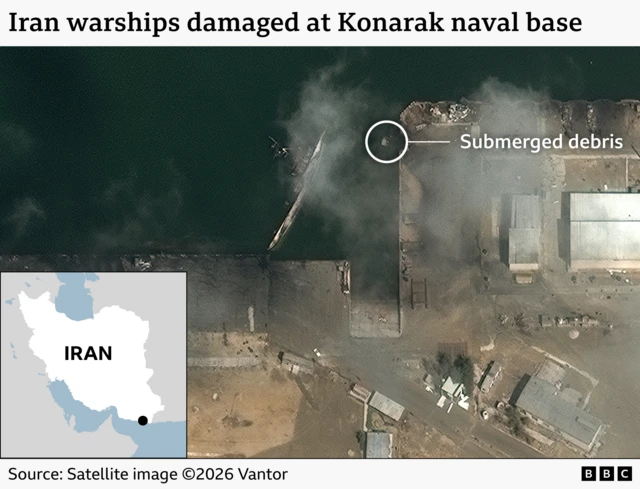
    BBC Verify has been using satellite images to track Iranian navy ships which have been damaged or destroyed in US and Israeli strikes.

    The US military’s Central Command posted on X yesterday that more than 20 Iranian warships had been "struck or sunk" since Saturday. Experts from intelligence firm Maiar have identified six of them at the southern Konarak naval base.

    A new satellite image captured by Vantor yesterday shows a closer view of an Iranian navy frigate - possibly Alvand class - which is lying partially submerged on its side.

    The imagery also shows what appears to be debris from an attack on another naval vessel which was docked at Konarak.

    A satellite image showing a pariially submerged warship and a small amount of submerged debris

    Read BBC Verify’s full analysis of what has been confirmed damaged or destroyed here.

  7. World Health Organization says it has verified 13 attacks on Iranian healthcare sitespublished at 15:56 GMT 5 March

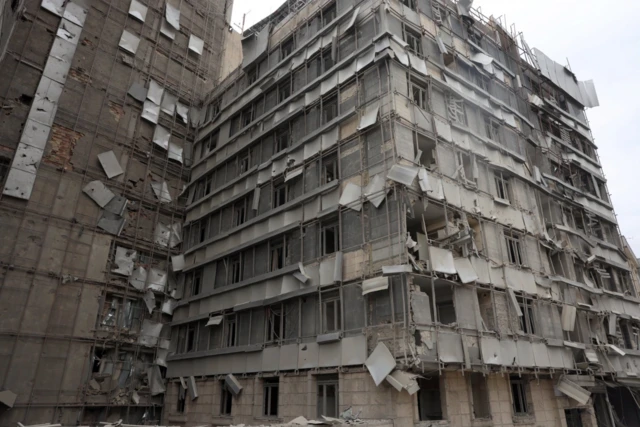
    Exterior view on the damaged Gandhi hospital, several panels hanging off windows and the building is covered in dustImage source, Reuters
    Image caption,

    The outside of Gandhi Hospital, Tehran

    The director of the World Health Organization (WHO), Tedros Ghebreyesus, says they have verified "13 attacks on healthcare in Iran, and one in Lebanon" since the start of the war.

    He did not state who was responsible or provide further details.

    On Monday, Fatemeh Mohammad Beigi, a member of the Iranian Parliament Health Commission, said that nine hospitals were hit in Iran, accusing Israel and the US of targeting them.

    The IDF has responded to allegations of targeting Tehran's Gandhi Hospital, saying the attack "was not targeted at the hospital".

    The BBC has contacted United States Central Command (Centcom) for a response on the Gandhi Hospital.

    White House Press Secretary Karoline Leavitt said yesterday: "The United States armed forces do not target civilians."

    Israel has said it is targeting military assets with "precision" to protect civilians.

  8. UAE says its air defences are responding to Iranian strikespublished at 15:41 GMT 5 March
    Breaking

    The United Arab Emirates' air defences are responding to incoming missile and drone threats from Iran, the UAE defence ministry says.

    In a brief statement, the ministry adds that "the sounds heard in scattered areas of the country are the result of the air defence systems intercepting ballistic missiles, and fighter jets intercepting drones and loitering munitions".

    This comes not long after the UAE said it intercepted six Iranian missiles and 131 drones so far today. One missile and six drones landed on its territory.

  9. Sports stadium in Tehran 'destroyed' by strikes - Iranian state broadcasterpublished at 15:39 GMT 5 March

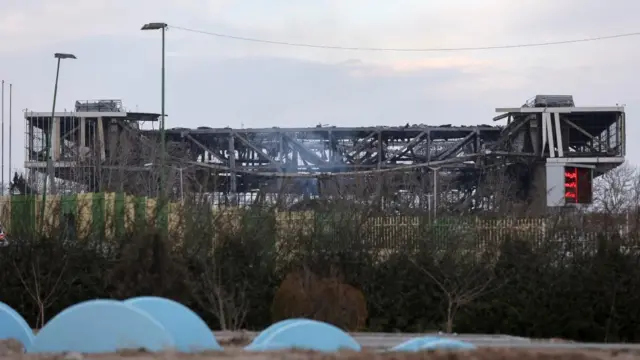
    Smoke rises over the wreckage of the Azadi Stadium following an attack. The metal pillars holding up the structure have emerged following destructionImage source, Reuters

    A sports stadium in Tehran has been "destroyed", Iran's state broadcaster, Islamic Republic of Iran Broadcasting (IRIB) said.

    It appears to be the Azadi indoor stadium, which has capacity for around 12,000 people when standing, and is part of the complex for the much larger Azadi Stadium - the largest sports stadium in the country.

    IRIB shared footage originally from the Tasnim News Agency, of collapsed stands and smoke rising from the stadium.

    "Neither nuclear bombs nor ballistic missiles are made in stadiums," the IRIB says in a post on X.

    Israel's Persian account on X also shared footage of the stadium and showed debris spread across a car park outside the stadium.

    It says the area was being used by the regime's forces.

  10. Our experts answer your questions - watch live abovepublished at 15:29 GMT 5 March

    Our experts will be on the BBC News channel shortly to answer your questions about the ongoing conflict in the Middle East.

    From 15:30 GMT, we'll be hearing from our diplomatic correspondent Caroline Hawley, our economics editor Faisal Islam, BBC Persian's Siavash Ardalan and Barbara Plett Usher, who's been reporting from Doha.

    You can watch live at the top of the page.

    A BBC graphic saying "your voice"
  11. Azerbaijan preparing 'retaliatory measures' following drone strikepublished at 15:23 GMT 5 March

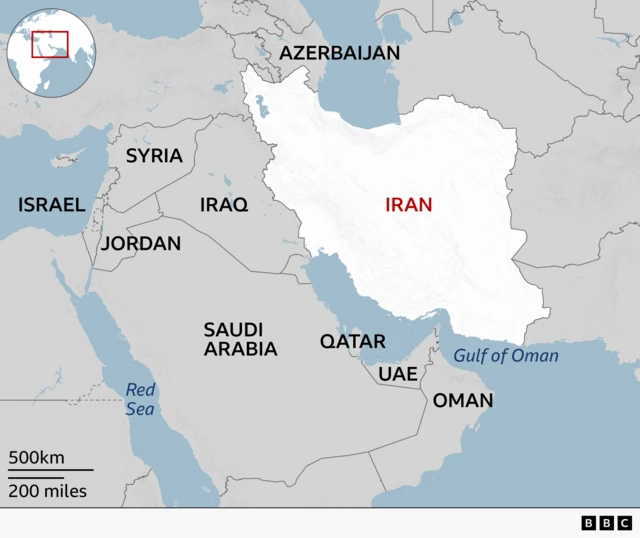
    In our last post, we brought you a report that Azerbaijan has closed part of its airspace, saying Iranian drones have crossed its borders.

    A little earlier, President Ilham Aliyev said Azerbaijan's armed forces have been instructed to "prepare and implement appropriate retaliatory measures" after it accused Iran of carrying out two drones strikes.

    "The targets of the attack were civilian facilities, including the Nakhchivan International Airport and its terminal building, a school, and other civilian sites, all treacherously struck by Iran," the statement adds.

    Azerbaijan’s foreign ministry said one drone struck the terminal building of the airport while another fell near a school building in Shakarabad. Two civilians were injured, it added.

    The general staff of the Iranian armed forces have denied any involvement in the incident and blamed Israel, BBC Persian reports.

    A map of the Middle East highlighting Iran in white with its name in red. Surrounding countries—including Azerbaijan, Iraq, Syria, Jordan, Israel, Saudi Arabia, Qatar, the UAE, and Oman—are labelled in black. Bodies of water such as the Gulf of Oman and the Red Sea are labelled in blue. A scale bar shows distances of 500 km and 200 miles. An inset map in the top left shows the region’s location on a world map, and a BBC logo appears in the bottom right.
  12. Azerbaijan closes airspace in south, citing Iranian drone activity - reportpublished at 15:06 GMT 5 March

    Azerbaijan has closed part of its airspace in the south after it said four Iranian drones flew across its border, the Reuters news agency reports.

    The airspace will remain closed for 12 hours, according to a notice to airmen (NOTAM) issued by Azerbaijan, according to Reuters.

    As we reported earlier, Azerbaijan earlier accused Iran of attacking its Nakhchivan region, an autonomous exclave bordering Iran and Armenia, with drones - Iran has denied the claim, blaming Israel.

  13. Huge queues in Beirut after Israel tells people to evacuatepublished at 14:51 GMT 5 March

    Alice Cuddy
    Reporting from Beirut

    Traffic in Beirut

    There is huge traffic coming out of Beirut's southern suburbs as residents flee after Israel warned people to immediately leave their homes.

    In its unprecedented "urgent warning", the Israeli military told people to "save your lives and evacuate your homes immediately".

    It comes amid renewed hostilities between Israel and the Iran-backed Lebanese group Hezbollah. Israel yesterday told people across huge swathes of the south of Lebanon to move north.

    Return to the latest post
  14. As Starmer finishes his news conference, we return to the latest from around the Middle Eastpublished at 14:49 GMT 5 March

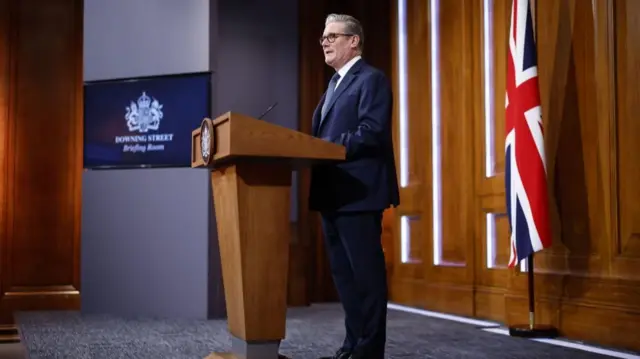
    We've just been focusing on a news conference from UK Prime Minister Keir Starmer in London, in which he said the UK was sending more fighter jets to Qatar, while confirming the first British repatriation flight had left Oman.

    We're now switching back to our reporting from the Middle East. Our next post will be from our correspondent in Beirut, Alice Cuddy.

  15. UK sending more jets to the Middle East - a recap of Starmer's news conferencepublished at 14:44 GMT 5 March

    Keir StarmerImage source, EPA

    We've just heard from UK Prime Minister Keir Starmer, who said the UK is sending more jets to the Middle East. He also warned the conflict could continue "for some time".

    Here's what else we heard during the Downing Street news conference:

  16. Starmer says he spoke to Trump on Saturday eveningpublished at 14:36 GMT 5 March

    Starmer is questioned on whether he thinks the displacement of people as a result of the conflict will manifest in more asylum claims and small boat arrivals in the UK.

    He repeats that he does not know how long the conflict will last, but says the UK is looking at "further scenarios into the future".

    He is then asked if he has spoken to Trump since the American president criticised him.

    Starmer says he spoke to Trump on Saturday evening.

  17. Starmer calls for de-escalationpublished at 14:35 GMT 5 March

    Starmer is asked if Trump has given him any insight into the next phase of his campaign.

    The PM says risk of escalation is a concern for everybody, which is why the UK is clear de-escalation needs to happen.

    "All of my team are having discussions all the time with the Americans," Starmer says.

  18. 'The special relationship is in operation right now'published at 14:34 GMT 5 March

    Starmer is asked whether he has ruined the so-called "special relationship" with the US after President Trump said Starmer was "no Winston Churchill".

    "Look, the special relationship is in operation right now," Starmer says, giving examples of their cooperation around joint bases and sharing intelligence.

    It's for Trump to take the right decisions for the US, and for himself to take decisions in the best interest of the UK, Starmer says. "There's nothing controversial about that," he says.

  19. Starmer says pre-deployment to the region was done alongside alliespublished at 14:32 GMT 5 March

    Sticking with questions to Starmer from journalists in the room - he is asked the UK has let down its allies and its people in the Middle East, with some criticising the speed of the UK's response.

    Starmer says that Britain started pre-deploying in January and February to make sure it had capability.

    He adds that this was not an isolated set of decisions and was done alongside the US and other allies.

  20. Starmer asked about disagreement in cabinet over use of British basespublished at 14:29 GMT 5 March

    Henry Zeffman
    Chief political correspondent

    Sir Keir Starmer was asked about a report in The Spectator, which claimed that at a meeting of some cabinet ministers on Friday, he had been open to allowing the US to use British bases for strikes on Iranian missile sites if a conflict broke out.

    That report claimed that cabinet ministers, among them the energy secretary Ed Miliband, persuaded him otherwise - meaning that the government did not reach that position until Sunday.

    The story represents a highly unusual apparent leak of incredibly sensitive national security discussions at the very apex of government.

    The prime minister did not quite deny the report, simply saying that on Friday the US had not made a formal request yet.