Israeli PM Netanyahu speaking - watch live abovepublished at 18:22 BST 8 April
We're now hearing from Israeli Prime Minister Benjamin Netanyahu - we'll bring you updates here and you can watch live above.
This page is no longer being updated. You can continue to follow our coverage at our new live page here
The Iranian Revolutionary Guard Corps (IRGC) says it will deliver a "regret-inducing response" if Israeli strikes on Lebanon don't stop immediately, state media reports
Israel and the US say Lebanon is not included in a two-week ceasefire deal with Iran. PM Benjamin Netanyahu says today Israel delivered "the greatest blow" to Hezbollah since the start of its ground operation in Lebanon
White House Press Secretary Karoline Leavitt says Vice-President JD Vance will lead a US negotiating team at peace talks in Pakistan on Saturday - here's what we know about the truce
Iran warns ships passing through the Strait of Hormuz without permission will be "targeted and destroyed", adding the route "remains closed" - Leavitt says Trump wants the strait to reopen "without any limitations"
Since the ceasefire was announced there have been reports of attacks continuing in the UAE, Kuwait, and at an oil refinery in southern Iran
Mohammad Bagher Ghalibaf, the speaker of the Iranian Parliament, says that three ceasefire clauses have already been "openly and clearly violated"
We're now hearing from Israeli Prime Minister Benjamin Netanyahu - we'll bring you updates here and you can watch live above.
The Iranian Revolutionary Guard Corps (IRGC) has said it will deliver a "regret-inducing response" if strikes against Lebanon are not ended immediately, state broadcaster Islamic Republic of Iran Broadcasting (IRIB) reports.
In a message on Telegram, the outlet says: "We have a stern warning to the oath-breaking United States and its Zionist partner in slaughter.
"If the aggressions against dear Lebanon are not brought to an immediate end we shall fulfil our duty and deliver a regret-inducing response to the malicious aggressors in the region."
State-run Islamic Republic News Agency (IRNA) quotes an IRGC official as saying: "Any attack on the proud Hezbollah is an attack on Iran. The [military] field is preparing a heavy response to the regime’s [Israel’s] savage crimes."

 Nick Beake
Reporting from Jerusalem
Headlines around the world today may have shouted "Ceasefire in the Middle East", but this is a fragile truce.
And notably, away from Iran, Israel has turbocharged its strikes in Lebanon.
Hitting Hezbollah targets there is a fight Benjamin Netanyahu does have the power to intensify - independent of any changing American position - unlike the conflict with Iran.
Donald Trump has told PBS News Hour that Lebanon is not part of the two-week ceasefire deal. This backs Netanyahu’s interpretation but contradicts what the Pakistani mediators have been saying.
Meanwhile, the New York Times has reported details of how Netanyahu made a highly successful sales pitch to Trump before the war to secure US involvement in a joint enterprise to target Iran that none of his predecessors had agreed to.
With rising fuel prices, Iran holding the Strait of Hormuz hostage and his Gulf allies suffering daily retaliation, the US president decided to get out of it, at least for now.
But his Israeli partner's intensified attacks in Lebanon - along with reports of Iranian violations of the deal - are imperilling this delicate ceasefire.
 Ethar Shalaby
BBC News Arabic
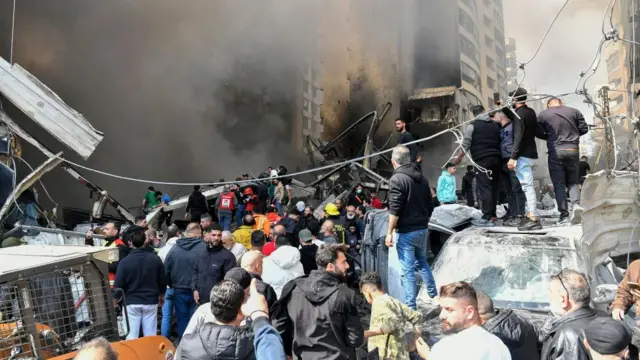 Image source, EPA
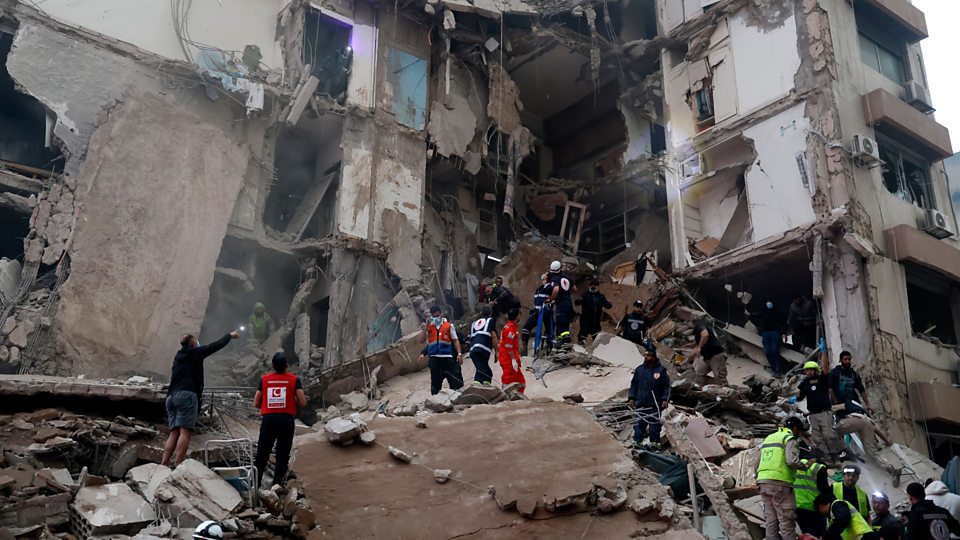
People gather at the scene of an Israeli air strike in the Corniche el-Mazraa neighbourhood of Beirut
I've spoken to BBC Arabic colleague Ahmed Abdallah, who recounts hearing today's strikes in Beirut.
He tells me he was in a meeting when the attacks began suddenly and in rapid succession, with one strike landing near his home and another directly behind it.
He describes the scene as “terrifying,” noting that he could hear the screams of his family members, including his mother, sisters, and niece, which prompted him to leave the meeting immediately and rush to them.
His home is less than 200 meters from the targeted areas, he tells me.
Raymond Essayan, who lives a few miles from Beirut, says a powerful explosion shook his area.
“There is widespread panic in the country, hospitals are full of the wounded, and everyone in Beirut is in a state of fear,” he adds.
Israel's strikes across Lebanon today have killed at least 89 people and wounded over 700, a spokesperson for the health ministry has told Reuters.
The spokesperson also says 12 medics were among the dead in southern Lebanon.
It comes after the Israel Defence Forces (IDF) announced its largest wave of strikes since the start of its ground operation in Lebanon last month.
The Israel Defence Forces (IDF) says in a Telegram post it has struck a Hezbollah commander in Beirut "a short while ago".
The military says further details will follow.
The Lebanese state-run National News Agency is also reporting fresh strikes in Beirut, and towns in southern Lebanon.
Earlier, the IDF said it had launched the "biggest strike" against Hezbollah today since the start of its operation last month.
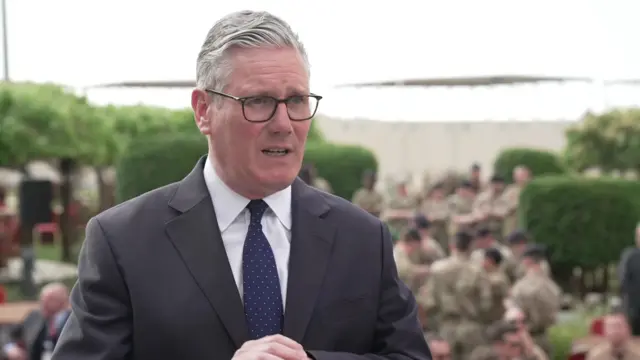 Image source, ITN
UK Prime Minister Keir Starmer has been visiting an air base in Saudi Arabia, where he called on those involved in the conflict to make the truce "permanent" and urged "all sides to implement the ceasefire, including in Lebanon".
Israel has continued to strike Lebanon throughout the day.
Starmer said the UK was in "close contact" with the US and other partners.
Asked whether his relationship with the US President was "in tatters", he said: "My principles and values made sure that... we wouldn’t get involved in the action without a lawful basis, without a viable, thought-through plan.”
 Bernd Debusmann Jr
Reporting from the White House
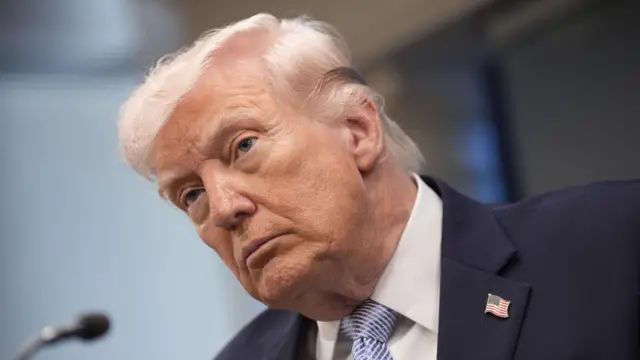 Image source, EPA
As we reported earlier, the White House has denied that the plans being reported by Iran's state media - and being shared by global news outlets - are the same ones that the US has received.
We've now heard from Donald Trump directly on Truth Social, where he criticises the "numerous agreements, lists and letters" he says are being sent out by "people that have nothing to do" with the negotiations.
"In many cases, they are total Fraudsters, Charlatans, and WORSE," he writes. "They will be rapidly exposed after our federal investigation is completed."
Trump adds that only one proposal is acceptable to the US and is being discussed behind closed doors.
Bernd Debusmann Jr
Reporting from the White House
The White House has pushed back on reports about the outline of the ceasefire plan being aired in the media.
Some news outlets have reported that the 10-point Iranian proposal reported by its state media is different from what was actually received by US officials.
Just moments ago, a White House official confirmed that to me, saying that the "document being reported by media outlets is not the working framework".
"We're not going to negotiate in public out of respect for the process," the official added.
A second question I put to the White House - about whether Lebanon is including in the deal - went unanswered.
The situation is fast moving, but we're likely to hear more from White House Press Secretary Karoline Leavitt at her briefing in about an hour's time.

By Joshua Cheetham
Ship-broker SSY has confirmed to BBC Verify that vessels in the Gulf have received the following message:
"Attention all vessels. Attention all vessels. Attention all vessels in Persian Gulf and Oman Sea. This is the IRGC Navy Station. Transiting the Strait of Hormuz remains closed and you need permission from the IRGC before sailing through the strait. Any vessel trying to travel into the sea will be targeted and destroyed.”
Claire Grierson, head of tanker research at SSY, told BBC Verify that the firm is aware vessel crews have heard this on a radio channel used for international maritime alerts.
Iranian media reports oil tankers have stopped passing through the Strait of Hormuz, as Israel hits Lebanon with the "biggest strike" since its ground operation began.
Allowing tankers through the strait is a key to the ceasefire between Iran and the US.
But Islamic Revolutionary Guard Corps (IRGC)-affiliated news agency Fars has reported that while two oil tankers were able to pass through the strait with permission from Iran this morning, the passage of oil tankers through the Strait of Hormuz has been stopped.
The Islamic Republic News Agency is also reporting ships have been halted, with both outlets referencing Israel's continued strikes on Lebanon.
 Carine Torbey
BBC Arabic correspondent, in Beirut
I'm at Rafik Hariri Hospital in Lebanon.
This is one of the hospitals where injured people were brought in following what has been described as one of the largest and most intense series of Israeli strikes on Lebanon.
In a matter of just 10 minutes, Israel launched 100 strikes on different parts of the country. Some of the areas that have been targeted are residential areas, extremely crowded ones.
The Lebanese President has described what happened as a "massacre".
Although we don't have yet a final toll for the attacks, it is estimated that hundreds of people have been either killed or injured.
Another question refers to Iran's reported demand for reparation costs for reconstruction following the US-Israeli bombing campaign, and whether the US would ever agree to do so.
Chief presenter Sumi Somaskanda says it is "highly unlikely" the Trump administration would agree to this and the US "see these strikes as justified".
The only potential economic agreement Trump may be open to, says Somaskanda, is for both Iran and US collect tolls in Strait of Hormuz. Though, it is unlikely that Iran would agree to this, she says.

Our panel of experts has been fielding questions from the BBC audience on the ceasefire announced this morning between the US and Iran.
Someone asks if a viable peace agreement between US and Iran can be reached if Israel continues to strike Lebanon.
Chief international correspondent Lyse Doucet says that despite Pakistani Prime Minister Shehbaz Sharif announcing a ceasefire on all fronts, attacks in Lebanon have continued - and in some ways intensified.
Iran has been "pointing these out as violations - evening hinting that the ceasefire is off completely unless these attacks halt," Doucet says.
She says a leaked ten point-plan from Iran demands Israel stop its attacks on Lebanon.
"The only way they [Israel] can be stopped is if President [Donald] Trump calls up Prime Minister Netanyahu and says stop," she says.

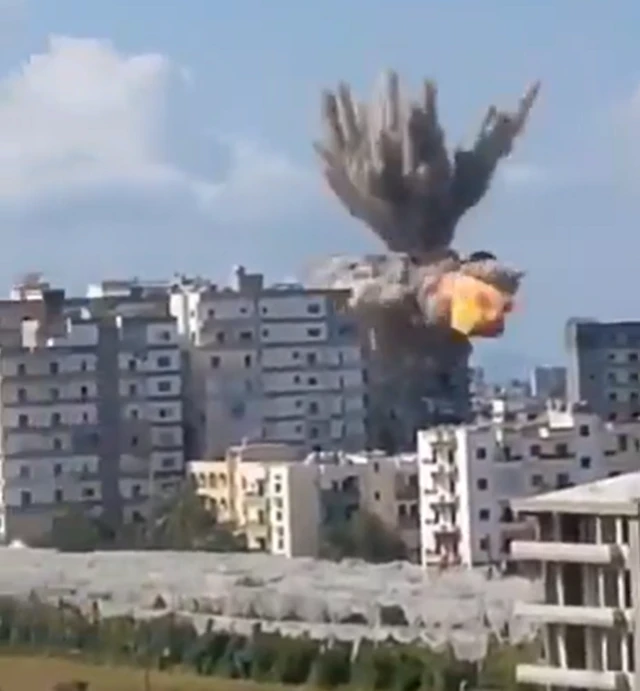 Image source, X
By Sherie Ryder and Peter Mwai
BBC Verify has been examining videos of reported strikes in southern Lebanon this morning, after the Israel Defense Forces (IDF) said it is continuing to target Hezbollah despite ceasing attacks on Iran.
One verified video shows what appears to be a strike on a building in the city of Tyre.
No munition is visible in the clip, but the video shows the top floors of a high-rise structure exploding and throwing up a smoke plume which engulfs nearby apartment blocks.
The blast comes after the IDF issued a statement it was going to strike Tyre, telling residents to evacuate their homes and move north of the Zahrani river. Alongside this, the IDF published an image highlighting the building as a target.
A second verified clip shows a huge smoke plume rising from the town of Srifa, about 12 miles (20km) to the east of Tyre.
We have not seen a specific IDF warning about this location being targeted, but did issue a general warning to all residents of southern Lebanon to move north.
Israel's Home Front Command has reported rocket and missile fire in northern parts of the country in the past hour and a half.
For the first time since early morning, the alert sounded for Manara, Margaliot, Kiryat Shmona at 14:24 BST before giving the all-clear 10 minutes later. At about 15:15 BST another alert went out for Netua, Shetula, lasting for 10 minutes.
While the alerts posted on Telegram didn't specify where the projectiles came from, the areas are located near the Lebanese border, and Israel's military has continued striking sites in Lebanon today.
Throughout the day, you've been sending us your questions on the temporary truce that's been called by the US and Iran.
On hand to answer all of them are the BBC's chief international correspondent Lyse Doucet, deputy economics editor Dharshini David, Pakistan correspondent Caroline Davies, and our correspondent in Washington Sumi Somaskanda.

Ceasefire violations have been reported at a "few places across the conflict zone", says Shehbaz Sharif, prime minister of Pakistan, which is mediating negotiations between Iran and the US.
In a statement on X, he says: "Violations of ceasefire have been reported at few places across the conflict zone which undermine the spirit of peace process.
"I earnestly and sincerely urge all parties to exercise restraint and respect the ceasefire for two weeks, as agreed upon, so that diplomacy can take a lead role towards peaceful settlement of the conflict."
 Tom Bateman
US State Department correspondent
Hegseth was triumphalist in his news conference but in the room few details were forthcoming about the nature of the truce and planned negotiations with Iran.
His statements were marked by contradiction and a lack of clarity.
The administration says the aim of the war was to deny Iran a nuclear weapon in the future. Hegseth said at one point Iran would hand over its stockpile of nuclear fuel “right now”. He didn’t say who would do this, how it would happen, or how it would be verified.
He was later asked about this and said: “They will either give it to us, which the president laid out, or if we have to do something else ourselves."
On the Strait of Hormuz, Tehran has said its re-opening it during the truce will be under Iranian military coordination. Hegseth was asked about control of the strait, and said the oil tankers “will be sailing” but the US retained options.
And he was asked about Trump’s post on Tuesday threatening a “whole civilization” would die, and his threat to destroy all of Iran’s power plants and bridges.
Hegseth quoted the president saying the US could “take it all” including Iran’s “ability to export energy”, adding: “The United States military has the ability to strike those things with impunity”.
This is not true, Congress has a series of laws limiting US conduct in war and has ratified treaties including the Geneva Conventions, which mean its military and leadership cannot act “with impunity”.
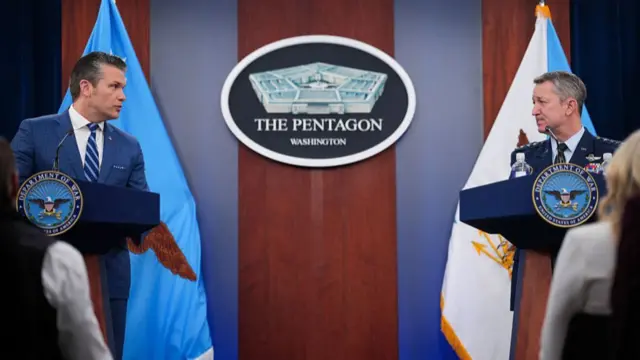 Image source, Getty Images
Here's a roundup from today's earlier Pentagon briefing, where US Defence Secretary Pete Hegseth and Chairman of the Joint Chiefs of Staff, General Dan Caine, updated reporters on Washington's achievements during Operation Epic Fury in Iran.
Here's what we learned:
Hegseth and Caine both see the ceasefire as a resounding victory, but significant questions remain about the broader deal, as the BBC's Bernd Debusmann Jr writes.