Summary

  1. Iran formally agrees to ceasefire and to open Strait of Hormuz if attacks stoppublished at 00:25 BST 8 April
    Breaking

    Iranian Foreign Minister Abbas Araghchi has announced Iran will agree to a ceasefire "if attacks against Iran are halted".

    He continues "for a period of two weeks, safe passage through the Strait of Hormuz will be possible".

    This will take place "via co-ordination with Iran's Armed Forces and with due consideration of technical limitations", he says.


  2. The 10-point plan for the conditional ceasefire, according to Iranpublished at 00:20 BST 8 April

    Here is the 10-point plan, according to an Iranian state broadcaster:

    1. Complete cessation of the war on Iraq, Lebanon, and Yemen
    2. Complete and permanent cessation of the war on Iran with no time limit
    3. Ending all conflicts in the region in their entirety
    4. Reopening the Strait of Hormuz
    5. Establishing a protocol and conditions to ensure freedom and security of navigation in the Strait of Hormuz
    6. Full payment of compensation for reconstruction costs to Iran
    7. Full commitment to lifting sanctions on Iran
    8. Release of Iranian funds and frozen assets held by the United States
    9. Iran fully commits to not seeking possession of any nuclear weapons
    10. Immediate ceasefire takes effect on all fronts immediately upon approval of the above conditions
    Return to the latest post
  3. Sirens sound in Israel, military sayspublished at 00:05 BST 8 April

    Minutes after Trump's announcement, the Israel Defense Forces (IDF) said that they have identified missiles launched from Iran.

    The IDF says "defensive systems are operating to intercept the threat".

    The public have also been warned to "enter a protective space and remain there until further notice".

  4. Analysis

    So many questions remainpublished at 00:03 BST 8 April

    Daniel Bush
    Washington correspondent at the White House

    Many, many questions remain, now.

    But perhaps the most pressing is how Donald Trump will frame this.

    Will he declare this to be victory, or is there more fighting to come?

    Sources say he might still launch more airstrikes after the two-week period ends, and then declare victory at a later date.

    In the Middle East, one important question is what will be the US relationship with its allies going forward.

    How will Iran interpret this? Will it continue to attack? What disagreements remain?

    What will Israel do? Will it continue its attacks on Iran?

    We at the White House are still waiting to find out if Trump plans to make any remarks in person to announce the conditional ceasefire deal.

  5. Oil prices slide after Trump's ceasefire announcementpublished at 23:57 BST 7 April

    Global oil prices have fallen sharply after US President Donald Trump announced a conditional two-week ceasefire.

    Brent crude is down 5.8% at $103.42 a barrel, while US-traded oil was almost 8.5% lower at $103.25.

    But prices remain much higher than before the conflict started on 28 February.

  6. Iranian state media reports Trump's announcementpublished at 23:55 BST 7 April
    Breaking

    Ghoncheh Habibiazad
    Senior reporter, BBC Persian

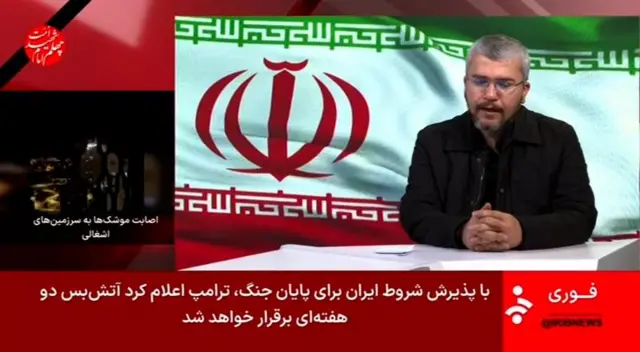
    Iranian state media reports on Donald Trump's ceasefire announcementImage source, IRINN

    Iranian state media is reporting on Donald Trump's social media post.

    The headline says "Trump announces two-week ceasefire accepting Iran's conditions to end war" and the outlet also refers to "Trump's humiliating retreat from anti-Iran rhetoric".

  7. What does Trump say about the next steps in achieving peace?published at 23:54 BST 7 April

    Trump says Iran has sent the US and Israel a ten-point plan.

    We do not yet know the details of this plan, but Trump says it is a "workable basis on which to negotiate".

    "Almost all of the various points of past contention have been agreed to between the United States and Iran, but a two week period will allow the Agreement to be finalized and consummated."

    He adds that "it is an Honor to have this Longterm problem close to resolution."

  8. Trump says military objectives have been 'met and exceeded'published at 23:52 BST 7 April

    Continuing on Truth Social, Trump says the reason he has agreed to the provisional ceasefire is because "we have already met and exceeded all Military objectives".

    He also says the announcement comes because "we are very far along with a definitive Agreement concerning Longterm PEACE with Iran, and PEACE in the Middle East".

  9. Who has the US been negotiating with?published at 23:48 BST 7 April

    Pakistan has been acting as a mediator in the US-Israeli conflict with Iran.

    Trump has named the Prime Minister of Pakistan Shehbaz Sharif as one of the people he has held conversations with that have led to this conditional agreement for a ceasefire.

    The country's Field Marshal Asim Munir is also named in his Truth Social post.

    They "requested that I hold off the destructive force being sent tonight to Iran", Trump writes.

  10. Trump announces ceasefire with Iran if Strait of Hormuz reopenedpublished at 23:38 BST 7 April
    Breaking

    Donald Trump says that after discussions with the leadership of Pakistan there will be a ceasefire between the US and Iran if Iran agrees to allow traffic through the Strait of Hormuz.

    "I agree to suspend the bombing and attack of Iran for a period of two weeks," he says.

    "This will be a double sided CEASEFIRE!"

    Trump continues, saying he will agree to the two week ceasefire "subject to the Islamic Republic of Iran agreeing to the COMPLETE, IMMEDIATE, and SAFE OPENING of the Strait of Hormuz".

  11. Analysis

    Trump's threat shows that his options are limitedpublished at 23:32 BST 7 April

    Jeremy Bowen
    International Editor

    Donald Trump’s phrase that "a whole civilisation will die tonight" unless a deal is reached are not the kind of words you would expect to hear from the US president or the leader of any country that purports to conduct itself by the usual international norms.

    These are not just words - they have come from the president of the United States.

    Trump has various options, and frankly none of them are attractive.

    This is a situation where the president has come up against the limits of his own power.

    These techniques of threat, of bluster, have worked in different ways in the past. But he's dealing with a regime that doesn't seem that concerned if they die, and they're certainly not concerned if their own people die.

    And they believe that their capacity for suffering pain is greater than America's, and that they essentially have got the Americans on the run even though it's going to cost them something.

    Reports of the peace plan put forward by the US suggest it's essentially a bucket list of everything that Israel and the US have demanded of the Islamic Republic over many years.

    Iran has said they want a permanent ceasefire before they will do any sorts of deals and they also want their positions to be recognised.

    Right now, the two sides are way apart.

  12. Trump loses support from some Republicanspublished at 23:05 BST 7 April

    Among the voices condemning Trump for his threat against Iranian "civilization" and the ongoing US airstrikes are some of his long-time allies in the Republican party.

    Georgia Congressman Austin Scott, who serves on both the House Armed Services committee and the intelligence committee, told BBC News that Trump's comments will do little to stop the fighting.

    "The president's comments are counter-productive and I do not agree with them," said Scott.

    Texas Republican Nathaniel Moran posted on X that he takes issue with Trump's threat.

    "Our nation has always conducted military operations for just causes and through just and moral means. This must continue in the future; otherwise we forfeit our legitimacy to lead the world," Moran wrote.

    "So, let me be clear: I do not support the destruction of a 'whole civilization.' That is not who we are, and it is not consistent with the principles that have long guided America."

    Trump has also faced criticism from notable conservative voices in the media, including Tucker Carlson, Alex Jones, Candace Owens and Joe Rogan.

    Former Congresswoman Marjorie Taylor Greene, who split with Trump after building her political career as a Trump loyalist, called his latest threat "insane" and called for him to be removed from office.

    "We cannot kill an entire civilization," she wrote on X. “This is evil and madness.”

    Joe Kent, the former director of the National Counterterrorism Center who quit over Trump decision to attack Iran, says Trump risks America's reputation if he decides to target civilian infrastructure.

    "Trump believes he is threatening Iran with destruction, but it is America that now stands in danger," he posted on X.

    "If he attempts to eradicate Iranian civilization, the United States will no longer be viewed as a stabilizing force in the world, but as an agent of chaos—effectively ending our status as the world’s greatest superpower."

  13. Watch: Americans react to Trump's threat that a 'whole civilisation will die tonight'published at 22:26 BST 7 April

    Americans visiting Washington DC from around the country have given their reaction to Trump's warning that "a whole civilisation will die tonight" if Iran does not capitulate and re-open the Strait of Hormuz.

    "It's very concerning to put the public in an alarming state," says one woman.

    Another man says, "I think it's been a long-time coming. It's inevitable."

    Media caption,

    Americans react to Trump's 'a whole civilisation will die tonight' warning

  14. Analysis

    Is Trump considering an off-ramp?published at 22:09 BST 7 April

    Daniel Bush
    Washington correspondent

    President Donald Trump may be considering an off-ramp to deescalate the war with Iran.

    The White House said on Tuesday that Trump was "aware" of a proposal by Pakistan that Trump extend his deadline by two weeks to pave the way for a temporary ceasefire. His proposal, posted on social media, includes requests for a two-week ceasefire and opening of the Strait of Hormuz, and would be followed by talks for a permanent end to the war.

    Trump declined several times in talks with reporters on Tuesday to offer details on the US-Iran talks. He said the countries are involved in "heated negotiations."

    Trump has given Iran until 20:00 eastern time (0100 BST) to reach a deal, or face an attack that he said would destroy the country's bridges and power plants. Trump also warned Tuesday that "a whole civilisation might die" if Iran doesn't agree to a deal.

    The social media post sparked a backlash. It also underscored how much pressure Trump faces as he pushes for a deal and weighs whether or not to follow through with his threat to escalate the war.

  15. Gulf states brace for potential retaliationpublished at 22:05 BST 7 April

    Frank Gardner
    Security correspondent

    Soon after the sirens sounded in Bahrain tonight an eery calm descended over much of the capital Manama.

    Some residents of high rise buildings have been warned to expect power outages, while the US Embassy has ordered all Americans to shelter in place.

    Bahrain is home to the headquarters of the US Fifth Fleet. Like its neighbours, it has been subjected to nightly bombardments by Iranian drones and ballistic missiles, a small portion of which get through the island's air defences.

    But Iran has threatened to hit the Arab Gulf states with devastating force if Donald Trump goes through with his threat to "bomb it back to the Stone Age".

    Its retaliation is expected to target power generation, desalination plants and other civilian infrastructure up and down the Gulf.

    In Qatar today a Foreign Ministry briefing for the international media was packed, with one journalist saying the situation felt "apocalyptic".

  16. BBC Verify

    Iran state media videos show demonstrations at infrastructure sitespublished at 21:55 BST 7 April

    By Joshua Cheetham

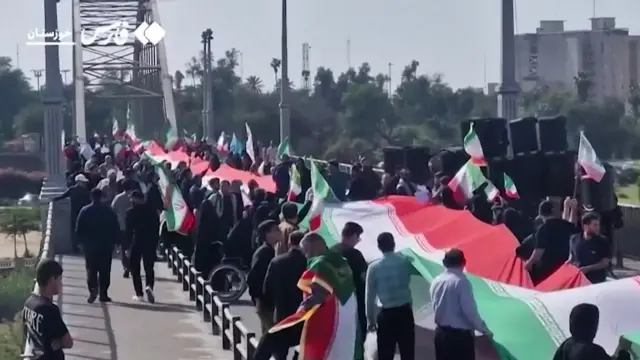
    Verified videos and images showing dozens of people forming "human chains" at several bridges and energy sites in Iran have been shared by state media, following days of US threats to attack them.

    BBC Verify has checked several clips which show Iranian government supporters gathered near the sites, including:

    • Kazeroun power plant in south-western Fars province and Shahid Rajaee power plant in northern Qazvin province
    • Bridges in the cities of Dezful and Ahvaz, in south-western Khuzestan province
  17. Iranian minister encourages 'human chains' around infrastructurepublished at 21:55 BST 7 April

    Some authorities in Iran are encouraging Iranians to form "human chains" around power plants to deter threatened attacks from the United States.

    Iran's deputy minister of youth and sports Alireza Rahimi posted a statement on X, saying the "Human Chain of Iranian Youths for a Bright Tomorrow" campaign was held "across the country" today.

    Footage shared by Iran's official Fars state news agency and verified by the BBC showed what it said was a "Human chain in front of the Kazerun combined cycle power plant".

    In a post on Telegram, an account for the Iranian government said: "Those who participated in this campaign unanimously condemned the American-Israeli aggression and declared their strong support for the country's armed and defence forces.

    "In this movement, young people across the country considered any attack on the country's infrastructure to be a war crime and condemned these actions with one single voice."

    In a separate post on X, Iran President Masoud Pezeshkian said that 14 million Iranians had signed up to "sacrifice their lives to defend Iran". Applicants can register by sending a text message to a designated phone number.

    Trump later slammed the reported use of human shields around physical infrastructure.

    "Totally illegal," Trump told NBC News. "They’re not allowed to do that."

    Iranians gather on a bridge holding a large flagImage source, Reuters
  18. Analysis

    Some Democrats call for Trump's removalpublished at 21:34 BST 7 April

    Ione Wells
    Reporting from Washington DC

    A growing number of Democratic politicians in the US are calling for the 25th Amendment to be invoked after Donald Trump's threats today.

    It's a mechanism written into the US Constitution that allows the vice-president to take over from the president if he is unable to fulfil his duties.

    Section 4 of the amendment covers a scenario where the president can't or won't declare his own inability himself. If the vice-president and the majority of the cabinet agree the president is unable to do the job, they can send a declaration saying so to the leaders of Congress, which the president can then challenge.

    There's no sign that members of Trump's cabinet or Vice-President JD Vance are considering this, so it remains an unlikely scenario. But that hasn't stopped Democrats from calling for it.

    Dozens of Democratic lawmakers have accused Donald Trump of "threatening genocidal war crimes" or being "too dangerous" to "have the nuclear codes".

    Congresswoman Alexandria Ocasio-Cortez said on social media: "This is a threat of genocide and merits removal from office. The President's mental faculties are collapsing and cannot be trusted."

    Separately, senior Democrats in the House of Representatives have called on Republicans to join with them in a "vote to end this reckless war of choice in the Middle East before Donald Trump plunges our country into World War III", calling Trump "completely unhinged".

    "His statement threatening to eradicate an entire civilisation shocks the conscience and requires a decisive congressional response."

    The House is currently on recess and not due to return until 14 April.

  19. Marco Rubio and Yvette Cooper agree on 'need for international efforts'published at 21:32 BST 7 April

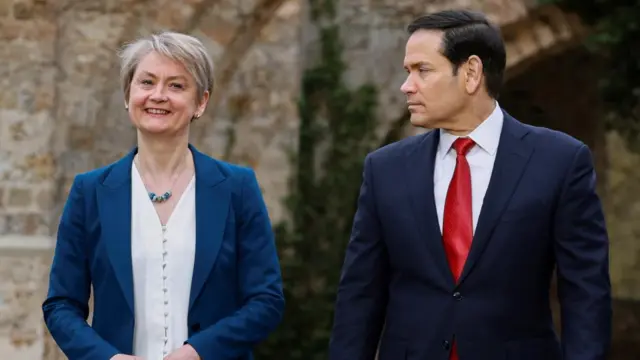
    US Secretary of State Marco Rubio and UK Foreign Secretary Yvette Cooper agreed today "on the need for international efforts" in response to the escalating crisis in the Middle East, according the State Department.

    According to US State Department principal deputy spokesman Tommy Pigott, the pair spoke about "the Iranian regime's ongoing attacks across the Middle East and the critical importance of restoring freedom of navigation in the Strait of Hormuz."

    He says: "The secretary and foreign secretary agreed on the need for international efforts to ensure shipping can move freely and energy supplies can reach global markets."

    Cooper and Rubio pictured in March 2026Image source, Reuters
    Image caption,

    Cooper and Rubio pictured in March

  20. Qatar intercepts missile headed for its borderspublished at 21:28 BST 7 April

    Qatari armed forces say they have intercepted an incoming missile strike headed for their borders.

    The country's Ministry of Defence wrote on social media that it neutralised the threat "by the grace of God".