
Tank: Life and Times of a 'Wonder Weapon'
By Patrick Wright
Last updated 2011-02-17
Agents of suppression
Agents of suppression
The British authorities learned their own lesson about tanks and their alarming symbolic power in Northern Ireland. As part of ‘Operation Motorman’ in 1972, Centurion tanks were used to break into Republican no-go areas in Derry and Belfast.
The photographs turned out to be a gift to the IRA. They confirmed the worst that the old rebel songs had to say about the British state, and they were doubly embarrassing thanks to events in the Soviet bloc, where unarmed civilians had repeatedly squared up to Soviet tanks as they ‘rolled onto the streets’ of rebellious eastern European cities.
This imagery became familiar when the Communist Bloc used tanks to crush the workers’ uprising in East Berlin, 1953. It was reprised in 1956, when Soviet tanks advanced into the Hungarian capital Budapest to suppress the popular revolution. The same tactic was used again in 1968, when tanks were confronted by flower-toting citizens as they ended the ‘Prague Spring’ in Czechoslovakia.
Further such images were generated by the collapse of the Soviet empire. Soviet tanks were used against civilians in Lithuania in 1991, and also in Moscow, where future Russian president Boris Yeltsin faced down a hardline Communist coup by mounting one of the tanks surrounding his presidential office and appealing directly to the Russian people.
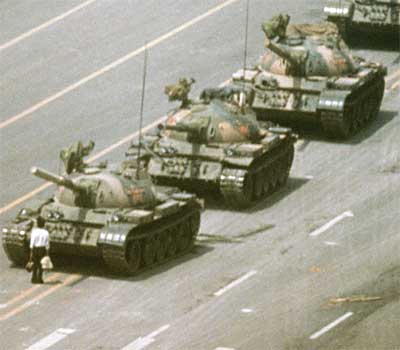
The tanks have hardly stopped rolling since then, and yet the imagery of people power surely found its culmination in during the bloody suppression of popular protests in Tiananmen Square, Beijing, China.
On 5 June 1989, a single man stepped out in front of a column of tanks. Though armed with nothing more formidable than a plastic shopping bag, he stopped them in their tracks. The resulting image supported a highly simplified interpretation of events, but subtlety has rarely been the point of tanks either in victory or in defeat.
World War One Centenary
- Find out more about how the BBC is covering the World War One Centenary, and see the latest programmes and online content
Surviving the trenches

Pack Up Your Troubles

BBC iD
BBC iDBBC navigation
BBC links

BBC © 2014 The BBC is not responsible for the content of external sites. Read more.
This page is best viewed in an up-to-date web browser with style sheets (CSS) enabled. While you will be able to view the content of this page in your current browser, you will not be able to get the full visual experience. Please consider upgrading your browser software or enabling style sheets (CSS) if you are able to do so.
