
Tank: Life and Times of a 'Wonder Weapon'
By Patrick Wright
Last updated 2011-02-17
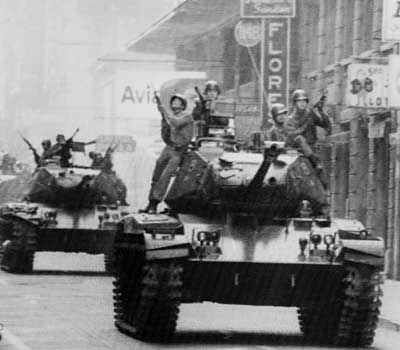
Tanks vs 'people power'
Tanks vs 'people power'
Even now, when advanced types of tank can destroy enemy targets while still far enough away to be invisible to the naked eye, the ‘shock effect’ of the machine’s appearance remains important.
The military theorists may have felt more at home with the thought of great clashes in which tank army came up against tank army, in the manner of the Battle of Kursk in 1943. (This was the largest tank engagement in history - more than 6,000 were involved - when the Soviet army won a decisive victory over the German Wehrmacht.)
Yet tanks have continued to play their part in ‘softer’ missions intended to maintain order, as in present-day ‘peace-keeping’ operations, or to overawe, if not flatten, protesting citizens.
The imagery of ‘people power’ which came to prominence in the later 20th century directly defined itself against tanks employed against civilians by dictatorial and totalitarian regimes.
In 1967, citizens faced and succumbed to the tanks of the so-called ‘Colonels’ Junta’ in Greece. In 1974, the world watched another crushing confrontation, this time in Chile, where General Pinochet’s forces flattened the Popular Unity government of Salvador Allende and threatened literally to crush prisoners under their machines.
Another such confrontation took place in the Philippines during the ESDA revolution in 1986. This time priests, nuns and children were prominent among the unarmed civilians who faced President Ferdinand Marcos’s tanks in Manila, and they won.
World War One Centenary

- Find out more about how the BBC is covering the World War One Centenary, and see the latest programmes and online content
Surviving the trenches

Pack Up Your Troubles

BBC iD
BBC iDBBC navigation
BBC links

BBC © 2014 The BBC is not responsible for the content of external sites. Read more.
This page is best viewed in an up-to-date web browser with style sheets (CSS) enabled. While you will be able to view the content of this page in your current browser, you will not be able to get the full visual experience. Please consider upgrading your browser software or enabling style sheets (CSS) if you are able to do so.
