
Tank: Life and Times of a 'Wonder Weapon'
By Patrick Wright
Last updated 2011-02-17
Tanks against civilians
Tanks against civilians
After World War One, the future of the tank seemed very uncertain. Satisfied that trench warfare was an aberration that was most unlikely to be repeated, a conservative faction in the British military command would have been content to see the tanks scrapped along with their unruly crews.
But the tank soon found new theatres of operation. In the last months of the war, Tank Corps officers had been interested to discover that captured German prisoners were inclined to report the terrifying sound of approaching tanks even in places where no tanks had ever been.
That sort of ‘tank terror’ was now applied to rebellious civilians and colonial subjects. Tanks were used to ‘overawe’ rioters and rebels in conquered Germany, both by the British army of occupation and by the German government, which employed captured or borrowed British tanks in the suppression of the Communist ‘Spartacist’ uprising in Berlin, 1919.
In the same year in Britain, tanks were sent to conquer revolutionary strikers in Glasgow. They were also taken to Ireland, where they assisted the notoriously brutal Black and Tans in their violent suppression of Sinn Fein.
British tanks and crews were also shipped to Russia as part of the Allied intervention on the side of the ‘White Russian’ forces, then engaged in civil war against the Bolshevik revolutionaries of November 1917.
They were received in a spirit of rapturous worship - on the Black Sea, Cossacks are said to have kissed the tanks as they were unloaded - but they were too few to prevent Bolshevik victory.
It might be thought that the ‘psychological’ dimension of the tank would recede in importance once the engineering improved and the machine, which had started as a crudely motorised and painted metal box, was converted into a truly effective weapon.
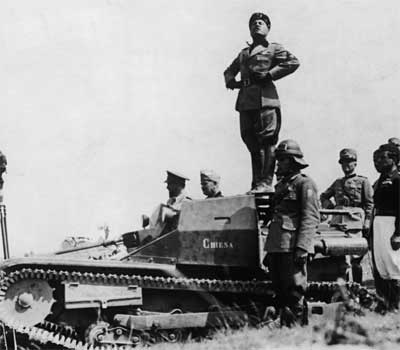
Yet the terrorising powers of the weapon would remain decisive. It was this that commended the tank to Italian dictator Benito Mussolini, who liked nothing better than to rally his troops from the roof of a charisma-enhancing Fiat model.
Similarly, Adolf Hitler in his last years would fantasise about regaining control of World War Two with the help of a vast 188-ton tank - the so-called ‘Maus’ - that was actually so heavy as to be practically immobile.
Nations may traditionally be known by their languages, customs, sporting prowess and literature. But by the 1930s, many were also proud to be known by their own distinct models of tank.
World War One Centenary
- Find out more about how the BBC is covering the World War One Centenary, and see the latest programmes and online content
Surviving the trenches

Pack Up Your Troubles

BBC iD
BBC iDBBC navigation
BBC links

BBC © 2014 The BBC is not responsible for the content of external sites. Read more.
This page is best viewed in an up-to-date web browser with style sheets (CSS) enabled. While you will be able to view the content of this page in your current browser, you will not be able to get the full visual experience. Please consider upgrading your browser software or enabling style sheets (CSS) if you are able to do so.
