
From Disaster to Victory: The British Army from 1916-1918
By Dr Dan Todman
Last updated 2011-02-17
Logistics
Logistics
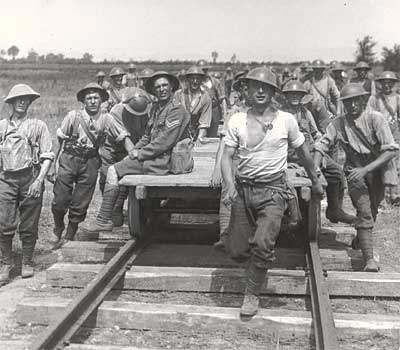
None of the British army’s tactical and technical developments would have been of much use if soldiers did not have the equipment, weapons and munitions to put them into effect. The Battle of the Somme stretched the improvised system of British logistics almost to breaking point.
Over the winter of 1916-1917, the way that the British managed supplies was completely reorganised, partly under the supervision of Sir Eric Geddes, a civilian brought in because of his pre-war expertise in railway organisation.
A new system of ‘prediction’ of where and when supplies would be needed, and a new emphasis on effective transport enabled British troops to fight more effectively. In particular, by 1917, British gunners were able to operate for the first time without serious restriction on the quantity of shells they could fire.
In this photograph, Royal Engineers are working on a light railway to bring up supplies and carry back wounded, near Boesinghe in Belgium, before the start of the Third Ypres campaign in July 1917.
World War One Centenary

- Find out more about how the BBC is covering the World War One Centenary, and see the latest programmes and online content
Surviving the trenches

Pack Up Your Troubles

BBC iD
BBC iDBBC navigation
BBC links

BBC © 2014 The BBC is not responsible for the content of external sites. Read more.
This page is best viewed in an up-to-date web browser with style sheets (CSS) enabled. While you will be able to view the content of this page in your current browser, you will not be able to get the full visual experience. Please consider upgrading your browser software or enabling style sheets (CSS) if you are able to do so.
