
From Disaster to Victory: The British Army from 1916-1918
By Dr Dan Todman
Last updated 2011-02-17
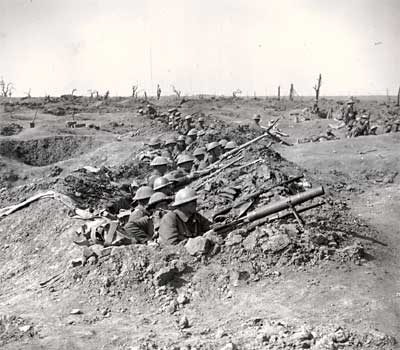
Infantry fire support
Infantry fire support
Although large scale infantry manoeuvres were not possible on the Western Front, at the very lowest level of combat there were sometimes opportunities to outflank opponents in fixed positions. But junior infantry leaders found it difficult to exploit these opportunities when the only firepower available to them consisted of newly-trained soldiers armed with bolt-action rifles.
Before, during and after the Somme, British infantry were re-equipped with light machine guns and rifle grenades, as well as being able to call upon their usual pre-war weapons. As a result, while infantry battalions became steadily smaller throughout the war, the quantity of firepower they could produce became steadily larger.
In the winter of 1916-1917, as a direct result of experience on the Somme, the infantry were formally reorganised to make the ‘platoon’ (40 men) the key tactical unit, rather than the larger ‘company’ (150 men). Platoon commanders were given control of these new infantry weapons, so that they had available both automatic fire (machine gun) and indirect fire (such as trench mortars).
Compared to their predecessors, junior commanders - subalterns and non-commissioned officers (NCOs) - were expected by 1917 to exercise far greater control and initiative over the battle at a local level.
A new system of standard formations and drills, combining fire and movement, was promulgated throughout the army to make use of this devolution of weapons and responsibility. When combined with accurate artillery fire in sufficient quantity, these changes made it possible for British infantry in 1917 to regularly break into strongly defended positions.
World War One Centenary

- Find out more about how the BBC is covering the World War One Centenary, and see the latest programmes and online content
Surviving the trenches

Pack Up Your Troubles

BBC iD
BBC iDBBC navigation
BBC links

BBC © 2014 The BBC is not responsible for the content of external sites. Read more.
This page is best viewed in an up-to-date web browser with style sheets (CSS) enabled. While you will be able to view the content of this page in your current browser, you will not be able to get the full visual experience. Please consider upgrading your browser software or enabling style sheets (CSS) if you are able to do so.
