
From Disaster to Victory: The British Army from 1916-1918
By Dr Dan Todman
Last updated 2011-02-17
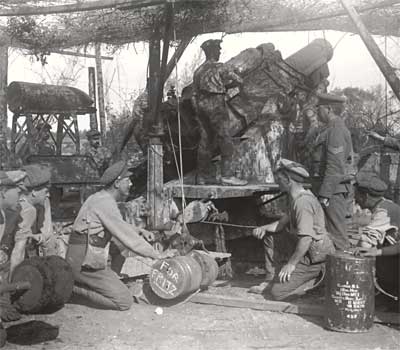
Artillery
Artillery
Artillery was the key battle-winning weapon on the Western Front. The bombardment which preceded the infantry attack on 1 July 1916 shocked both British and Germans in its scale.
In reality, the British guns were trying to bombard too large an area, often with poorly directed fire, using inadequate shells. In terms of the proportion of guns firing to the size of the target, the preliminary bombardment for the Somme was weaker than that at the Battle of Neuve Chapelle the year before.
Probably the most important learning experience undergone on the Somme related to artillery. Even during the battle, some commanders learned the importance of concentrating artillery fire. Comparing the attack of 14-15 July 1916 to that of a fortnight before, we find two thirds of the guns firing at one eighteenth the length of trench. By the end of the battle, it was more widely accepted that German artillery batteries were themselves a prime target which had to be dealt with before and during an attack.
The Somme saw the one of the first uses of the ‘creeping barrage’, a wall of exploding shells which moved forward slowly over enemy trenches with infantry following close behind. It ensured the Germans stayed under cover until the British soldiers were upon them.
In the early days of the Somme, these barrages sometimes moved too fast for the troops behind them, allowing the Germans to emerge from their bunkers and man their defences before the British arrived. But over the next two years the barrages would become increasingly sophisticated, incorporating different weapons and multiple variations in timing.
In the period after the Somme, British artillery became increasingly adept at using a variety of methods to bring their guns into action quickly, accurately and decisively. These included dispensing with the practice of firing ‘ranging shots’ which gave the Germans prior warning of an attack, in favour of ‘pre-registration’ of artillery using a grid map system.
Heavier guns - like this 12-inch howitzer - and innovations in the shells designed for them allowed British artillery to perform a wide range of tasks, from destroying barbed wire to knocking out enemy guns.
World War One Centenary

- Find out more about how the BBC is covering the World War One Centenary, and see the latest programmes and online content
Surviving the trenches

Pack Up Your Troubles

BBC iD
BBC iDBBC navigation
BBC links

BBC © 2014 The BBC is not responsible for the content of external sites. Read more.
This page is best viewed in an up-to-date web browser with style sheets (CSS) enabled. While you will be able to view the content of this page in your current browser, you will not be able to get the full visual experience. Please consider upgrading your browser software or enabling style sheets (CSS) if you are able to do so.
