
From Disaster to Victory: The British Army from 1916-1918
By Dr Dan Todman
Last updated 2011-02-17
Co-ordination
Co-ordination
A central problem the army experienced during World War One was the difficulty of co-ordinating different arms and taking advantage of fleeting opportunities.
On the Somme, soldiers in the front line found it extremely hard to communicate with rear areas and supporting units. Both telegraph wires and human runners were very vulnerable to enemy shellfire. Even when local successes occurred - as they did even on 1 July 1916 - by the time news got back to headquarters it was too late.
The British recognised the problem of communications, and in December 1916 ‘signallers’ were instructed to follow close behind the attack, burying cables connected in a ‘ladder’ system so that one break would not disable the network.
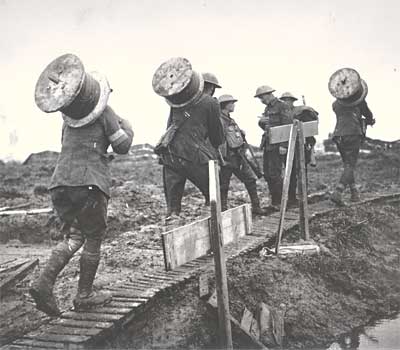
In this photograph from October 1917, Royal Engineers carry drums of telephone wire to connect units on the battlefield near Ypres. The British Expeditionary Force (BEF) began experiments with the use of radio (which doesn’t require vulnerable cables) at a divisional level, but sets remained too bulky and temperamental to use lower down the chain of command.
In its planning for the Battle of the Menin Road in September 1917, 1st Australian Division specified seven different means of communication between headquarters and the front line, including telegraph and telephone, visual signalling, wireless, power buzzers, motor cycle despatch riders, runners and pigeons.
These developments did not solve the problem of communications, but they did make it more likely that messages would get through.
World War One Centenary

- Find out more about how the BBC is covering the World War One Centenary, and see the latest programmes and online content
Surviving the trenches

Pack Up Your Troubles

BBC iD
BBC iDBBC navigation
BBC links

BBC © 2014 The BBC is not responsible for the content of external sites. Read more.
This page is best viewed in an up-to-date web browser with style sheets (CSS) enabled. While you will be able to view the content of this page in your current browser, you will not be able to get the full visual experience. Please consider upgrading your browser software or enabling style sheets (CSS) if you are able to do so.
