
Armada Gallery
By Felipe Fernandez-Armesto
Last updated 2011-02-17
Truth versus fiction
- Truth versus fiction
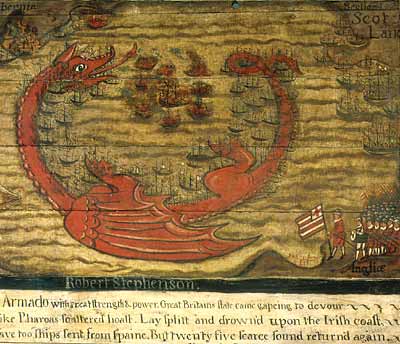
- Propaganda rapidly turned the Armada into a subject of myth. Both sides represented the fight as holy - a terrestrial arena of celestial conflict, on which divine attention is focused and divine power concentrated. Little evidence survives of how widely ordinary people accepted these messages, but in a Lincolnshire parish, a rustic painter - who emblazoned his effort with his own name - echoed the official line.
Painted on a piece of ship's board, and displayed in the parish church, the work represents the Armada's crescent formation as a dragon - a beast recognisable to everyone at the time as diabolic.
The verses (detail below) compare the Spaniards to pharaoh's hosts¹: English propaganda frequently likened the English to the Israelites, and Elizabeth to Old Testament judges and prophet.

- Spaine's proud Armado with great strength and power
- Great Britain's state came gapeing to devour,
- This Dragon's guts, like Pharaos scattered hoast,
- Lay splitt and drowned upon the Irish coast.
- For of eight score save too ships sent from Spaine
- But twenty-five scarce sound return'd again.
Despite the inaccuracies of the painter's geography, the work is a reliable guide to the origins of some false conceptions. Here it demonises the enemy, and displays some of the misrepresentations that English tradition came to treat as fact. Also, the size of the Armada is exaggerated, and the Armada's losses wildly over-estimated. In reality, only 21 ships are known to have been lost on the coasts of Scotland and Ireland.
Even allowing for undocumented losses, a high proportion of the ships of the Armada - up to five-sixths of them - returned home. Most of the principal fighting ships escaped. In some ways, the outcome of the campaign left Spain stronger than before - the prodigious resources and shipbuilding capacity of the monarchy ensured that within a few years the lost ships had been replaced by better, stronger models, and much of the 'Spanish main' was refortified.
After the Armada, Spain's record of victories at sea continued, and was not seriously reversed until the 1630s. English successes at sea, by contrast, became rare. Spain even launched more Armadas (in 1596 and 1597); but the weather continued to protect Britain against them.
- Footnote
- ¹ The army of the Pharaoh of Egypt that pursued Moses and the Israelites out of Egypt. The Book of Exodus refers to the Red Sea parting, enabling the people of Israel to cross. When the Pharaoh and his army came after them, the sea closed over them, drowning them.
British History Timeline
World War One Centenary

- Find out more about how the BBC is covering the World War One Centenary, and see the latest programmes and online content
Surviving the trenches

The History of the Home

BBC iD
BBC iDBBC navigation
BBC links

BBC © 2014 The BBC is not responsible for the content of external sites. Read more.
This page is best viewed in an up-to-date web browser with style sheets (CSS) enabled. While you will be able to view the content of this page in your current browser, you will not be able to get the full visual experience. Please consider upgrading your browser software or enabling style sheets (CSS) if you are able to do so.
