
Armada Gallery
By Felipe Fernandez-Armesto
Last updated 2011-02-17
Homeward bound
- Homeward bound
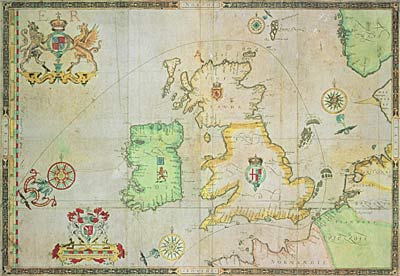
- On 9 August, Medina Sidonia held a Council of War to discuss whether to return to the Channel 'or sail home to Spain by the North Sea'. The wind settled the issue, as the fleet was driven ever further north. To get home in safety, the Armada needed to stay together, as supplies were not evenly distributed among the ships. Fair weather was therefore essential.
It was important, moreover, to sail deep into the Atlantic after rounding the north coast of Scotland, to exploit the prevailing westerlies and avoid rocky coasts. The fleet therefore followed the course illustrated in commemorative maps made shortly afterwards by Augustine Ryther.
As late as 21 August, all was still well. The Armada had rounded Scotland and was homeward bound. The letters home of that day evince confidence and self-congratulation. Indeed, had the weather continued to hold, the outcome would have been hailed as a Spanish triumph - especially as the English defensive effort had almost collapsed under the strain, with naval supplies exhausted, while hastily mobilised manpower perished of disease and want.
But the wind veered and quickened. The Armada was delayed, then dispersed. Between 11 and 24 September, the fleet endured some of the worst weather ever recorded in the region, culminating in a veritable hurricane that seemed, reported one witness, 'that it would overwhelm and destroy the whole world'. At least 21 ships came to grief on Scottish and Irish shores. In one wreck - the Girona, lost while trying to leave Ireland after emergency repairs - the flower of Spanish chivalry died.
Surviving ships arrived home severely storm-damaged, with thousands of sick soldiers and crew. Medina Sidonia declared he would rather lose his head than return to sea. An English squadron commander, Sir Martin Frobisher agreed stating: 'let me be hailed to the stake before I come abroad again.'
British History Timeline
World War One Centenary

- Find out more about how the BBC is covering the World War One Centenary, and see the latest programmes and online content
Surviving the trenches

The History of the Home

BBC iD
BBC iDBBC navigation
BBC links

BBC © 2014 The BBC is not responsible for the content of external sites. Read more.
This page is best viewed in an up-to-date web browser with style sheets (CSS) enabled. While you will be able to view the content of this page in your current browser, you will not be able to get the full visual experience. Please consider upgrading your browser software or enabling style sheets (CSS) if you are able to do so.
