
Armada Gallery
By Felipe Fernandez-Armesto
Last updated 2011-02-17
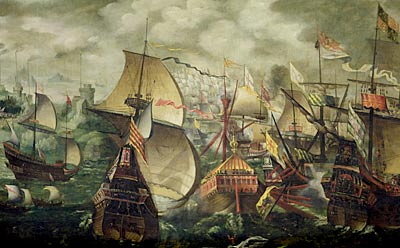
Battle of Gravelines
- Battle of Gravelines
- On the night of 7 August, English fireships broke the Spanish formation, and Medina Sidonia's ships 'scattered in a thousand directions'. Until then, the English had not dared to properly engage with the Armada. Even now, they hesitated long enough before opening fire for the Spaniards to form a fighting rearguard, in the teeth of a strong current that claimed two ships and threatened to drive the rest onto the shore.
The ensuing battle, depicted here, is traditionally seen by English historians as a great English victory. In fact, the English failed to press their advantage. Sir Francis Drake's squadron led the attack, but Drake himself quickly slipped away from the fighting, presumably in search of prizes, drawing charges of 'cowardice or knavery' from fellow-commanders.
The English continued to use the wind, which remained in their favour, as it had been throughout almost the entire campaign, to hold off, much to the anger of the Spaniards, who would have been able to make use of their superior manpower had the English tried to board their vessels. Although overall the Armada had abundant stocks of shot, most of the front-line Spanish ships ran out of heavy ammunition before the English closed the range.
As a result, the English suffered almost no damage at Gravelines, and the Spanish relatively little. Towards seven o'clock in the evening, the English broke off the fight, probably because of the worsening weather and the apparently inexorable drift of the Armada towards the shoals. The following day, however, said the official Spanish account, 'From this desperate peril we were saved by God's mercy.'
The wind shifted. The Armada escaped northwards, essentially intact and effectively undefeated, scotched but not killed, bloodied but unbowed. The English commander thought he had 'plucked its feathers'. The Spaniards, though apprehensive about how long their fleet could remain battleworthy, were willing to renew the fight.
British History Timeline
World War One Centenary

- Find out more about how the BBC is covering the World War One Centenary, and see the latest programmes and online content
Surviving the trenches

The History of the Home

BBC iD
BBC iDBBC navigation
BBC links

BBC © 2014 The BBC is not responsible for the content of external sites. Read more.
This page is best viewed in an up-to-date web browser with style sheets (CSS) enabled. While you will be able to view the content of this page in your current browser, you will not be able to get the full visual experience. Please consider upgrading your browser software or enabling style sheets (CSS) if you are able to do so.
