
Armada Gallery
By Felipe Fernandez-Armesto
Last updated 2011-02-17
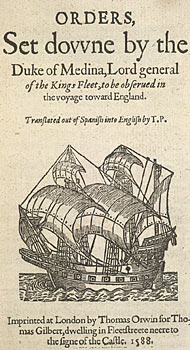
Orders and preparations
- Orders and preparations
- The Duke of Medina Sidonia took command of the Spanish Armada after the death of the king's first choice, the Marquess of Santa Cruz, for the job in February 1588. The duke had just the right background to overcome the main task - getting the fleet to sea. This demanded a huge logistical effort, of the kind the duke had previously managed well, in kitting out fleets for the New World trade, and for local defence on the coasts of Andalusia.
He was also one of the richest men in Spain and contributed handsomely to the costs of the campaign - as Spanish nobles, in pursuit of a strong ethos of service to the crown, customarily did.
Logistically, indeed, the Armada's preparations were a triumph - far superior to anything the English could manage. It was better supplied with foodstuffs, munitions, hospital facilities and cash - even though it was operating far from home. The English, by contrast, were in home waters, and had far fewer men to keep provisioned at sea.
Medina Sidonia's orders reflected the effective way he organised the fleet for its voyage, in squadrons, with the transports protected by fighting vessels in the vanguard, rear and wings. They also contained a summons to confession and contrition before sailing, and injunctions against swearing, blaspheming, whoring, brawling and gambling. The Spaniards were well aware that they were undertaking a risky voyage, unlikely to succeed without divine favour.
Spanish preparations, however, contained a fatal weakness: strategy was still undecided when the Armada put to sea. If the opportunity arose, would it attempt to land the forces it carried on English soil? Would it hold back until it had met up with the Spanish troops that awaited it in the Netherlands? And if so, how would it effect a junction with those troops? On these critical questions, the Armada's commanders were uncertain and divided.
British History Timeline
World War One Centenary

- Find out more about how the BBC is covering the World War One Centenary, and see the latest programmes and online content
Surviving the trenches

The History of the Home

BBC iD
BBC iDBBC navigation
BBC links

BBC © 2014 The BBC is not responsible for the content of external sites. Read more.
This page is best viewed in an up-to-date web browser with style sheets (CSS) enabled. While you will be able to view the content of this page in your current browser, you will not be able to get the full visual experience. Please consider upgrading your browser software or enabling style sheets (CSS) if you are able to do so.
