
Armada Gallery
By Felipe Fernandez-Armesto
Last updated 2011-02-17
Ship design
- Ship design
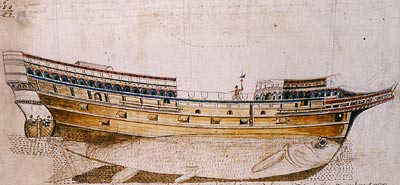
- Matthew Baker (c.1530-1613) - author of the design illustrated here - was one of three master-shipwrights responsible for building English royal vessels. At the time of the Armada, England had only 34 purpose-built fighting ships: the rest of the fleet consisted of about 200 commandeered merchant vessels. The royal ships, however, were mostly in good condition, and 22 had been built or extensively re-built in the previous ten years - some 13 of them under Baker's personal supervision. They performed admirably, generally outmanoeuvring Spanish ships and sustaining remarkably little damage.
The key features of successful design were traditional - robust construction and manoeuvrability in battle. But English shipwrights concentrated on developing features that proved important in confronting the Armada, giving ships a low profile for speed and manoeuvrability, and cutting down the space traditionally reserved on the superstructure for large numbers of soldiers. Baker, in particular, favoured what came to be known as the 'race-built' hull - relatively long and narrow.
The Armada had no more than 19 fighting vessels that were as well suited to Atlantic waters as the English ships, while 16 converted merchantmen, or vessels designed for Mediterranean warfare, made up the rest of the core squadron. The remainder of the 151 ships were transports. Essentially, the Armada was a troop-carrying convoy, and the fighting ships were there to guard it, not to invite combat.
Gunnery played an increasing role in naval warfare; so the size and siting of ordnance became a major consideration. At the battle of Terceira in 1583, the Spanish navy had shown that it was possible to disable and even to sink ships by well-directed firepower. The English tried to turn this tactic against the Spaniards, keeping their distance to avoid boarding, while pounding the enemy with their cannon. But they enjoyed little success: only one Spanish ship was sunk in combat.
British History Timeline

World War One Centenary

- Find out more about how the BBC is covering the World War One Centenary, and see the latest programmes and online content
Surviving the trenches

The History of the Home

BBC iD
BBC iDBBC navigation
BBC links

BBC © 2014 The BBC is not responsible for the content of external sites. Read more.
This page is best viewed in an up-to-date web browser with style sheets (CSS) enabled. While you will be able to view the content of this page in your current browser, you will not be able to get the full visual experience. Please consider upgrading your browser software or enabling style sheets (CSS) if you are able to do so.
