
Armada Gallery
By Felipe Fernandez-Armesto
Last updated 2011-02-17
Propaganda wars
- Propaganda wars
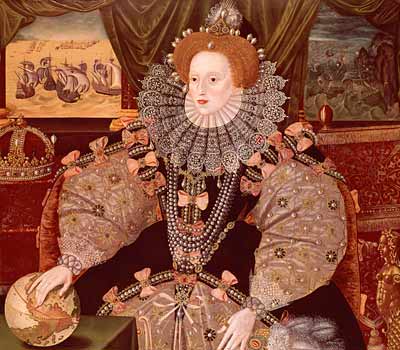
- The paintings of Philip and Elizabeth share propaganda devices: both have backgrounds of battle; both allude to spoils - a gilded figurehead behind the queen, the Turkish captive and weaponry at Philip's feet; both sketch past glories and make promises for the future.
Philip's painting promises continuity of achievement: the birth of a prince, the solidity of the imperial columns that uphold the edifice, the angel's palm of victory. Elizabeth stands alongside a 'crown imperial' and rests a hand on a globe, in allusion to the attempt - canvassed by some of her courtiers - to found an English empire overseas.
The differences of propaganda are fascinating. Philip's message is religious - an angel descends amid heavenly rays. The enemy is an infidel. Elizabeth's message is almost entirely secular - the only hint of God is in the storm depicted at top right of her portrait - for war and the sea were God's arenas, and storms were His weapons.
Whereas Philip makes much of his subordination to God and his role as God's servant and supplicant, Elizabeth divinizes herself, almost to the point of blasphemy. She becomes - at least in appearance - a bejewelled idol, the 'Virgin Queen' rivalling the Virgin Mary. Philip could project himself as the sword of the Church (although in reality dynastic and Spanish interests dominated his policy). Elizabeth, who had abjured the Catholic faith, and ruled a religiously divided realm, had to seek other ways of legitimating her authority.
 Detail of the right-hand cartouche
©
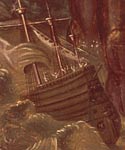
Both paintings are essays in 16th-century spin-doctoring. Interestingly, however, the English painter does not attempt to spin England's encounter with the Armada into a victory. No engagement between the rival fleets is shown. In the left-hand cartouche, English ships in the foreground have the Spanish fleet under observation. The famous, formidable Spanish crescent-shaped convoy formation is clearly visible. So is the approach of the fireships that broke that formation when the Armada was at anchor outside Calais harbour. The wreckage of Spanish vessels on rocky coasts, shown in the right-hand cartouche, happened long after the fleets had disengaged, and the English had nothing to do with it.
Detail of the right-hand cartouche
©
Both paintings are essays in 16th-century spin-doctoring. Interestingly, however, the English painter does not attempt to spin England's encounter with the Armada into a victory. No engagement between the rival fleets is shown. In the left-hand cartouche, English ships in the foreground have the Spanish fleet under observation. The famous, formidable Spanish crescent-shaped convoy formation is clearly visible. So is the approach of the fireships that broke that formation when the Armada was at anchor outside Calais harbour. The wreckage of Spanish vessels on rocky coasts, shown in the right-hand cartouche, happened long after the fleets had disengaged, and the English had nothing to do with it.
By contrast, in the background of Titian's painting of Philip, the Battle of Lepanto of 7 October 1571 can be seen. This battle really was a decisive encounter. In it, the Spaniards, with their Italian allies, captured or destroyed 250 Turkish ships, whereas the English never really defeated the Armada, sinking only one vessel in combat, capturing another (which was disabled by a collision), and seeing two grounded as a result of the fireship attack. In the absence of an English victory, the solution of Elizabeth's spin-doctors was to depict the Armada's dispersal by storms as a victory for God.
British History Timeline
World War One Centenary
- Find out more about how the BBC is covering the World War One Centenary, and see the latest programmes and online content
Surviving the trenches

The History of the Home

BBC iD
BBC iDBBC navigation
BBC links

BBC © 2014 The BBC is not responsible for the content of external sites. Read more.
This page is best viewed in an up-to-date web browser with style sheets (CSS) enabled. While you will be able to view the content of this page in your current browser, you will not be able to get the full visual experience. Please consider upgrading your browser software or enabling style sheets (CSS) if you are able to do so.
