
Armada Gallery
By Felipe Fernandez-Armesto
Last updated 2011-02-17
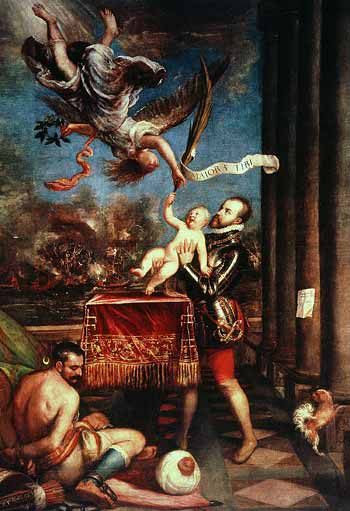
Contrasting kingdoms
- Contrasting kingdoms
- The court art of Philip II and Elizabeth I, as shown in the first two images of this gallery, displays the contrast between the kingdoms of Spain and Britain at the time of the Armada. Philip ruled the richest, most educated, most sophisticated, most technically advanced monarchy in Europe. England, by contrast, was regarded at the time as a backwater, a realm of lightly gilded savagery.
Whereas Philip had Titian to paint him, Elizabeth had to rely on barely competent locals, working in an old-fashioned style. Philip had an heir - the glory of a king and the hope of a kingdom. Elizabeth was childless. Whereas Elizabeth is depicted iconically, hieratically, without motion and almost without bodily solidity, Philip is confident enough to appear as a flesh-and-blood human being. Elizabeth's face is masked in make-up, while Philip is portrayed realistically, with the features recognisable.
Thus, wherever Philip's portraits went as diplomatic gifts they were reminders of his power - especially with his characteristic jutting jawline, evidence of his membership of the divinely elected Habsburg dynasty. Elizabeth, by contrast, suffered from two disqualifications for kingship, she was a woman in a patriarchal world, and a royal bastard whose claim to the throne was dubious.
British History Timeline
World War One Centenary

- Find out more about how the BBC is covering the World War One Centenary, and see the latest programmes and online content
Surviving the trenches

The History of the Home

BBC iD
BBC iDBBC navigation
BBC links

BBC © 2014 The BBC is not responsible for the content of external sites. Read more.
This page is best viewed in an up-to-date web browser with style sheets (CSS) enabled. While you will be able to view the content of this page in your current browser, you will not be able to get the full visual experience. Please consider upgrading your browser software or enabling style sheets (CSS) if you are able to do so.
