
Armada Gallery
By Felipe Fernandez-Armesto
Last updated 2011-02-17
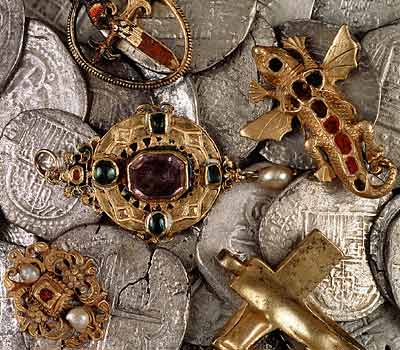
Treasure of the 'Girona'
- Treasure of the 'Girona'
- The Girona was a galleass - an oared fighting ship, designed for Mediterranean warfare. But she performed extraordinarily well in northern waters, and survived the coast of Ireland with need of only slight repairs. In it, Don Alonso de Leiva - one of the most dashing youths aboard the Armada, whom his admirers regarded as the great hope for Spain's future - collected about 1,300 survivors from various wrecks.
On 26 October 1588, they set out to make their escape from Ireland in the crammed vessel. Packed into a space barely sufficient for 500 men, they could not hope to get far, but dashed for Scotland, where more shipping was available. They set sail with a fair wind, but the apparently implacable weather turned against them at the last. They were in sight of safety when the wind veered, and blew them back onto the rocks of Ulster. Few men survived.
Don Alonso's companions included Spain's gilded young generation of aristocratic warriors. Their loss was irreparable - comparable to the extinction of Scotland's 'Flowers of the Forest' at the Battle of Flodden, or the immolation of a generation of England's potential leaders in World War One.
When Robert Sténuit excavated the wreck-site in 1968, the ship's timbers had been ground to smithereens, but a rich haul of treasure - pathetic gold and jewelled trinkets, badges of rank, religious charms, tenderly inscribed love-tokens, money chains and nearly 1,200 gold and silver coins - showed where the offspring of Spain's 'best' families perished.
The cross of Santiago, of gold enamelled in red, could have belonged to Alonso de Leiva himself. He was a member of the Order of Chivalry of Santiago. The gold salamander, set with rubies, is particularly poignant. It was a talisman favoured by soldiers because the mythical salamander could live in fire. This one survived water, too.
British History Timeline
World War One Centenary

- Find out more about how the BBC is covering the World War One Centenary, and see the latest programmes and online content
Surviving the trenches

The History of the Home

BBC iD
BBC iDBBC navigation
BBC links

BBC © 2014 The BBC is not responsible for the content of external sites. Read more.
This page is best viewed in an up-to-date web browser with style sheets (CSS) enabled. While you will be able to view the content of this page in your current browser, you will not be able to get the full visual experience. Please consider upgrading your browser software or enabling style sheets (CSS) if you are able to do so.
