
Astronomical Instruments Through Time
By Emily Winterburn
Last updated 2011-02-17
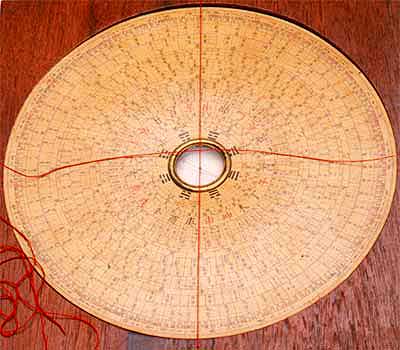
Chinese geomancer's compass
This is a 19th-century geomancer’s compass. Geomancy (related to 'feng shui') is used in China to determine the most auspicious positioning for burial sites or buildings of different sorts. It is also used to select the best times and locations for important events.
The instrument shown here has a compass needle at the centre, and concentric tables expanding out from the middle, containing data relating to astrology, time of day, the elements, directions, and forms of landscape - all the various factors thought to help in deciding the best orientation for a building.
The earliest compasses originated in China around the second century BC, and were used for geomancy long before they were ever used for navigation. It was, however, the Chinese who first applied the technology to navigation, and by 1000 AD the crews of trading ships from China were able to sail as far as Saudi Arabia without losing their way. This knowledge was instrumental in allowing the Chinese to trade with more nations, bring back new and exotic merchandise and ideas, and to become a rich and influential nation.
Hands on History: Ancient Britain

Hands on History: Roman Britain

BBC iD
BBC iDBBC navigation
BBC links

BBC © 2014 The BBC is not responsible for the content of external sites. Read more.
This page is best viewed in an up-to-date web browser with style sheets (CSS) enabled. While you will be able to view the content of this page in your current browser, you will not be able to get the full visual experience. Please consider upgrading your browser software or enabling style sheets (CSS) if you are able to do so.
