
Astronomical Instruments Through Time
By Emily Winterburn
Last updated 2011-02-17
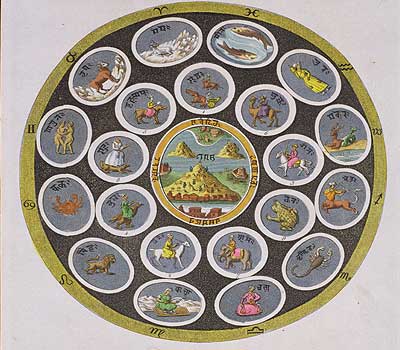
Engraving of Indian zodiac
This image shows a mid-19th-century European interpretation of the Indian zodiac. At the centre is a depiction of Mount Meru, a remote Tibetan mountain thought in early Indian astronomy to be at the centre of the universe. Around this are the nine ‘planets’, made up of the five planets visible to the naked eye - Mercury, Venus, Mars, Jupiter and Saturn - plus the Sun and Moon (grouped as planets in most cultures until relatively recent times), plus two additional characters unknown in Western astronomy or astrology, known as Rahu and Ketu, at the nodes of the Moon (the points at which the Sun, Moon and Earth are all aligned).
The outer circle then illustrates the same 12 signs of the zodiac we use today, thought to have originated with the Babylonians around 500 BC.
The inclusion of Rahu and Ketu into the Indian system of planets led to a particular interest in eclipses in Indian astronomy. One of the best known early Indian astronomers, Aryabhatta, is today credited with producing - in 498 AD - the first correct mathematical theory of eclipses within an Indian context, allowing them to be predicted with accuracy.
Today, the exact time of both solar eclipses (when the Sun, Moon and Earth line up at new Moon) and lunar eclipses (when they line up at full Moon) are known in advance with great accuracy - as are the places on Earth from which they will be visible. Although in the past this information has been used by astronomers to find out about the composition of the Sun, today the information is mainly used to help tourists get the best view possible of this spectacular astronomical phenomenon.
Hands on History: Ancient Britain

Hands on History: Roman Britain
BBC iD
BBC iDBBC navigation
BBC links

BBC © 2014 The BBC is not responsible for the content of external sites. Read more.
This page is best viewed in an up-to-date web browser with style sheets (CSS) enabled. While you will be able to view the content of this page in your current browser, you will not be able to get the full visual experience. Please consider upgrading your browser software or enabling style sheets (CSS) if you are able to do so.
