
Astronomical Instruments Through Time
By Emily Winterburn
Last updated 2011-02-17
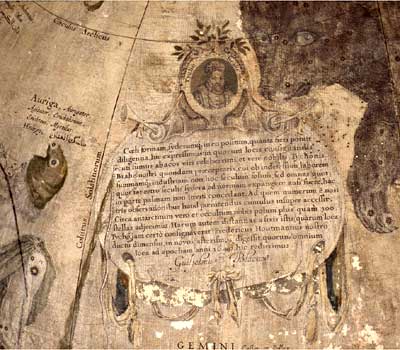
European globe with constellations in Arabic
As Islamic science started to reach Europe, Islamic astronomical instruments, such as the globe illustrated here, became highly prized. Some were bought and copied, and the names of the stars and constellations were translated into the Latin versions of Arabic star names that we still use today. Others were bought and used straight away, as many astronomers could read Arabic and didn't need translations.
Both Latin and Arabic were in use as scientific languages in Europe for some time, and Arabic was often used on European globes among the other scientific languages. On the example shown here each constellation illustrated has its name in Latin, Greek and Arabic.
In addition, many Arabic words in astronomy were adopted in Europe without translation, so many of our star names have remained Arabic. ‘Alderbaran’, for example, means 'the follower' in Arabic, and refers to the star's apparent following of the Pleiades in the sky. ‘Altair’ in the constellation Aquila (the Eagle) means 'the flyer' while ‘Rigel’ in Orion literally translated means 'the foot'.
Willem Janszoon Blaeu, who made the globe pictured here, was a map and instrument maker in the 16th century. He studied astronomy under the famous Danish astronomer Tycho Brahe, and then set up shop in Amsterdam making extremely accurate and highly prized scientific (rather than purely decorative) globes.
Hands on History: Ancient Britain
Hands on History: Roman Britain
BBC iD
BBC iDBBC navigation
BBC links

BBC © 2014 The BBC is not responsible for the content of external sites. Read more.
This page is best viewed in an up-to-date web browser with style sheets (CSS) enabled. While you will be able to view the content of this page in your current browser, you will not be able to get the full visual experience. Please consider upgrading your browser software or enabling style sheets (CSS) if you are able to do so.
