
Astronomical Instruments Through Time
By Emily Winterburn
Last updated 2011-02-17
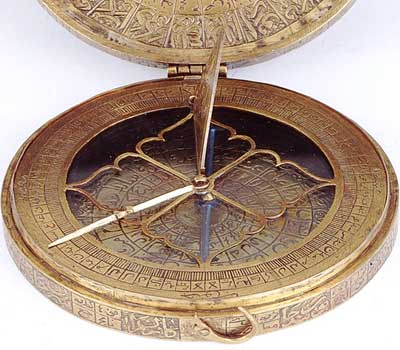
Persian qibla
This is a scientific instrument designed solely for the purpose of finding Mecca from anywhere within the Islamic world. Qibla simply means 'the direction of Mecca', so a qibla indicator indicates what that direction is. One of the five pillars of Islam directs Muslims to pray in the direction of Mecca five times a day, so it is essential they know which way to face, wherever they are.
Many devices exist to find the direction of Mecca, but once the compass found its way into the Islamic world - around the 13th-century AD - it became one of the most popular. Different types of compass can often be found incorporated into other instruments, such as astrolabes, or in qibla indicators like the one shown here.
On the top section of the instrument, there is a circular grid called a gazetteer, this lists all the places you might possibly want to find Mecca from. Another section gives an approximate direction (eg NE) for Mecca in relation to where you are, and another gives you a more accurate direction still. The bottom section contains a compass, which you line up with the direction quoted for your location, to find Mecca.
This device allowed anyone within the expanding Islamic world to find the direction of Mecca with a minimum of scientific knowledge. All a devout Muslim needed to know was the name of the town nearest to where he found himself. Independent travel, while keeping to the pillars of Islam, was now possible.
Hands on History: Ancient Britain
Hands on History: Roman Britain
BBC iD
BBC iDBBC navigation
BBC links

BBC © 2014 The BBC is not responsible for the content of external sites. Read more.
This page is best viewed in an up-to-date web browser with style sheets (CSS) enabled. While you will be able to view the content of this page in your current browser, you will not be able to get the full visual experience. Please consider upgrading your browser software or enabling style sheets (CSS) if you are able to do so.
