Wednesday
18th April 2001, 1130 BST
Sun,
sand and searing heat |
|
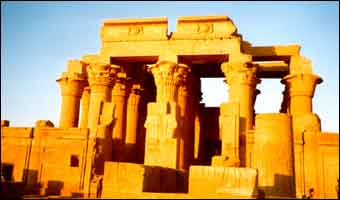 Temple ruins
are among the highlights which attract tourists to Egypt
Temple ruins
are among the highlights which attract tourists to Egypt |
|
Egypt
is four times the size of the United Kingdom.
Because it boundaries extend from the Mediterranean Sea in the north
to the Sudan in the south, its climate varies greatly. But although
some tourists venture into the searing heat of the Sahara desert,
most confine their travels to the Red Sea coast and the Valley of
the Nile.
That Egypt is one of the hottest and sunniest countries on the face
of the Earth is hardly any great surprise.
Around Alexandria and the resorts that fringe the Mediterranean, summertime
temperatures usually peak at around 31 Celsius (87F) but further south,
in Aswan, temperatures average 41 Celsius (106F).
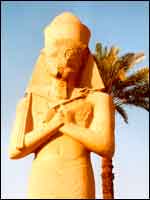 |
| Many
of Egypt's ancient statues have survived the centuries |
In extreme conditions
these temperatures soar to a very uncomfortable 44 Celsius (111F)
in Alexandria and a dangerously hot 51 Celsius (124F) in Aswan.
Although there can be a few wet days each month along the Mediterranean
coast, much of Egypt experiences little or no rainfall.
So with sunshine averaging eight to 10 hours each day in the winter
and as much as 12 hours in the summer, the tourist can base their
choice of time to visit solely on the likely temperatures.
With summer temperatures in excess of 35 Celsius (95F) touring the
sites around Cairo can be very uncomfortable. But it should also be
pointed out that January and February can be quite chilly months in
Cairo and along the northern half of Egypt’s Red Sea coast.
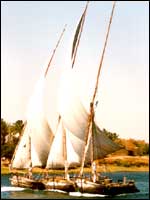 |
| Feluccas
plying their trade on the Nile |
Strong northerly
winds can accentuate the lower temperatures so, surprisingly, you
may find a warm, windproof jacket quite useful during these months.
Dust-laden winds can affect almost any part of the country between
late March and June. These can give some very unpleasant conditions
at times.
Taking everything into consideration, the most favourable months to
visit Egypt are likely to be November and early March. These months
are generally not too hot and daytime temperature unlikely to exceed
the low thirties Celsius.
For those of a more adventurous disposition, who decide to venture
into the desert regions, it must be borne in mind that night-time
temperatures can fall to freezing at any time of the year.
With the searing heat of the day and (usually) a total lack of shade,
the usual warnings about using a high factor sun block, drinking as
much water as possible and keeping covered up are doubly important. |
|