 | 13 November 2014 |

|
|
| BBC Homepage | | |
| |||
| Contact Us | | |
Local historyYou are in: Nottingham > History > Local history > Evacuees: Your stories and pictures 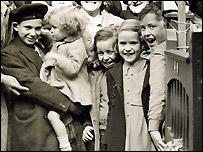 Evacuees: Your stories and picturesWe want to hear your Nottinghamshire World War II evacuation stories. It wasn't just soldiers who fought to win World War II. Britain's 'Heroes of the home front' included the 80,000 members of the Women's Land Army, members of the reserved occupations and ordinary men and women who 'kept calm and carried on' in often lethal circumstances. These 'heroes' included those who took in, fed and housed evacuees from other parts of the country. Were you evacuated and do you have memories or did you family take in evacuees? Was your mother or father moved during the war? Did your grandmother or grandfather take in evacuees? Did they keep in correspondence with their evacuee children after the war? We are after Nottinghamshire's evacuation stories and photographs that relate to your stories. Dr Denise Amos on Nottinghamshire's evacuees:"Essentially there were three evacuation waves; the start of the war around 1939, with the expectation of bombings of cities; March 1941 with the expected invasion and actual bombings of cities; during 1944 and 1945 with the use of flying bombs. "In the first wave children from inner Nottingham were evacuated out of the city to villages within Nottinghamshire. In the second wave children arrived into Nottingham from the south east of the country to avoid the anticipated invasion. The third wave saw children from London and the south east arriving in Nottingham. "A great many Notts villages took in evacuees, including Plumtree, Keyworth, Kimberley, Lambley and Lowdham. Newark received evacuees from Sheffield, Worthing and Great Yarmouth. Retford received over 6000 children some from West Leeds High School and others from The West Midlands and Great Yarmouth. An entire school of deaf children were evacuated from Sheffield to Southwell by bus and Worksop received evacuees arriving from Nottingham by bus and train. "Children stayed with their host family for varying periods of time, some only a few weeks and others throughout the war years. Their experiences also varied widely, some enjoying their country life; others could not wait to return home." The BBC is not responsible for the content of external websites Fill in the form below and send us your stories.The information may be used as part of our coverage on BBC Radio Nottingham, BBC East Midlands Today and this website. BBC Radio Nottingham and/or BBC East Midlands Today may contact you regarding the information you supply. Under no circumstances will your information or details be passed to any third party outside the BBC. last updated: 13/07/2009 at 15:25 SEE ALSOYou are in: Nottingham > History > Local history > Evacuees: Your stories and pictures 

 |
| | About the BBC | Help | Terms of Use | Privacy & Cookies Policy |