 | 13 November 2014 |

|
|
| BBC Homepage | | |
| |||
| Contact Us | | |
Local historyYou are in: Nottingham > History > Local history > Nottinghamshire's VC winners 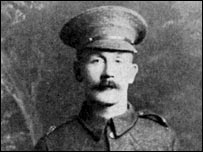 Nottinghamshire's VC winnersThe stories of 20 Nottinghamshire men who were awarded the Victoria Cross go on display at Nottingham's Council House. The exhibition will opens on Monday 3 August and will remain at the Council House until the middle of September. It is hoped that it will help raise awareness of the campaign to erect a memorial to all the county's winners of Britain's highest honour for valour. The Nottingham and Nottinghamshire Victoria Cross committee hope to collect £20,000 for a permanent monument at Nottingham castle. The BBC is not responsible for the content of external websites Below is a list of the 20 they want recognised and what they did to earn their award. The criteria for being included is that the recipient was either born or is buried in Nottinghamshire. The BBC is not responsible for the content of external websites Albert BallProbably the most famous Nottinghamshire VC winner. He was born in Lenton, Nottingham and served with the 7th Battalion Sherwood Foresters and the Royal Flying Corps. Between 26 April and 6 May 1917, Captain Ball took part in 26 combats, destroying 11 enemy aircraft. On one occasion he fought six enemy planes single-handed. He died on 7 May 1917. He is buried in Annoeullin in northern France. The BBC is not responsible for the content of external websites Harry Churchill BeetBorn in Bingham in 1875. He was awarded the VC during the Boer War. In April 1900 he stayed with a wounded corporal despite coming under heavy fire. He managed to keep the Boers at bay until night fall when allied medics arrived to help the wounded solider. Mr Beet died in 1946 and is buried in Vancouver. The BBC is not responsible for the content of external websites Anthony Clarke BoothBorn in Carrington in 1846 he received his award during the Zulu war in 1879. During an attack Colour Sergeant Booth rallied a few men on the south bank of the Intombi River in South Africa. He covered the retreat of 50 soldiers for three miles. All would have died had it not been for his actions. He died in 1899 and is buried in Brierley Hill in the West Midlands. Robert James ByeHe was instrumental in knocking out two German defensive strong points at the Yser Canal in Belgium in July 1917. He died in 1962 and is buried in Warsop cemetery. The BBC is not responsible for the content of external websites John Joseph CaffreyHe helped rescue wounded colleagues during the First World War near La Brique, Ypres in Belgium. Together with a corporal he went to help a fallen colleague. Initially beaten back by shrapnel fire (the enemy was only 350 yards away) they tried again, reached the soldier and tended his wounds. The BBC is not responsible for the content of external websites While trying to return the soldier to safety the corporal was shot in the head. Private Caffrey bandaged his wounds, took him to safety, then returned for his other colleague. He died in 1953 and is buried in Wilford Hill cemetery (Nottingham southern cemetery). The BBC is not responsible for the content of external websites Wilford Dolby FullerBorn in East Kirkby, Greasley, Notts in 1893. He was a member of the Grenadier Guards when, on 12 March 1915, he single-handedly captured around 50 men. They were trying to escape along a communication trench at Neuve Chapelle in France. Fuller used a bomb to kill the leading man and the remainder surrendered to him. He died in 1947.
The BBC is not responsible for the content of external websites Charles Ernest GarforthOn three occasions during fighting at the village of Harmingnies near Mons in Belgium he saved the lives of his colleagues. On 23 August 1914, whilst under heavy fire, he cut barbed wire, allowing his squadron to escape. On 2 September he helped free a sergeant who'd been trapped under his horse. The following day he drew off enemy fire to allow another sergeant to escape. He died in 1973 and is buried at Wilford Hill cemetery in Nottingham. The BBC is not responsible for the content of external websites William HackettBorn in Nottingham in 1873, Sapper Hackett was a miner who became a tunneller during World War 1. He became entombed with four others after an enemy mine exploded. He helped three colleagues escape but remained with the injured fourth. Both perished when the tunnel collapsed on them on 27 June 1916. The BBC is not responsible for the content of external websites Samuel HarveyHe was born in the Basford / Bulwell area in 1881. On 29 September 1915 at the Big Willie Trench near the Hohenzollern Redoubt on the Western Front in France, the allies were running low on ammunition. Harvey volunteered to run back and forth over bullet swept terrain for 13 hours. During this time he brought 30 boxes of bombs to the front line; an action that eventually drove the enemy back. He suffered a head wound but survived the war, dying in 1960. Robert HumpstonOn 22 April 1855, along with a fellow soldier, Private Bradshaw, he attacked a Russian gun pit which overlooked the Woronzoff Road near Sebastopol and captured it. Its destruction was of major importance during the campaign. Robert Humpston died in 1884 and is buried in the General Cemetery (Canning Circus) in Nottingham. The BBC is not responsible for the content of external websites last updated: 31/07/2009 at 10:46 SEE ALSOYou are in: Nottingham > History > Local history > Nottinghamshire's VC winners 
 |
| | About the BBC | Help | Terms of Use | Privacy & Cookies Policy |