Equipping journalism students for tomorrow
How we are bridging the gap between classrooms and newsrooms in Armenia
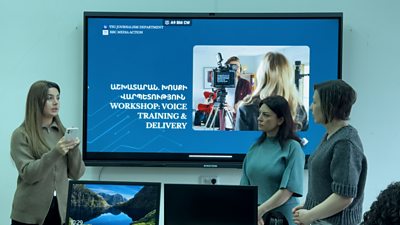
For many journalism students around the world, the real skills test isn’t in the classroom. It comes when they have left the classroom to enter the newsroom - when they must spot a strong story, ask the right questions, film on location and turn their reporting into a clear and compelling story under pressure.
For every journalism student, this transition plays a crucial part in their career. In Armenia, we ran a practical boot camp to help journalism students make this transition with greater confidence.
While working with eight media outlets and Yerevan State University (YSU), discussions revealed significant gaps between academic approaches and the industry.
“Our media organisation partners, including editors and reporters, would tell us that students coming from the universities often lacked practical skills. They don't know how to edit, how to write articles, and so on. Similarly, the Dean of YSU acknowledged that the curriculum is largely theoretical and that there is a need to strengthen the practical component in teaching journalism. So, we decided to organise a practical bootcamp to help fill this gap,” said Ani Hovhannisyan, Armenia country coordinator for BBC Media Action.
A year after our first boot camp, in which 10 university students spent a week learning critical skills before joining media outlets for more formal internships, we ran a second with YSU’s Faculty of Journalism this spring, this time hosted within the faculty itself and led by YSU lecturers, with BBC Media Action trainers mentoring them and giving feedback.
Around 30 final-year undergraduate students attended the sessions as a part of the university’s academic curriculum.
Learning to find, pitch and cover the story
Wendy Pilmer, BBC Media Action consultant and former Head of BBC Northeast & Cumbria, who worked closely with industry leaders and academics to develop the training, said, “Newsrooms are busy places with little time to learn on the job. To be successful, students need to know how to find stories, pitch them at editorial meetings, develop creative treatments and turn them around fast on the day.
“Our work with Yerevan State University aims to bring the latest industry expertise to YSU's curriculum. We built an internship programme for YSU students to work with our partner media organisations and we offered a pre-internship course so students could hit the ground running during their internships,” she added.
Karen Fowler-Watt, Head of Journalism at City St George’s, University of London, also mentored and worked with YSU lecturers to help embed the approach into the curriculum. She sees a strong long-term value in the approach.
She said: “The development of the pre-internship course is an exciting development, which I believe has the potential to transform the final-year experience of YSU’s journalism students and to build a positive dialogue with industry, supporting closer engagement with the academy. There is already evidence that industry/academy relationships have been strengthened by the internships and ensuing dialogue.”
Among the first batch of boot camp students, 70% reported that they still intend to pursue a career in journalism, and 4 in 10 said they are already working in this field.

What happened at the boot camp
The students said they felt motivated by the opportunity to gain practical knowledge from trainers at BBC Media Action, as well as their own teachers, to better prepare them for entering the media industry. Topics included media environment and newsroom culture, storytelling for different platforms, mobile journalism, camera operations, and editing. One session emphasized on-camera performance, helping students build confidence while presenting.
In-field practical assignments then allowed participants to apply their skills in real-world scenarios. Students chose topics, spent a day producing their video reports – including interviewing, filming on location and producing stand-ups - and then edited and presented them on the final day. Real-time feedback highlighted both the strengths and areas that needed improvement, allowing students to apply their learning and learn from their mistakes.
According to Nane Vardanyan, associate professor of YSU Faculty of Journalism, students at the camp begin to work not for the sake of giving a good answer or completing a task well, but to deliver a real result. This is one of the most important foundations for entering a professional environment.
One of the participants, Marine Zohrabyan, said: “Throughout the boot camp, we completed different practical exercises each day, each interesting in its own way. Topics and knowledge we were already familiar with were applied through new practical approaches and methods, which made them all the more engaging. What I enjoyed most was probably the production of the final piece, a two-minute story that brought together everything we had worked on. The process demanded quick thinking, team collaboration and the ability to deliver quality results under tight deadlines, which authentically reflects what real editorial work looks like.”
Complementing the curriculum
Journalism today relies on speed, accuracy and responsible decision-making. At boot camp, students began to think not merely in terms of completing and submitting assignments but about how to make critical decisions quickly and responsibly – not easily achieved in a traditional classroom setting.
“(We) created an intensive environment where the students were immersed in a real work rhythm within a short period of time. This is precisely the link that is often missing from traditional education. Filling that gap is of significant importance," said YSU lecturer Kristine Alagulyan.
By bringing together students, lecturers and industry professionals, we are helping future journalists build the confidence, skills and judgement they need to deliver trustworthy information and to succeed in a fast-paced media environment.
And by embedding the boot camp into the university’s own approach to teaching journalism, we’re creating a sustainable approach to aligning academic learning with industry expectations.
Our work training and supporting journalism students and independent media in Armenia is funded by the UK Foreign, Commonwealth and Development Office.
Latest news from Armenia

Search by Tag:
- Tagged with Armenia Armenia
- Tagged with Europe and Caucasus Europe and Caucasus
- Tagged with Media development Media development