Fourteen days inside BBC Verify
Kamal Hossain, a journalism trainer from our Bangladesh team, shares a first-hand look at his time with BBC News’ specialist verification team
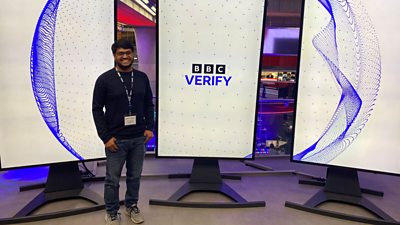

I flew from Dhaka to London to spend two weeks embedded with BBC Verify. I was nervous, slightly jet-lagged and unsure if I really belonged.
Now, at the end of my placement, I feel like a different journalist.
I had imagined the BBC newsroom to be frantic with ringing phones, urgent voices, people sprinting with papers. But, walking into London Broadcasting House, it was… quiet.
Not completely silent, but a focused, purposeful, intense kind of quiet.
I had worked in the media and trained journalists for years in Bangladesh, but this felt very different.
Every morning began with a calm, precise, purposeful team meeting. Which claims threatened real public harm? What should be prioritised and what could be left to fade away on its own? These were the basic questions discussed. And I learned that not everything merits a spotlight, even in debunking and verification.
In at the deep end
I was only a few days into the placement when the conflict between Iran, Israel and the US began to unfold at a relentless pace. Hour by hour, social media was flooded with new claims: casualty numbers with no sources, AI generated war footage, clips from video games shared as real missile strikes, and satellite images shown out of context.
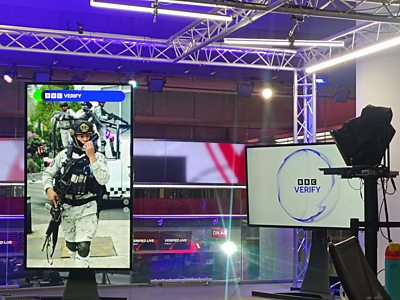
The team remained focused, their eyes fixed on the screens in front of them. One colleague cross-referenced a satellite image showing damage at an Iranian military base. Another paused a viral video claiming to show a missile hitting a US fighter jet and a US Navy warship, comparing it frame by frame with footage from a video game.
That clip turned out to be fake. Millions had already seen it online. I watched as the team broke it down and explained their story to the audience. No one was rushing or taking short-cuts. Their work unfolded quietly and deliberately, and I realised it was some of the most impactful journalism I had ever seen.
Verification as a mindset
It was this discipline, even under pressure, that has stayed with me. I learned a great deal about tools and techniques, such as carrying out reverse image searches, cross checking satellite images against timelines claimed in reports, and pinpointing locations by studying rooftops, street patterns or even the angle of shadows. But it was the culture and mindset of BBC Verify that really stood out.
Verification can feel like shouting into the wind. Debunks are posted, but false claims keep circulating. You work knowing that misinformation often outlives correction.
Seeing the team take on this reality day after day, calmly and without frustration, was a lesson in itself.
What I’m bringing back
Bangladesh has journalists who care deeply about accuracy. What they often lack is structured methods and the confidence to slow down when the pressure is high. This is the gap BBC Media Action works to close.
I am bringing back more than open-source intelligence platforms or satellite tools. I am bringing back the culture: the team meeting that decides what is worth chasing, the instinct to ask where every number came from, and the discipline to document every step. Journalism everywhere deserves this standard, not as an aspiration, but as a foundation.
I will continue to work with BBC Verify online to design and run a "training of trainers" course for other BBC Media Action staff, who will then go on to train local journalists using what they have learned. So much false content around the world, on elections, climate, political unrest, could be exposed using these methods.
And I return to Bangladesh with a clearer sense of purpose. I know why this work matters. My biggest lesson from Verify is that news may move fast, but verification must always come first.
Kamal Hossain is a Media Development Officer at BBC Media Action Bangladesh and recently completed a two-week shadowing placement with BBC Verify in London. A huge thank you to the BBC Verify team for hosting him at such a busy time.
Our impact areas
-
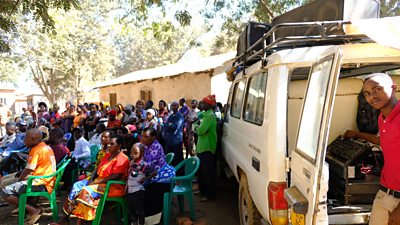
Building stronger democracies
We strengthen democracy by supporting public interest media content and platforms that enable vulnerable people to participate in democratic processes as active and informed citizens who are better able to understand and address the biggest challenges they and the world are facing. -
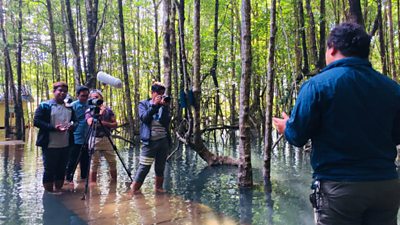
A safer, more habitable planet
We contribute to a safer and more habitable planet by providing an information lifeline in humanitarian emergencies, by supporting information flows that help people adapt to climate change, live sustainable lifestyles and protect nature, and by supporting balanced discussion of conflict and division. -
More inclusive societies
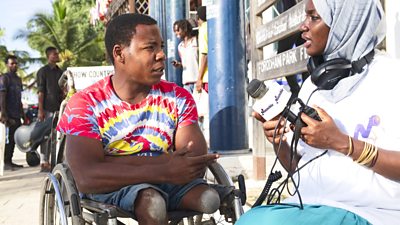
By ensuring everyone has access to trustworthy information and fair representation, our work supports the UN SDG commitment to “leave no one behind”. We meaningfully include people who are often marginalised or excluded in society; addressing gender norms and barriers, the rights of people with disabilities and of LGBTQI+ communities, improving access to health, education and work opportunities.
Latest Insight stories
Search by Tag:
- Tagged with Bangladesh Bangladesh
- Tagged with Information disorder Information disorder