
WDYTYA? Series One: Celebrity Gallery
By Dan Waddell
Last updated 2011-02-17
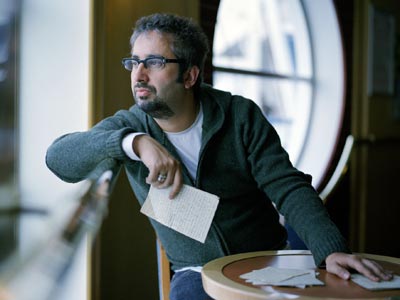
David Baddiel
- Fleeing the Holocaust
- David Baddiel was born 19 years after World War Two ended. The war years were therefore not exactly ancient history while he was growing up, but he says that that's what it seemed like. He says he showed almost no interest at all in what must have been the most dramatic years of his grandparents' life, and he has come to regret this greatly, particularly as they are no longer alive.
In recent years, David has become increasingly interested in his family history, and he has written a novel, The Secret Purpose (Little, Brown, 2004) based loosely on the story of his maternal grandparents, who were Jewish and who fled from the Holocaust. David's book focuses on themes of immigration and race, dominant subjects in his own genealogy.
- On the run
- As David researched into his background he discovered that his mother, Sarah, was just five months old when she left Germany with her parents following the outbreak of war.
David's maternal grandfather, Ernst, was the director of a brickworks, employing more than 1,000 people. Before the war, he travelled in a chauffeur-driven Mercedes, and his wife Oti was aided by a large domestic staff to host parties, and worked for charitable causes.
- Persecution
- The rise of the Nazis, however, changed the family's fortunes irrevocably. Humiliating directives stripped the couple of their wealth, and their position in society. Ernst was forced to sell his business and the only way the couple could make money was by selling their possessions.
The persecution of the Jews increased. After Kristallnacht (a night of organised riots, when synagogues and Jewish-owned homes and businesses were attacked throughout Germany and Austria) Ernst was forced to spend a month in a penal camp, and was given an ultimatum either to leave Germany or to face an uncertain future. So in August 1939 the couple fled Konigsberg and travelled to Berlin, from where they caught the train to Bremerhaven and sailed to England. Baby Sarah spent the journey asleep, safely hidden in the string luggage-rack of her parents' train compartment.
The family arrived in Southampton with only the clothes they were wearing, a situation far from the comfortable life they had led in Germany prior to the rise of the Third Reich.
- Enemy alien
- In Britain Ernst was classed as an enemy alien. He had fought with the German army during World War One (ironically, David's paternal grandfather, Henry Baddiel, fought for the Allies) - and he was therefore considered a 'B' classification, medium risk. This meant internment at a camp on the Isle of Man. Thus, only a few months after he had risked his life for his wife and daughter to bring them to safety, he was wrenched away from them and didn't see them for almost 12 months.
When Ernst emerged from internment, he found he would have to start work from scratch, taking any job available to him. He worked in various capacities, from fruit-picker to porter, from waiter to factory worker. The experience of losing his business in Germany, however, and the humiliation of his internment, left him a shadow of the entrepreneur he had once been, and he spent the rest of his life moving from job to job.
- Missing
- Despite their privations, Ernst and Oti were the lucky ones. They survived, millions did not. Among those murdered may have been Oti's brother Arno, whom Sarah Baddiel is convinced was her real father. Sarah believes that there's a clue in her birth certificate, but no evidence has come to light, despite David's family history researches. Sarah also thinks Arno may have visited his sister and her husband at their house on Konigsberg as they prepared to flee, and left Sarah as a baby with them, because he, Arno, was in danger, and he wanted to guarantee the safety of his daughter.
After Ernst and Oti escaped to Britain, they tried to keep in touch with Arno. As late as 1940 he was living in the Warsaw ghetto, from where he wrote his final letters to them. But after that there was no more news.
As part of his family history research, David visited Warsaw and carried out some enquiries. Three possibilities emerged regarding Arno's fate. He might have died of starvation or typhoid in the terrible conditions in the ghetto. He might have been deported to a concentration camp, where he died or was killed. Finally, he may have died playing a part in the Warsaw Uprising of 1943, because his last known address was near to the Jewish Resistance bunker. The truth will never be known, but David is pleased to have got a little closer to the story of his own grandparents.
Family History
Programmes
BBC iD
BBC iDBBC navigation
BBC links

BBC © 2014 The BBC is not responsible for the content of external sites. Read more.
This page is best viewed in an up-to-date web browser with style sheets (CSS) enabled. While you will be able to view the content of this page in your current browser, you will not be able to get the full visual experience. Please consider upgrading your browser software or enabling style sheets (CSS) if you are able to do so.
