| 29 October 2014 |

|
|
| BBC Homepage | | |
| |||
| Contact Us | | |
Theatre and Dance PreviewsYou are in: Beds Herts and Bucks > Entertainment > Theatre and Art > Theatre and Dance Previews > Centenary season goes Kafka-esque! 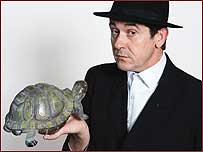 Adrian Lukis as Kafka pic: Gabriel Hyman Centenary season goes Kafka-esque!Katy Lewis Adrian Lukis tells us about the latest play in the Watford Palace's special centenary season. Kafka's DickWatford Palace 8-31 May 2008 Watford Palace's special centenary season continues this month (May) with Alan Bennett's Kafka's Dick - a comedy in which the famous Czech playwright arrives in present day England, decades after his death in 1919, and discovers, much to his surprise, that he is now famous! Playing the main man Kafka is Adrian Lukis, who is probably best-known to TV viewers for his portrayal of Mr Wickham in the BBC's now legendary 1995 version of Pride and Prejudice and for his two years as Dr Shearer in ITV's Peak Practice. We caught up with Adrian at the Palace during rehearsals to find out more! The play starts in 1919 and then moves forward to the present day doesn't it?Adrian: The play kicks of with me (Kafka) on the point of death in 1919 with my friend Brod and then jumps forward in a tardis Dr Who type way to the present day - well the mid 80s when it was written but we have sort of updated it to the present day. I can't explain why because Alan Bennett doesn't explain why - it just happens! 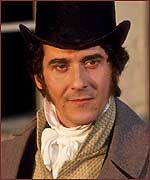 Adrian as Mr Wickham (1995) So, like in Bill and Ted, Kafka is transported to the present day. What happens then?Adrian: He arrives in the suburban home of married couple Sidney and Linda. Linda is an ex-nurse and doesn't consider herself to be very bright and is sort of picked on by her academic husband who is a great Kafka fan. He's one of those people who picks up facts about famous people without actually reading their work. I think it's to impress everybody else, so he's a little man trying to big himself up. Then, into his home comes his hero. Brod, Kafka's biographer, arrives first. Kafka asked Brod to burn all his works when he died and Brod of course didn't, he published Kafka's writings and made him into the world famous superstar that he is now. So these two arrive into this very suburban home and the comedy that ensues derives from that - but I can't really go into it because I'll give the plot away! But Kafka discovers that a lot has been given away about his private life and at times this was actually superceding what he'd written and he wasn't happy about that?Adrian: Yes, but I suppose the main thing in terms of the play is that Kafka always said he didn't want his works published. But they are, and he is supposedly very pleased about that because when he arrives in this home, what he actually wants - sort of - is to see his own name up there on the bookshelves with all the other great writers because he actually didn't want Brod to burn the books! That's the idea of Bennett's play - that he actually wanted to be remembered and he wanted to be a hero. But at the same time, which is why he's quite hard to play, he equally didn't want that and is terrified of it. It's very complex. So he comes back and is the same person but in the modern day and it looks at how it affects him.Adrian: Yes exactly - back into this suburban living room probably in Leeds comes Franz Kafka probably straight out of a Romanian alley way and finds himself surrounded by people eating tea and doileys and candlewick bedspreads - all the Alan Bennett stuff that we know and love. Of course he (Kafka) is utterly overwhelmed by it. They are talking about things in the 20th century that he has no conception of. Kafka is a famous word - some things are described as a bit Kafka-esque and he doesn't know why that should be the case. As far as he was concerned all his writings were burned but gradually he smells a rat that perhaps Brod did publish his works and that takes us up to part two of the play. He realises that far from being anonymous he's actually this hero to millions and millions of people and of course that is utterly overwhelming. So - he's kind of please and kind of not?Adrian: Yes and that's the difficulty of playing it. Has Alan Bennett been clever (I suspect he has!) and put 'Kafka-esque' elements into the play?Adrian: Yes he has - but you'll have to wait and see! [laughs] The play is very clever and very funny! You are well-known for many TV parts such as Mr Wickham in the BBC's now legendary 1995 version of Pride and Prejudice and for Dr Shearer in ITV's Peak Practice. Now you're back on stage - do you enjoy being on the stage more?Adrian: Almost every actor I know would say they prefer the stage. It's not just the fact that you're live - which is great! You work less hours if you think about it. When you do a play it might last two and a half hours whereas if you're filming you're working from 6.00am-7.00pm so there is that, but [in the theatre] you have the live experience, you come in and let go. You walk on from the wings and you go "bam". You don't know how it's going to turn out, whether you'll forget your lines, whether you'll be brilliant or terrible. And there's also something about playing it in the moment whereas television is endless, endless sitting around doing the crossword and eating too much! Television can be fine but on the whole I would say seriously that there's a lot of really rubbish TV made and all actors do it because we've got to work. In theatre, by and large, if a script's got through to the point where it's going to be produced, it's probably pretty good. Alan Bennett's a fantastic writer, you're not going to go wrong really and if you do there's something wrong with the actor, it's not the script! So if there was a play written about you, following the same sort of plot as Kafka's Dick, and you came back in 90 years time, what would you like people to be saying about you as far as your career is concerned?Adrian: Well - I guess we all want to be remembered well! I wouldn't mind them saying they'd seen me do one or two quite good theatre performances. I think that would be nice to be remembered for. Is it more satisfying when people remember you for theatre stuff then, rather than going on about Mr Wickham say?!Adrian: That particular version of Pride and Prejudice has become a sort of national treasure which is great. But it is more unusual for people to mention the theatre. For instance, I did a couple of plays at the Old Vic, one was called Cloaca and Kevin Spacey directed. The reviews weren't hugely kind but people told us they loved it and occasionally somebody will say to me that they saw me in it and that was a very interesting role for me, so that's lovely. So it's nice when people recognise you for something like that?Adrian: It's great! But I've never had fame to the point where you can't walk out the door. I can't imagine what that must be like. When Peak Practice was showing, that's about the closest I got I suppose. It was sometimes very flattering and sometimes very in your face and annoying, especially 10.00 on a Sunday morning, when you're unshaven and half asleep and trying do so your shopping in the supermarket! But hey - it's a small price to pay isn't it?! Why should people come and see Kafka's Dick?Adrian: Because it's incredibly funny and it's beautifully written. It has a lot of different moods to it actually, it's slapstick at times and I hope quite moving as well. It's been a really joyous experience. It's been a really joyous experience with a really wonderful cast and a fantastic director and I'm just really proud to be doing it so do come! last updated: 14/05/2008 at 13:31 You are in: Beds Herts and Bucks > Entertainment > Theatre and Art > Theatre and Dance Previews > Centenary season goes Kafka-esque!  Rhythms of the World! |
| | About the BBC | Help | Terms of Use | Privacy & Cookies Policy |